
[논문 리뷰] Black holes and modular forms in string theory
이 논문은 문자열 이론에서 블랙홀 엔트로피가 미시 상태의 생성 함수가 모듈식 형태인 방식으로 계산되고, 이것이 mock modular forms 및 Hardy-Ramanujan-Rademacher expansion과의 연결로 이어진다는 것을 설명한다.
The study of black holes in string theory has led to the discovery of deep and surprising connections between black holes and modular forms -- which are two classical, a priori unrelated, subjects. This article explains the main physical and mathematical ideas behind these connections. It is known from the pioneering work of J.Bekenstein and S.Hawking in the 1970s that black holes have thermodynamic entropy, and should therefore be made up of a collection of microscopic quantum states. Superstring theory provides a framework wherein we can associate a number of microscopic states that make up the quantum-statistical system underlying a black hole, thus explaining their thermodynamic behavior from a more fundamental point of view. %The above-mentioned connections arise from the observation that, i The basic connection to modular forms arises from the observation that, in the simplest superstring-theoretic construction, the generating function of the number of microscopic states is a modular form. In one direction, modular symmetry acts as a powerful guide to the calculation of quantum-gravitational effects on the black hole entropy. In the other direction, the connection has led to the discovery of surprising relations between Ramanujan's mock modular forms and a class of string-theoretic black holes, thus providing an infinite number of new examples of mock modular forms.
연구 동기 및 목표
- Motivate and explain the thermodynamic entropy of black holes and its microscopic counting within string theory.
- Show how modular symmetry governs the counting of microstates and quantum gravitational corrections.
- Demonstrate the emergence of mock modular forms from certain string-theoretic black holes.
제안 방법
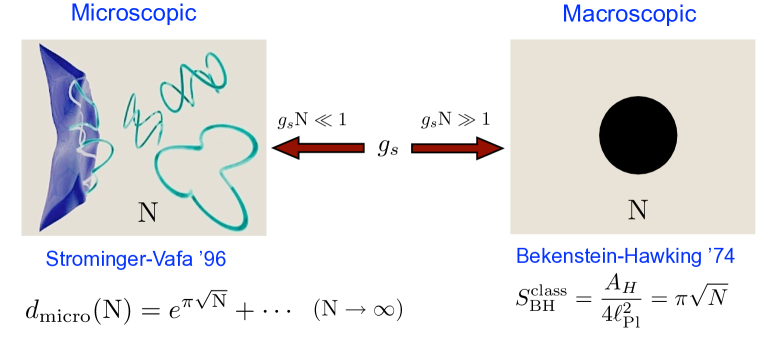
- Bekenstein-Hawking entropy와 이를 문자열 이론에서의 미시상태를 통한 양자통계 해석으로 설명한다.
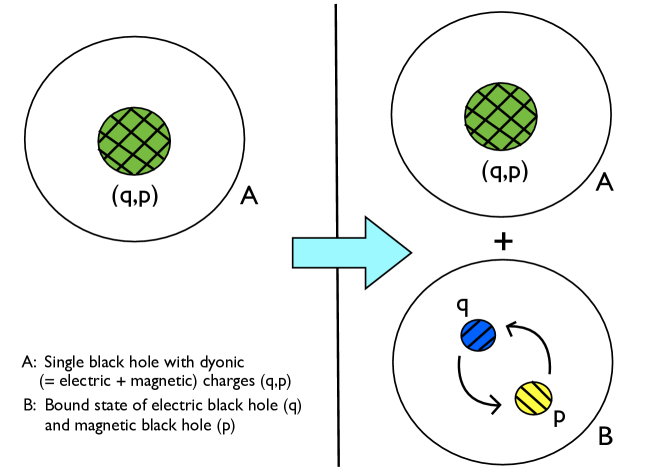
- 문자열 이론에서의 블랙홀에 대한 두 가지 그림을 설명한다: 거시적 (GR) 및 미시적 (brane/string bound states).
- supersymmetric indices (Witten index)와 이들이 BPS 상태를 계산하는 데 있어 역할을 도입한다.
- 미시적 다중성을 Dedekind eta 및 theta 함수와 같은 모듈식 형태와 연결한다.
- degeneracies를 추정하고 이를 엔트로피의 양자 보정과 연결하기 위해 Hardy-Ramanujan-Rademacher 형의 전개를 적용한다.
실험 결과
연구 질문
- RQ1모듈러 대칭이 블랙홀 엔트로피의 양자 중력 보정을 계산하는 데 어떤 도움이 되는가?
- RQ2다양한 문자열 이론 압축에 대해 블랙홀 미시상태 계산과 모듈식 형태 사이의 정확한 관계는 무엇인가?
- RQ3특정 문자열 이론 블랙홀에서 mock modular forms가 나타날 수 있으며 이것이 미시상태 계산에 대해 무엇을 시사하는가?
- RQ4supersymmetric indices가 BPS 블랙홀의 Bekenstein-Hawking 엔트로피를 재현하거나 설명하는 정도는 어느 정도인가?
주요 결과
- 미시적 블랙홀 상태의 생성 함수가 간단한 문자열 구성에서 모듈식 형태이며, 이는 Bekenstein-Hawking 공식과의 엔트로피 일치를 이끈다.
- Hardy-Ramanujan-Rademacher 전개는 미시적 상태 수를 블랙홀 엔트로피의 양자 중력 보정과 연결한다.
- 일부 Calabi–Yau 압축에서 미시적 다중성은 eta- 및 theta 함수 조합으로 이루어진 모듈형 대상에 의해 지배되며 그 거동은 BH 엔트로피를 재현한다.
- BPS 블랙홀은 영온도를 보이며 엔트로피를 가지며, 그 미시상태 계산은 적절한 분리 해에서 중력 엔트로피와 일치하는 초대칭 지표를 통해 맞춰진다.
- 이 연구는 특정 문자열 이론 블랙홀을 통해 Ramanujan의 mock modular forms와의 연결을 드러내며 물리학에서 모듈식 대상의 수학적 풍경을 확장한다.
더 나은 연구,지금 바로 시작하세요
연구 설계부터 논문 작성까지, 연구 시간을 획기적으로 줄여보세요.
카드 등록 없음 · 무료 플랜 제공
이 리뷰는 AI가 만들고, 인간 에디터가 검토했습니다.