
[Paper Review] Boosting Logical Reasoning in Large Language Models through a New Framework: The Graph of Thought
This paper introduces Graph of Thought (GoT), a novel prompting framework that enhances large language models' logical reasoning by modeling reasoning paths as a dynamic, interconnected graph rather than a linear or tree-structured chain. By enabling bidirectional reasoning from the goal, validating connections between thoughts, and iteratively refining the graph, GoT achieves 97% accuracy on the 24-point game—surpassing GPT-4 by 89.7% and SOTA ToT by 23%—demonstrating state-of-the-art performance in multi-step logical reasoning tasks.
Recent advancements in large-scale models, such as GPT-4, have showcased remarkable capabilities in addressing standard queries. However, when facing complex problems that require multi-step logical reasoning, their accuracy dramatically decreases. Current research has explored the realm of extit{prompting engineering} to bolster the inferential capacities of these models. Our paper unveils a pioneering prompting technique, dubbed extit{Graph of Thoughts (GoT)}. Through testing on a trio of escalating challenges: the 24-point game, resolution of high-degree polynomial equations, and derivation of formulas for recursive sequences, our method outperformed GPT-4, achieving accuracy improvements of $89.7\%$, $86\%$, and $56\%$ for each respective task. Moreover, when juxtaposed with the state-of-the-art (SOTA) prompting method, extit{Tree of Thought (ToT)}, our approach registered an average accuracy boost of $23\%$, $24\%$, and $15\%$.
Motivation & Objective
- To address the persistent limitation of large language models in performing multi-step logical reasoning, especially on complex, structured problems.
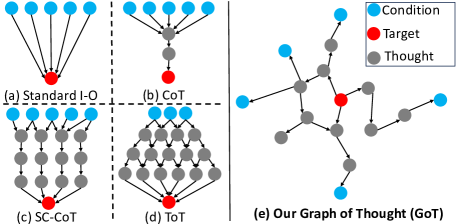
- To overcome the hierarchical and linear constraints of existing prompting methods like Chain-of-Thought (CoT) and Tree-of-Thought (ToT).
- To develop a reasoning framework that better emulates human cognitive processes by allowing bidirectional, interconnected reasoning paths.
- To improve reasoning accuracy in tasks requiring recursive reasoning, equation transformation, and algebraic insight.
Proposed method
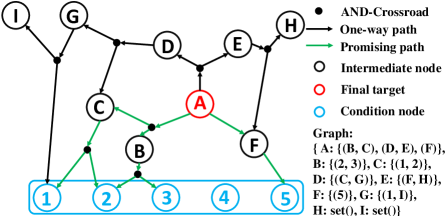
- GoT models reasoning as a dynamic, non-hierarchical graph where each node represents a thought or intermediate reasoning step.
- The framework initiates reasoning from the desired outcome rather than the initial conditions, enabling goal-directed exploration.
- Thoughts are connected via a checking mechanism that validates logical consistency and correctness of transitions between nodes.
- A graph updating mechanism enables iterative refinement by re-evaluating and re-adding promising reasoning paths based on new insights.
- The method integrates mathematical tools such as variable transformation and formula simplification to enhance derivational accuracy.
- It uses a depth-limited traversal strategy with multiple inspection rounds (n) to explore diverse reasoning paths and select the most consistent ones.
Experimental results
Research questions
- RQ1Can a non-hierarchical, graph-based reasoning structure outperform linear or tree-structured prompting in complex logical reasoning tasks?
- RQ2How does goal-directed reasoning from the solution backward improve accuracy compared to forward-only reasoning in LLMs?
- RQ3To what extent can a validation mechanism for thought connections reduce logical errors in multi-step reasoning?
- RQ4Does iterative graph refinement with multiple inspection rounds significantly improve reasoning outcomes?
- RQ5Can the integration of mathematical tools within a graph-based framework further enhance performance on algebraic and recursive reasoning problems?
Key findings
- GoT achieved 97% accuracy on the 24-point game, a 89.7 percentage point improvement over GPT-4’s 7.3% and a 23 percentage point gain over the SOTA ToT method.
- On solving high-degree polynomial equations, GoT improved accuracy by 86% compared to GPT-4 and 24% over ToT.
- For deriving formulas of recursive sequences, GoT reached 57% accuracy with mathematical tools enabled, a 15 percentage point improvement over ToT and 56% over GPT-4.
- The method’s performance improved with increased inspection rounds (n), reaching 55% accuracy at n=5 and 57% with mathematical tools.
- GoT outperformed all baselines across all three tasks, demonstrating consistent superiority in multi-step logical reasoning.
- The framework’s ability to validate connections between thoughts and iteratively refine the graph structure significantly reduced logical inconsistencies and improved solution quality.
Read this paper
Open the full text in the Nubint reader and ask about any passage as you read.
Read this paper on NubintThis review was generated by AI from the original paper. Please check the paper before citing it.