
[Paper Review] BUFFALO/Flashlights: Constraints on the abundance of lensed supergiant stars in the Spock galaxy at redshift 1
This paper constrains the abundance of lensed supergiant stars at redshift z ≈ 1 in the Spock galaxy using microlensing events in a strongly lensed arc. By modeling the MACS J0416.1-2403 cluster with 214 multiple images from 72 lensed galaxies, the authors show that four observed transients are consistent with microlensing of supergiant stars, implying either <400 stars kpc⁻² beyond the Humphreys-Davidson limit or ~9000 stars kpc⁻² between 10⁵ and 6×10⁵ L☉, with JWST expected to detect ~5 such stars per F200W observation.
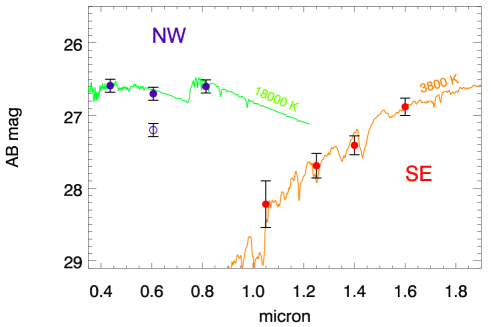
We present a constraint on the abundance of supergiant (SG) stars at redshift z approx. 1, based on recent observations of a strongly lensed arc at this redshift. First we derive a free-form model of MACS J0416.1-2403 using data from the BUFFALO program. The new lens model is based on 72 multiply lensed galaxies that produce 214 multiple images, making it the largest sample of spectroscopically confirmed lensed galaxies on this cluster. The larger coverage in BUFFALO allows us to measure the shear up to the outskirts of the cluster, and extend the range of lensing constraints up to ~ 1 Mpc from the central region, providing a mass estimate up to this radius. As an application, we make predictions for the number of high-redshift multiply-lensed galaxies detected in future observations with JWST. Then we focus on a previously known lensed galaxy at z=1.0054, nicknamed Spock, which contains four previously reported transients. We interpret these transients as microcaustic crossings of SG stars and compute the probability of such events. Based on simplifications regarding the stellar evolution, we find that microlensing (by stars in the intracluster medium) of SG stars at z=1.0054 can fully explain these events. The inferred abundance of SG stars is consistent with either (1) a number density of stars with bolometric luminosities beyond the Humphreys-Davidson (HD) limit (L ~ $6 imes10^5 L_{\odot}$) that is below 400 stars per sq. kpc, or (2) the absence of stars beyond the HD limit but with a SG number density of ~ 9000 per sq. kpc for stars with luminosities between $10^5$ and $6 imes10^5$. This is equivalent to one SG star per 10x10 pc$^2$. We finally make predictions for future observations with JWST's NIRcam. We find that in observations made with the F200W filter that reach 29 mag AB, if cool red SG stars exist at z~1 beyond the HD limit, they should be easily detected in this arc
Motivation & Objective
- To constrain the number density of supergiant stars at z ≈ 1 in the Spock galaxy using microlensing events.
- To test the existence and evolution of the Humphreys-Davidson luminosity limit for red supergiants at high redshift.
- To improve the lens model of MACS J0416.1-2403 using 72 multiply-lensed galaxies and 214 multiple images for better mass and shear constraints.
- To predict detectability of high-redshift supergiant stars with JWST’s NIRCam in the F200W filter.
- To determine whether the observed transients are consistent with microlensing of supergiant stars, including color-dependent interpretations.
Proposed method
- A free-form lens model of MACS J0416.1-2403 is constructed using 72 multiply-lensed galaxies with 214 multiple images, extending mass constraints to ~1 Mpc from the cluster center.
- Photometric modeling with BAGPIPES is used to fit the Kroupa initial mass function and constrain the intrinsic stellar population properties of the Spock galaxy.
- Microlensing light curves of four transients are interpreted as microcaustic crossings of supergiant stars, assuming a constant magnification and stellar temperature range from 3500 K to 30,000 K.
- The probability of observing such events is computed under two scenarios: stars beyond the HD limit (L_max ≈ 6×10⁵ L☉) or stars below it but above 10⁵ L☉.
- Distance to the critical curve is used as a consistency check for the HD limit, assuming at least one critical curve is well-modeled.
- JWST F200W depth predictions are made based on stellar luminosity, temperature, and surface density, estimating ~5 detectable supergiants per observation.
Experimental results
Research questions
- RQ1What is the maximum number density of supergiant stars beyond the Humphreys-Davidson luminosity limit at z ≈ 1 in the Spock galaxy?
- RQ2Can the observed microlensing transients in the Spock arc be fully explained by microlensing of supergiant stars?
- RQ3How does the metallicity of the Spock galaxy affect the expected luminosity function and the HD limit?
- RQ4What is the expected number of detectable supergiant stars in future JWST observations with the F200W filter?
- RQ5Is the observed separation of microlensed events from the critical curve consistent with the existence of the HD limit?
Key findings
- The observed microlensing transients in the Spock arc are fully consistent with microlensing of supergiant stars, with the NW S2 event likely due to a blue supergiant and the SE event to a red supergiant.
- If stars beyond the HD limit (L_max ≈ 6×10⁵ L☉) exist at z ≈ 1, their number density must be less than 400 stars kpc⁻² to avoid overproducing detectable events.
- An alternative scenario with no stars beyond the HD limit requires a surface number density of ~9000 supergiant stars kpc⁻² for luminosities between 10⁵ and 6×10⁵ L☉, equivalent to one star per 10×10 pc².
- The metallicity of the Spock galaxy is likely supersolar, which may tighten the HD limit due to enhanced mass loss via radiation-driven winds.
- The observed distances of microlensed events from the critical curve are consistent with the presence of an HD limit, assuming at least one critical curve is well-modeled.
- JWST observations with the F200W filter reaching 29 mag AB are predicted to detect approximately 5 supergiant stars per observation along the Spock arc, depending on stellar temperature and luminosity.

Read this paper
Open the full text in the Nubint reader and ask about any passage as you read.
Read this paper on NubintThis review was generated by AI from the original paper. Please check the paper before citing it.