
[Paper Review] Calibrating Undisciplined Over-Smoothing in Transformer for Weakly Supervised Semantic Segmentation
This paper proposes Adaptive Re-Activation Mechanism (AReAM), a novel method to mitigate undisciplined over-smoothing in Vision Transformers for weakly supervised semantic segmentation. By adaptively supervising deep-layer affinity matrices using shallow-layer attention via entropy-based weighting, AReAM reduces background noise and improves object localization, achieving state-of-the-art performance on standard benchmarks.
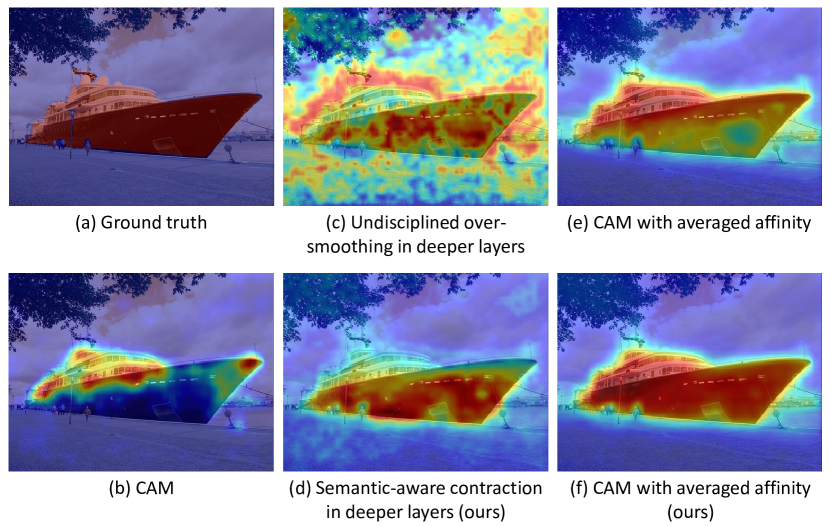
Weakly supervised semantic segmentation (WSSS) has recently attracted considerable attention because it requires fewer annotations than fully supervised approaches, making it especially promising for large-scale image segmentation tasks. Although many vision transformer-based methods leverage self-attention affinity matrices to refine Class Activation Maps (CAMs), they often treat each layer's affinity equally and thus introduce considerable background noise at deeper layers, where attention tends to converge excessively on certain tokens (i.e., over-smoothing). We observe that this deep-level attention naturally converges on a subset of tokens, yet unregulated query-key affinity can generate unpredictable activation patterns (undisciplined over-smoothing), adversely affecting CAM accuracy. To address these limitations, we propose an Adaptive Re-Activation Mechanism (AReAM), which exploits shallow-level affinity to guide deeper-layer convergence in an entropy-aware manner, thereby suppressing background noise and re-activating crucial semantic regions in the CAMs. Experiments on two commonly used datasets demonstrate that AReAM substantially improves segmentation performance compared with existing WSSS methods, reducing noise while sharpening focus on relevant semantic regions. Overall, this work underscores the importance of controlling deep-level attention to mitigate undisciplined over-smoothing, introduces an entropy-aware mechanism that harmonizes shallow and deep-level affinities, and provides a refined approach to enhance transformer-based WSSS accuracy by re-activating CAMs.
Motivation & Objective
- To investigate the root cause of performance degradation in deep transformer layers for weakly supervised semantic segmentation.
- To identify undisciplined over-smoothing in successive affinity matrices as a key factor causing global relationship collapse and background noise.
- To develop a mechanism that adaptively calibrates deep-layer attention using shallow-layer global relationships.
- To improve pseudo-label quality and segmentation accuracy by suppressing semantically irrelevant activations.
- To enable effective aggregation of multi-layer attention maps through calibrated, semantic-aware supervision.
Proposed method
- AReAM uses the mean normalized inverse entropy of successively enhanced CAMs to assign adaptive weights to different layers.
- Layers with higher entropy (more uniform, noisier attention) receive lower weights during forward pass, reducing their influence.
- During backpropagation, weights are inverted to emphasize high-entropy layers, enabling stronger supervision on deep layers.
- The method supervises deep affinity matrices using shallow affinity matrices, promoting attention to semantic regions over background.
- AReAM is integrated into existing transformer-based WSSS frameworks without architectural changes, enabling plug-and-play deployment.
- Final segmentation predictions are generated by aggregating calibrated affinity matrices across all layers.
Experimental results
Research questions
- RQ1Does undisciplined over-smoothing in deep-layer affinity matrices degrade attention quality in Vision Transformers for WSSS?
- RQ2To what extent does over-smoothing lead to background noise and incomplete object activation in deep layers?
- RQ3Can shallow-layer global relationships effectively supervise deep-layer attention to mitigate over-smoothing?
- RQ4How does entropy-based adaptive weighting improve the calibration of affinity matrices across layers?
- RQ5Can AReAM enhance both object localization and background suppression without architectural modifications?
Key findings
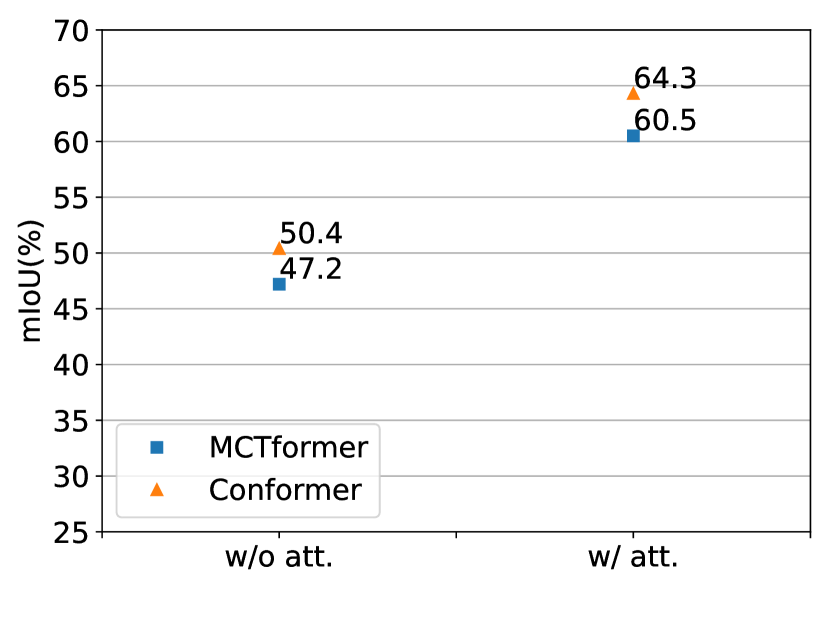
- AReAM achieves a 66.4% mIoU on the PASCAL VOC 2012 dataset, a 2.4% absolute improvement over the baseline without AReAM.
- On the COCO-2017 dataset, AReAM improves mIoU from 70.0% to 70.4%, demonstrating consistent gains across benchmarks.
- Layerwise analysis shows a 25% mIoU increase at layer 8 in MCTFormer when AReAM is applied, confirming its effectiveness in deep layers.
- The method reduces background noise significantly, as visualized in attention maps, especially in deeper layers where noise is most prominent.
- Aggregating all calibrated affinity matrices yields better performance than using the best single layer, proving complementary benefits of AReAM.
- The adaptive entropy-based weighting mechanism enables effective supervision without requiring additional parameters or training complexity.
Read this paper
Open the full text in the Nubint reader and ask about any passage as you read.
Read this paper on NubintThis review was generated by AI from the original paper. Please check the paper before citing it.