
[Paper Review] CaloShowerGAN, a Generative Adversarial Networks model for fast calorimeter shower simulation
CaloShowerGAN is a Generative Adversarial Network (GAN)-based model for fast, high-fidelity simulation of calorimeter showers in particle physics. It achieves state-of-the-art performance by optimizing GAN architecture, hyperparameters, and data preprocessing—particularly layer-energy normalization—outperforming existing ATLAS GAN-based methods like FastCaloGAN while being directly integrable into the ATLAS software framework.
In particle physics, the demand for rapid and precise simulations is rising. The shift from traditional methods to machine learning-based approaches has led to significant advancements in simulating complex detector responses. CaloShowerGAN is a new approach for fast calorimeter simulation based on Generative Adversarial Network (GAN). We use Dataset 1 of the Fast Calorimeter Simulation Challenge 2022 to demonstrate the efficacy of the model to simulate calorimeter showers produced by photons and pions. The dataset is originated from the ATLAS experiment, and we anticipate that this approach can be seamlessly integrated into the ATLAS system. This development brings a significant improvement compared to the deployed GANs by ATLAS and could offer great enhancement to the current ATLAS fast simulations.
Motivation & Objective
- Address the growing computational demand for fast, high-precision Monte Carlo simulations in high-luminosity LHC experiments.
- Overcome the bottleneck of Geant4-based calorimeter shower simulation, which consumes ~80% of total simulation time in ATLAS.
- Develop a GAN-based model that matches or exceeds the performance of state-of-the-art generative models while maintaining compatibility with the ATLAS software stack.
- Optimize GAN training through domain-aware data preprocessing and architectural tuning to improve fidelity and stability.
- Demonstrate superior performance on the Fast Calorimeter Simulation Challenge 2022 dataset, particularly in energy resolution and shower shape reconstruction.
Proposed method
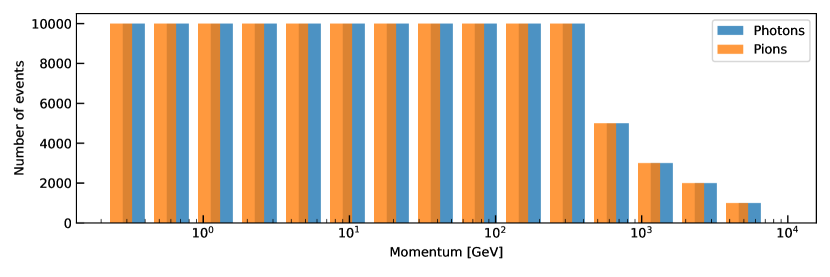
- Train a conditional GAN on ATLAS-generated Geant4 simulation data from Dataset 1, covering photons and pions with momenta from 256 MeV to 4 TeV.
- Apply layer-energy normalization to scale energy deposits per longitudinal layer, improving GAN training stability and performance.
- Implement momentum split training for photons, enabling better interpolation across momentum values.
- Use a U-Net-like generator and PatchGAN-based discriminator with spectral normalization and leaky ReLU activations.
- Optimize hyperparameters via grid search and early stopping, using a custom metric replacing traditional χ²/NDF for GAN training.
- Preprocess data by removing low-energy voxels below 1 keV and applying energy normalization per layer to enhance model generalization.
Experimental results
Research questions
- RQ1Can a GAN-based model achieve higher fidelity in calorimeter shower simulation compared to existing ATLAS fast simulation methods?
- RQ2How does layer-energy normalization impact GAN training stability and reconstruction accuracy in shower simulation?
- RQ3To what extent can momentum interpolation be improved through training strategy and data partitioning?
- RQ4Does noise injection or voxel masking improve GAN performance on calorimeter shower data?
- RQ5Can a GAN-based model outperform or match the performance of more complex generative models like normalizing flows or diffusion models on this task?
Key findings
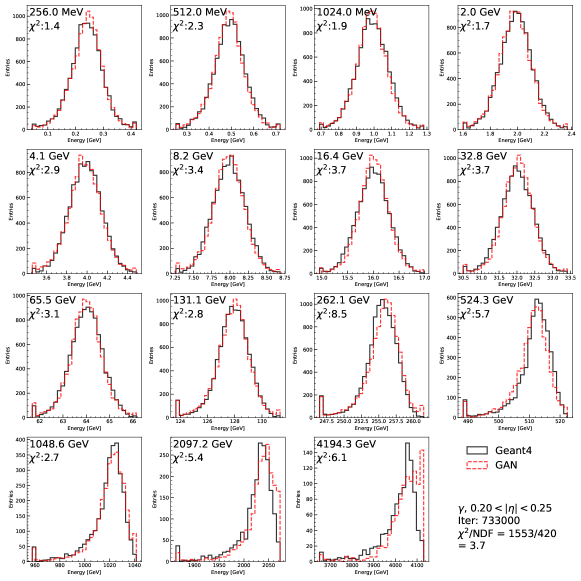
- CaloShowerGAN achieves superior energy resolution and shape reconstruction compared to FastCaloGAN, with reduced energy bias and improved stability.
- Layer-energy normalization significantly enhances training convergence and reduces mode collapse, leading to more realistic shower profiles.
- Momentum split training for photons enables better interpolation across momentum values, improving generalization to unseen momenta.
- Noise injection and voxel masking strategies did not improve performance and often degraded results, suggesting GANs are robust to low-energy noise.
- The model achieves generation times under 10 ms per event on GPU, enabling real-time simulation for large-scale analyses.
- Memory requirements remain low, with inference requiring less than 1 GB of GPU memory, ensuring compatibility with existing ATLAS workflows.
Read this paper
Open the full text in the Nubint reader and ask about any passage as you read.
Read this paper on NubintThis review was generated by AI from the original paper. Please check the paper before citing it.