
[Paper Review] Can neutrino-assisted early dark energy models ameliorate the $H_0$ tension in a natural way?
This paper investigates neutrino-assisted early dark energy (νEDE) models to address the Hubble tension, proposing that a coupling between a scalar field and neutrinos could naturally trigger EDE at matter-radiation equality. Despite generating a feature in the EDE energy density via the neutrino transition, the model fails to produce sufficient EDE fraction ($f_{\text{EDE}} \approx 10\%$) to alleviate the Hubble tension under the considered parameters, indicating limited naturalness in this specific realization.
The idea of neutrino-assisted early dark energy ($ν$EDE), where a coupling between neutrinos and the scalar field that models early dark energy (EDE) is considered, was introduced with the aim of reducing some of the fine-tuning and coincidence problems that appear in usual EDE models. In order to be relevant in ameliorating the $H_0$ tension, the contribution of EDE to the total energy density ($f_ ext{EDE}$) should be around 10\% near the redshift of matter-radiation equality. We verify under which conditions $ν$EDE models can fulfill these requirements for a model with a quartic self-coupling of the EDE field and an exponential coupling to neutrinos. We find that in the situation where the EDE field is frozen initially, the contribution to $f_ ext{EDE}$ can be significant but it is not sensitive to the neutrino-EDE coupling and does not address the EDE coincidence problem. On the other hand, if the EDE field starts already dynamical at the minimum of the effective potential, it tracks this time-dependent minimum that presents a feature triggered by the neutrino transition from relativistic to nonrelativistic particles. This feature generates $f_ ext{EDE}$ in a natural way at around this transition epoch, that roughly coincides with the matter-radiation equality redshift. For the set of parameters that we considered we did not find values that satisfy the requirements on the background cosmological evolution to mitigate the Hubble tension in a natural way in this particular $ν$EDE model.
Motivation & Objective
- To assess whether neutrino-assisted early dark energy (νEDE) models can naturally alleviate the Hubble tension without fine-tuning initial conditions.
- To investigate if the neutrino transition from relativistic to nonrelativistic states can naturally trigger EDE at the matter-radiation equality redshift ($z \sim 3.5$).
- To determine whether the coupling between the EDE scalar field and neutrinos leads to a significant and timely contribution to the energy density ($f_{\text{EDE}} \approx 10\%$) required to mitigate the Hubble tension.
- To compare two initial condition scenarios: the EDE field frozen initially versus starting at the minimum of the effective potential.
- To evaluate the model's viability at the background level using CAMB, focusing on $f_{\text{EDE}}$ evolution and the role of the neutrino-EDE coupling.
Proposed method
- Implemented a νEDE model in CAMB at the background level, using a quartic self-coupling potential ($V \propto \phi^4$) and an exponential coupling to neutrinos ($A(\phi) = \exp(\beta\phi/M_{\text{Pl}})$).
- Solved the scalar field evolution equation in the Einstein frame, tracking the time-dependent minimum of the effective potential to model field dynamics.
- Analyzed two initial condition regimes: (1) field frozen at an arbitrary initial value due to Hubble friction, and (2) field starting at the minimum of the effective potential.
- Computed the EDE energy density fraction $f_{\text{EDE}}$ and the deviation parameter $\Delta$ to quantify the impact of the neutrino-EDE coupling.
- Used analytical approximations (Eq. 20) to predict $f_{\text{EDE}}$ and compared them with numerical results.
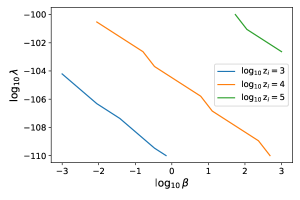
- Conducted parameter scans to assess sensitivity of $f_{\text{EDE}}$ to coupling strength $\beta$ and self-coupling $\lambda$, while keeping other cosmological parameters fixed.
Experimental results
Research questions
- RQ1Can the neutrino transition from relativistic to nonrelativistic states naturally trigger the EDE field at the matter-radiation equality epoch?
- RQ2Does the νEDE model produce a sufficiently large $f_{\text{EDE}} \approx 10\%$ at $z \sim 3.5$ to alleviate the Hubble tension?
- RQ3Is the EDE coincidence problem resolved in the νEDE model, particularly when the field starts at the minimum of the effective potential?
- RQ4How does the neutrino-EDE coupling ($\beta$) affect the evolution of $f_{\text{EDE}}$ in the field-minimum initial condition scenario?
- RQ5Can the model achieve a significant $f_{\text{EDE}}$ without fine-tuning the initial field value or scalar field parameters?
Key findings
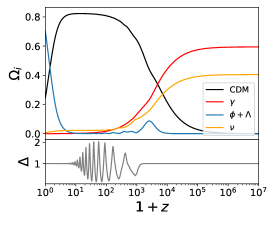
- When the EDE field is initially frozen at an arbitrary value, $f_{\text{EDE}}$ can reach cosmologically relevant levels, but this behavior is insensitive to the neutrino-EDE coupling and does not resolve the EDE coincidence problem.
- When the field starts at the minimum of the effective potential, it naturally follows the time-dependent minimum, and the neutrino transition induces a bump in $f_{\text{EDE}}$ at $z \sim 3.5$, as predicted analytically.
- The neutrino-EDE coupling plays a non-negligible role in the field-minimum scenario, with $f_{\text{EDE}}$ varying significantly with $\beta$, as shown in Fig. 7.
- Despite the coupling's influence, the maximum $f_{\text{EDE}}$ achieved in the field-minimum scenario remains too low to satisfy the $f_{\text{EDE}} \approx 10\%$ requirement for alleviating the Hubble tension.
- Increasing the self-coupling $\lambda$ to enhance $f_{\text{EDE}}$ leads to a field that remains frozen longer, effectively shifting the model into the first (non-natural) initial condition regime.
- Even with large couplings ($\beta = 1000$), the model fails to produce a significant $f_{\text{EDE}}$, indicating a fundamental limitation in this specific νEDE realization.
Read this paper
Open the full text in the Nubint reader and ask about any passage as you read.
Read this paper on NubintThis review was generated by AI from the original paper. Please check the paper before citing it.