
[Paper Review] Can You Rely on Your Model Evaluation? Improving Model Evaluation with Synthetic Test Data
This paper proposes 3S-Testing, a deep generative modeling framework that creates synthetic test data to improve evaluation of machine learning models on underrepresented subgroups and under distributional shifts. By leveraging conditional generative models and uncertainty quantification via deep generative ensembles, 3S-Testing provides more accurate performance estimates with better coverage of true performance than real test data alone, especially in low-sample regimes.
Evaluating the performance of machine learning models on diverse and underrepresented subgroups is essential for ensuring fairness and reliability in real-world applications. However, accurately assessing model performance becomes challenging due to two main issues: (1) a scarcity of test data, especially for small subgroups, and (2) possible distributional shifts in the model's deployment setting, which may not align with the available test data. In this work, we introduce 3S Testing, a deep generative modeling framework to facilitate model evaluation by generating synthetic test sets for small subgroups and simulating distributional shifts. Our experiments demonstrate that 3S Testing outperforms traditional baselines -- including real test data alone -- in estimating model performance on minority subgroups and under plausible distributional shifts. In addition, 3S offers intervals around its performance estimates, exhibiting superior coverage of the ground truth compared to existing approaches. Overall, these results raise the question of whether we need a paradigm shift away from limited real test data towards synthetic test data.
Motivation & Objective
- To address the challenge of unreliable model evaluation on underrepresented subgroups due to limited real test data.
- To enable robust assessment of model performance under plausible distributional shifts that may not be captured by existing real test data.
- To develop a framework that provides granular, reliable, and uncertainty-quantified performance estimates for high-stakes tabular ML applications.
- To reduce overreliance on average performance metrics that obscure performance disparities across subpopulations.
- To demonstrate that synthetic test data can outperform real test data in estimating true model performance on rare or shifted subgroups.
Proposed method
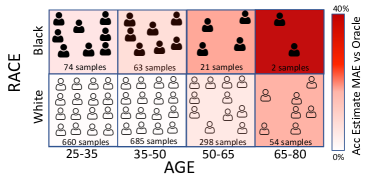
- 3S-Testing employs conditional deep generative models to synthesize test data for specific subgroups defined by sensitive or operational features (e.g., race, age, employment type).
- The framework uses a deep generative ensemble (DGE) to model uncertainty in the generative process, producing prediction intervals around performance estimates.
- Conditional generation is guided by user-specified subgroup conditions or distributional shift targets (e.g., increased mean age or proportion of non-US individuals).
- The method supports both minimal input (e.g., subgroup definitions) and prior knowledge (e.g., target shift distributions) for flexible deployment.
- Performance is evaluated using metrics like mean absolute error (MAE) and coverage of true performance within prediction intervals.
- The approach is validated on tabular datasets such as Adult, with comparisons to real test data and baseline methods like bagging and logistic regression.
Experimental results
Research questions
- RQ1Can synthetic test data improve the accuracy of model performance estimation on underrepresented subgroups with limited real test samples?
- RQ2How well can synthetic data capture model performance under distributional shifts not present in the original test set?
- RQ3Do prediction intervals generated by 3S-Testing provide reliable coverage of the true performance, especially in low-data regimes?
- RQ4How does 3S-Testing compare to real test data and baseline methods in estimating subgroup performance and shift sensitivity?
- RQ5To what extent can synthetic data reduce the risk of overestimating model reliability in safety-critical applications?
Key findings
- 3S-Testing significantly outperforms real test data alone in estimating true model performance on small subgroups, with lower mean absolute error (e.g., MAE of 1.11 ± 0.71 for 3S vs. 8.61 for real data on the 1% subgroup in the Adult dataset).
- Prediction intervals from 3S-Testing achieve superior coverage of the true performance, with 95% coverage rates across subgroups, outperforming baselines that often under-cover or over-cover.
- For distributional shifts such as increased mean age or higher proportions of non-US individuals, 3S-Testing generates more accurate performance estimates than real data or baseline methods.
- The framework successfully identifies underperformance in specific intersectional subgroups—e.g., self-employed individuals working over 80 hours/week—where real data fails due to sparsity.
- Model sensitivity curves generated via 3S-Testing reveal performance trends across operating ranges, such as declining performance with increasing education years or increasing proportion of Black individuals.
- 3S-Testing demonstrates robustness across diverse settings, including minimal input (subgroup definition only) and knowledge-enhanced settings (target shift distributions), showing broad applicability.
Read this paper
Open the full text in the Nubint reader and ask about any passage as you read.
Read this paper on NubintThis review was generated by AI from the original paper. Please check the paper before citing it.