
[Paper Review] Capsule Routing for Sound Event Detection
This paper proposes a capsule network with dynamic routing for weakly-supervised sound event detection, leveraging part-whole relationships to improve generalization and reduce overfitting. Evaluated on DCASE 2017 Task 4, it achieves a state-of-the-art F-score of 58.6% on audio tagging and 46.3% on event detection, with significantly reduced overfitting compared to CNN and RNN baselines.
The detection of acoustic scenes is a challenging problem in which environmental sound events must be detected from a given audio signal. This includes classifying the events as well as estimating their onset and offset times. We approach this problem with a neural network architecture that uses the recently-proposed capsule routing mechanism. A capsule is a group of activation units representing a set of properties for an entity of interest, and the purpose of routing is to identify part-whole relationships between capsules. That is, a capsule in one layer is assumed to belong to a capsule in the layer above in terms of the entity being represented. Using capsule routing, we wish to train a network that can learn global coherence implicitly, thereby improving generalization performance. Our proposed method is evaluated on Task 4 of the DCASE 2017 challenge. Results show that classification performance is state-of-the-art, achieving an F-score of 58.6%. In addition, overfitting is reduced considerably compared to other architectures.
Motivation & Objective
- To address overfitting in weakly-labeled sound event detection due to small datasets by introducing a capsule-based architecture.
- To improve generalization by learning global structural coherence through part-whole relationships in audio representations.
- To evaluate whether capsule routing can serve as an effective attention mechanism for localizing sound events without strong temporal supervision.
- To compare capsule networks against standard CNN and RNN architectures in both audio tagging and sound event detection tasks.
Proposed method
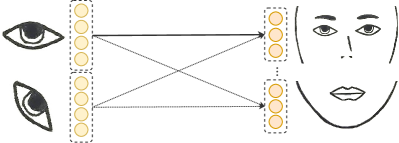
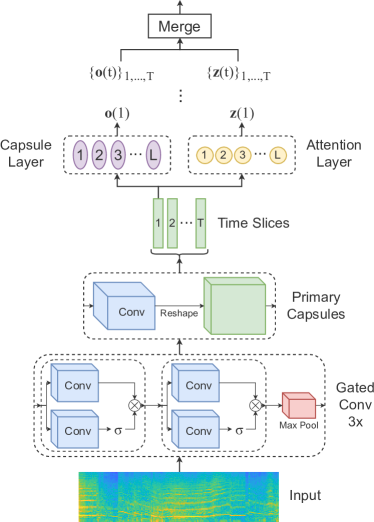
- Uses capsules—groups of neurons representing properties of a sound event (e.g., onset, offset, class)—to encode hierarchical features.
- Applies dynamic routing to compute coupling coefficients between capsules in adjacent layers, enabling attention-like weighting of part-to-whole relationships.
- Employs a routing-by-agreement mechanism where capsules in lower layers are routed to higher-level capsules based on predictive consistency.
- Uses a margin-based loss function to optimize for both classification and localization, with separate thresholds for onset and offset detection.
- Trains the model using mini-batch stochastic gradient descent with class-balanced sampling to mitigate data imbalance.
- Applies dilation and erosion operations (kernel size 10 and 5) to refine predicted event boundaries during inference.
Experimental results
Research questions
- RQ1Can capsule routing improve generalization in weakly-supervised sound event detection on small datasets?
- RQ2Does the dynamic routing mechanism effectively learn part-whole relationships in audio features, leading to better localization?
- RQ3How does capsule-based routing compare to recurrent and convolutional networks in terms of overfitting and performance on SED tasks?
- RQ4To what extent does capsule routing act as an implicit attention mechanism for sound event detection?
- RQ5Can capsule networks achieve state-of-the-art performance on both audio tagging and sound event detection subtasks of DCASE 2017?
Key findings
- The proposed GCCaps model achieved a state-of-the-art F-score of 58.6% on the audio tagging subtask of DCASE 2017, outperforming all baselines.
- On the sound event detection subtask, GCCaps achieved an F-score of 46.3% and an error rate of 0.76, outperforming GCNN (37.5% F-score) and GCRNN (43.3% F-score) in the ablation study.
- The model showed significantly reduced overfitting, as evidenced by lower training loss and higher validation accuracy that did not degrade over epochs compared to other architectures.
- Dynamic routing enabled better generalization, with the model maintaining stable performance across training epochs without severe divergence.
- The capsule-based architecture reduced overfitting more effectively than recurrent or standard CNN architectures, even without strong temporal supervision.
- The results suggest that capsule routing can serve as a viable alternative to recurrent layers for modeling temporal dependencies in weakly-labeled SED tasks.
Read this paper
Open the full text in the Nubint reader and ask about any passage as you read.
Read this paper on NubintThis review was generated by AI from the original paper. Please check the paper before citing it.