
[Paper Review] CCLF: A Contrastive-Curiosity-Driven Learning Framework for Sample-Efficient Reinforcement Learning
This paper proposes CCLF, a model-agnostic, contrastive-curiosity-driven framework that enhances sample efficiency in reinforcement learning by prioritizing under-explored experiences, selecting informative data augmentations, and regularizing the Q-network and encoder using surprise-based curiosity. It achieves state-of-the-art performance on DeepMind Control, Atari, and MiniGrid benchmarks with significantly reduced data usage and improved stability.
In reinforcement learning (RL), it is challenging to learn directly from high-dimensional observations, where data augmentation has recently been shown to remedy this via encoding invariances from raw pixels. Nevertheless, we empirically find that not all samples are equally important and hence simply injecting more augmented inputs may instead cause instability in Q-learning. In this paper, we approach this problem systematically by developing a model-agnostic Contrastive-Curiosity-Driven Learning Framework (CCLF), which can fully exploit sample importance and improve learning efficiency in a self-supervised manner. Facilitated by the proposed contrastive curiosity, CCLF is capable of prioritizing the experience replay, selecting the most informative augmented inputs, and more importantly regularizing the Q-function as well as the encoder to concentrate more on under-learned data. Moreover, it encourages the agent to explore with a curiosity-based reward. As a result, the agent can focus on more informative samples and learn representation invariances more efficiently, with significantly reduced augmented inputs. We apply CCLF to several base RL algorithms and evaluate on the DeepMind Control Suite, Atari, and MiniGrid benchmarks, where our approach demonstrates superior sample efficiency and learning performances compared with other state-of-the-art methods.
Motivation & Objective
- To address the inefficiency of uniform data augmentation in high-dimensional RL by identifying that not all samples are equally important for learning.
- To improve sample efficiency and learning stability by introducing a self-supervised, curiosity-driven mechanism that prioritizes under-explored and informative experiences.
- To develop a model-agnostic framework that integrates contrastive curiosity across four key RL components: experience replay, input selection, regularization, and intrinsic exploration.
- To reduce reliance on excessive augmented inputs while preserving representation invariances and enhancing generalization from raw pixels.
- To achieve state-of-the-art performance on standard RL benchmarks with lower variance and higher data efficiency.
Proposed method
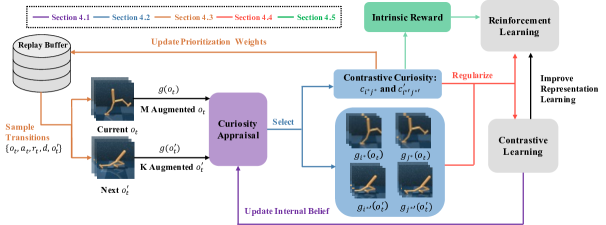
- CCLF introduces a contrastive curiosity signal based on prediction error from a contrastive representation learning module, reusing the CURL loss to quantify surprise without adding network parameters.
- The contrastive curiosity is used to prioritize transitions in the replay buffer, favoring those that are more surprising or under-learned.
- It guides the selection of the most informative augmented inputs by focusing on those that maximize prediction uncertainty.
- The curiosity signal regularizes both the Q-function and the encoder to concentrate learning on surprising, under-explored observations.
- An intrinsic curiosity-based reward is added to encourage the agent to explore novel and under-learned states.
- The framework is applied in a modular, model-agnostic way to both on-policy and off-policy RL algorithms.
Experimental results
Research questions
- RQ1Can a self-supervised curiosity mechanism based on contrastive representation learning improve sample efficiency in deep reinforcement learning?
- RQ2Does prioritizing under-explored and informative data augmentations lead to more stable and efficient learning compared to uniform data augmentation?
- RQ3Can contrastive curiosity be effectively integrated across multiple components of the RL pipeline—experience replay, input selection, regularization, and exploration—without increasing model complexity?
- RQ4How does the collaborative use of contrastive curiosity across all four components affect learning stability and final performance?
- RQ5To what extent can CCLF reduce the number of augmented inputs while maintaining or improving representation invariance and sample efficiency?
Key findings
- CCLF achieves a 1.22× higher mean score at 100K environment steps compared to the best-performing baseline (Reward+Selection), demonstrating superior sample efficiency.
- At 500K steps, CCLF achieves the highest asymptotic performance (869 ± 9) with the lowest standard deviation (±9), indicating stable and robust learning.
- Removing the selection or regularization components leads to a 29–33% drop in performance at 100K steps and higher variance, showing their critical role in stability and efficiency.
- The No Reward variant still outperforms several baselines, indicating that the core benefits of CCLF stem from prioritization, selection, and regularization, not just intrinsic rewards.
- CCLF reduces the need for excessive data augmentation by focusing only on the most informative and surprising samples, improving data efficiency without sacrificing invariance learning.
- The framework is effective across diverse benchmarks, including DeepMind Control, Atari, and MiniGrid, showing broad applicability and state-of-the-art performance.

Read this paper
Open the full text in the Nubint reader and ask about any passage as you read.
Read this paper on NubintThis review was generated by AI from the original paper. Please check the paper before citing it.