
[Paper Review] Chain-of-Symbol Prompting Elicits Planning in Large Langauge Models
The paper introduces Chain-of-Symbol (CoS) prompting, which uses condensed symbolic representations of spatial relations to elicit planning in LLMs, outperforming Chain-of-Thought (CoT) on three spatial tasks and a spatial QA benchmark while reducing input tokens.
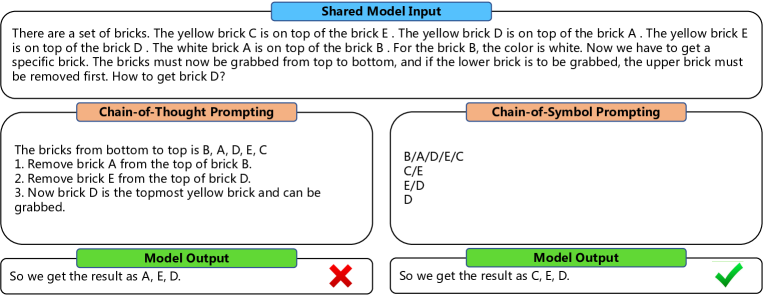
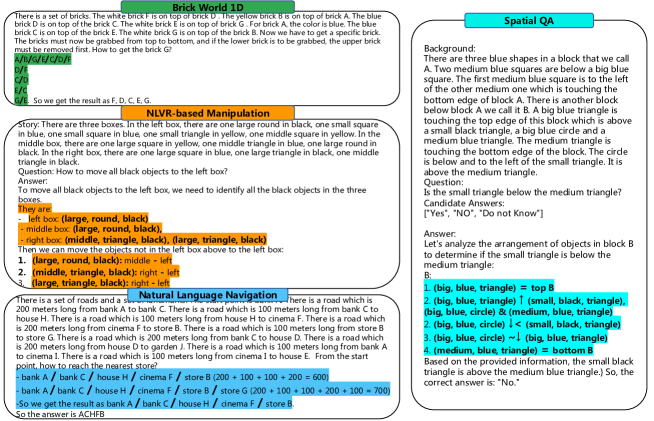
In this paper, we take the initiative to investigate the performance of LLMs on complex planning tasks that require LLMs to understand a virtual spatial environment simulated via natural language and act correspondingly in text. We propose a benchmark named Natural Language Planning and Action (Natala) composed of a set of novel tasks: Brick World, NLVR-based Manipulations, and Natural Language Navigation. We found that current popular LLMs such as ChatGPT still lack abilities in complex planning. This arises a question -- do the LLMs have a good understanding of the environments described in natural language, or maybe other alternatives such as symbolic representations are neater and hence better to be understood by LLMs? To this end, we propose a novel method called CoS (Chain-of-Symbol Prompting) that represents the complex environments with condensed symbolic spatial representations during the chained intermediate thinking steps. CoS is easy to use and does not need additional training on LLMs. Extensive experiments indicate that CoS clearly surpasses the performance of the Chain-of-Thought (CoT) Prompting in all three planning tasks with even fewer tokens used in the inputs compared with CoT on ChatGPT and InstructGPT. The performance gain is strong, by up to 60.8% accuracy (from 31.8% to 92.6%) on Brick World for ChatGPT. CoS also reduces the number of tokens in the prompt obviously, by up to 65.8% of the tokens (from 407 to 139) for the intermediate steps from demonstrations on Brick World. Code and data available at: https://github.com/hanxuhu/chain-of-symbol-planning
Motivation & Objective
- Evaluate LLMs on complex spatial understanding and planning tasks described in natural language.
- Assess whether symbolic representations can outperform natural-language intermediate steps (CoT) for spatial tasks.
- Propose and validate CoS prompting as a training-free method that reduces prompt length.
- Analyze robustness of CoS across models, languages, and symbol choices.
Proposed method
- Propose Chain-of-Symbol (CoS) prompting that replaces natural-language intermediate steps with condensed symbols representing spatial relationships.
- Automatically generate CoT demonstrations, correct errors, and convert to CoS by replacing spatial relations with symbols while removing non-essential text.
- Use few-shot prompting with CoS demonstrations to guide LLMs in three spatial planning tasks.
- Evaluate compatibility and performance across ChatGPT (gpt-3.5-turbo) and Text-Davinci-003, with zero-shot CoT, few-shot CoT, and few-shot CoS baselines.
- Measure accuracy, precision, recall (and LCS-based similarity for some tasks) for planning tasks, and accuracy for spatial QA.
Experimental results
Research questions
- RQ1Can symbolic representations of spatial relations improve LLM planning in text-described environments compared to natural-language CoT?
- RQ2Do CoS prompts generalize across different tasks, languages, and model types?
- RQ3How does CoS affect token efficiency and inference cost compared to CoT?
- RQ4Are CoS benefits robust to symbol choice and task complexity?
Key findings
- CoS uniformly improves performance over CoT across Brick World, NLVR-based Manipulation, and Natural Language Navigation.
- On Brick World 1D Shuffle Label with 1D scenario, CoS achieves 92.6% accuracy, a 60.8-point gain over the baseline CoT (from 31.8% to 92.6%).
- CoS reduces intermediate-step tokens dramatically (e.g., from 407 to 139 tokens for Brick World 1D).
- CoS maintains robustness across languages (Chinese shows improved performance over CoT) and across different symbols, with comma as an effective choice.
- On SPARTUN, CoS yields higher accuracy and fewer intermediate tokens than CoT for GPT-3.5-Turbo and GPT-4.
- CoS demonstrates lower output variability (smaller standard deviations) in several trials compared with CoT.
Read this paper
Open the full text in the Nubint reader and ask about any passage as you read.
Read this paper on NubintThis review was generated by AI from the original paper. Please check the paper before citing it.