
[Paper Review] ChatGPT-HealthPrompt. Harnessing the Power of XAI in Prompt-Based Healthcare Decision Support using ChatGPT
This paper proposes ChatGPT-HealthPrompt, a novel framework that enhances clinical decision support by integrating domain knowledge from interpretable machine learning models (e.g., XGBoost) into prompt engineering for OpenAI’s ChatGPT. By incorporating feature importance insights as contextual prompts, the method achieves few-shot performance on par with traditional supervised models—even in low-data scenarios—demonstrating that AI-augmented prompt design significantly boosts accuracy and interpretability in healthcare applications.
This study presents an innovative approach to the application of large language models (LLMs) in clinical decision-making, focusing on OpenAI's ChatGPT. Our approach introduces the use of contextual prompts-strategically designed to include task description, feature description, and crucially, integration of domain knowledge-for high-quality binary classification tasks even in data-scarce scenarios. The novelty of our work lies in the utilization of domain knowledge, obtained from high-performing interpretable ML models, and its seamless incorporation into prompt design. By viewing these ML models as medical experts, we extract key insights on feature importance to aid in decision-making processes. This interplay of domain knowledge and AI holds significant promise in creating a more insightful diagnostic tool. Additionally, our research explores the dynamics of zero-shot and few-shot prompt learning based on LLMs. By comparing the performance of OpenAI's ChatGPT with traditional supervised ML models in different data conditions, we aim to provide insights into the effectiveness of prompt engineering strategies under varied data availability. In essence, this paper bridges the gap between AI and healthcare, proposing a novel methodology for LLMs application in clinical decision support systems. It highlights the transformative potential of effective prompt design, domain knowledge integration, and flexible learning approaches in enhancing automated decision-making.
Motivation & Objective
- To investigate the feasibility of using large language models like ChatGPT for binary classification in clinical decision support without fine-tuning.
- To explore how integrating domain-specific knowledge from interpretable ML models (e.g., XGBoost, Random Forest) improves prompt-based inference in healthcare.
- To compare zero-shot and few-shot prompting strategies in terms of performance, reliability, and error profiles (FP/FN) on medical classification tasks.
- To evaluate whether prompt engineering with expert-derived insights can close the performance gap between LLMs and traditional supervised models, especially in data-scarce environments.
- To assess the trade-offs between false positives and false negatives in LLM-based diagnostic systems, with implications for clinical safety.
Proposed method
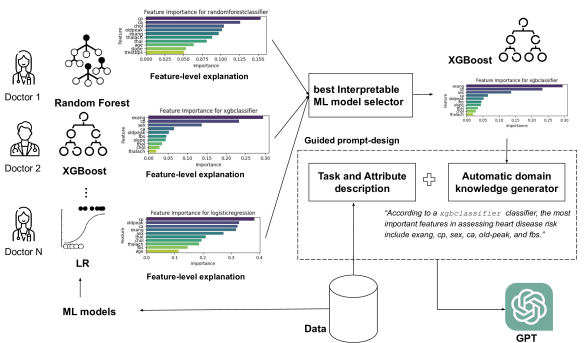
- The method constructs contextual prompts that include task description, input feature descriptions, and domain knowledge extracted from high-performing interpretable ML models (e.g., XGBoost, Random Forest, Logistic Regression).
- Domain knowledge is derived from feature importance scores (MLFI) and ordered feature importance (MLFI-ord) from trained interpretable models, which are then embedded into the prompt as reasoning cues.
- The framework employs few-shot prompting by including 8 or 16 annotated examples in the prompt, each formatted as a case narrative with clinical features and a binary outcome (e.g., presence/absence of heart disease).
- Zero-shot prompting is used as a baseline, where only the task instruction and input are provided, without any examples.
- Performance is evaluated using standard metrics: accuracy, F1-score, precision, recall, and false positive/negative rates across multiple prompt variants and model configurations.
- The approach treats trained interpretable models as 'medical experts' to extract actionable insights, which are then used to guide the LLM’s reasoning process in a human-interpretable format.
Experimental results
Research questions
- RQ1Can domain knowledge extracted from interpretable ML models significantly improve the performance of few-shot prompt-based inference in LLMs for clinical decision support?
- RQ2How does the performance of ChatGPT in zero-shot and few-shot prompting compare to traditional supervised ML models across varying data availability levels?
- RQ3What is the impact of integrating feature importance and ordered feature importance from XGBoost and other models on the reliability and interpretability of LLM-generated predictions?
- RQ4How do false positive and false negative rates differ between LLM-based prompting and classical ML models, and what are the clinical implications of these error profiles?
- RQ5To what extent can prompt engineering with expert-derived insights reduce data dependency in LLM applications for healthcare?
Key findings
- In few-shot scenarios with 16 examples, ChatGPT-HealthPrompt achieved an average F1-score of 0.8193, approaching or surpassing the performance of traditional supervised models in some configurations.
- The integration of domain knowledge via MLFI and MLFI-ord features improved model performance, with the best F1-score reaching 0.9267 when using XGBoost-derived insights in the prompt.
- ChatGPT outperformed zero-shot baselines significantly, with the average F1-score increasing from 0.7608 (zero-shot) to 0.8193 (few-shot) when using 16 examples.
- Despite higher false positive rates (FP) compared to classical models—averaging 11.54 in few-shot settings—false negative rates remained low, suggesting a safer error profile in high-stakes diagnostics.
- The method achieved a maximum accuracy of 0.9428 and F1-score of 0.9428 when using XGBoost-based prompts with 16 examples, demonstrating strong performance even in data-scarce conditions.
- The use of ordered feature importance (MLFI-ord) in prompts led to the highest F1-score (0.9267) among all configurations, indicating that structured feature ordering enhances reasoning in LLMs.
Read this paper
Open the full text in the Nubint reader and ask about any passage as you read.
Read this paper on NubintThis review was generated by AI from the original paper. Please check the paper before citing it.