
[Paper Review] Classification of Classical Spin Liquids: Typology and Resulting Landscape
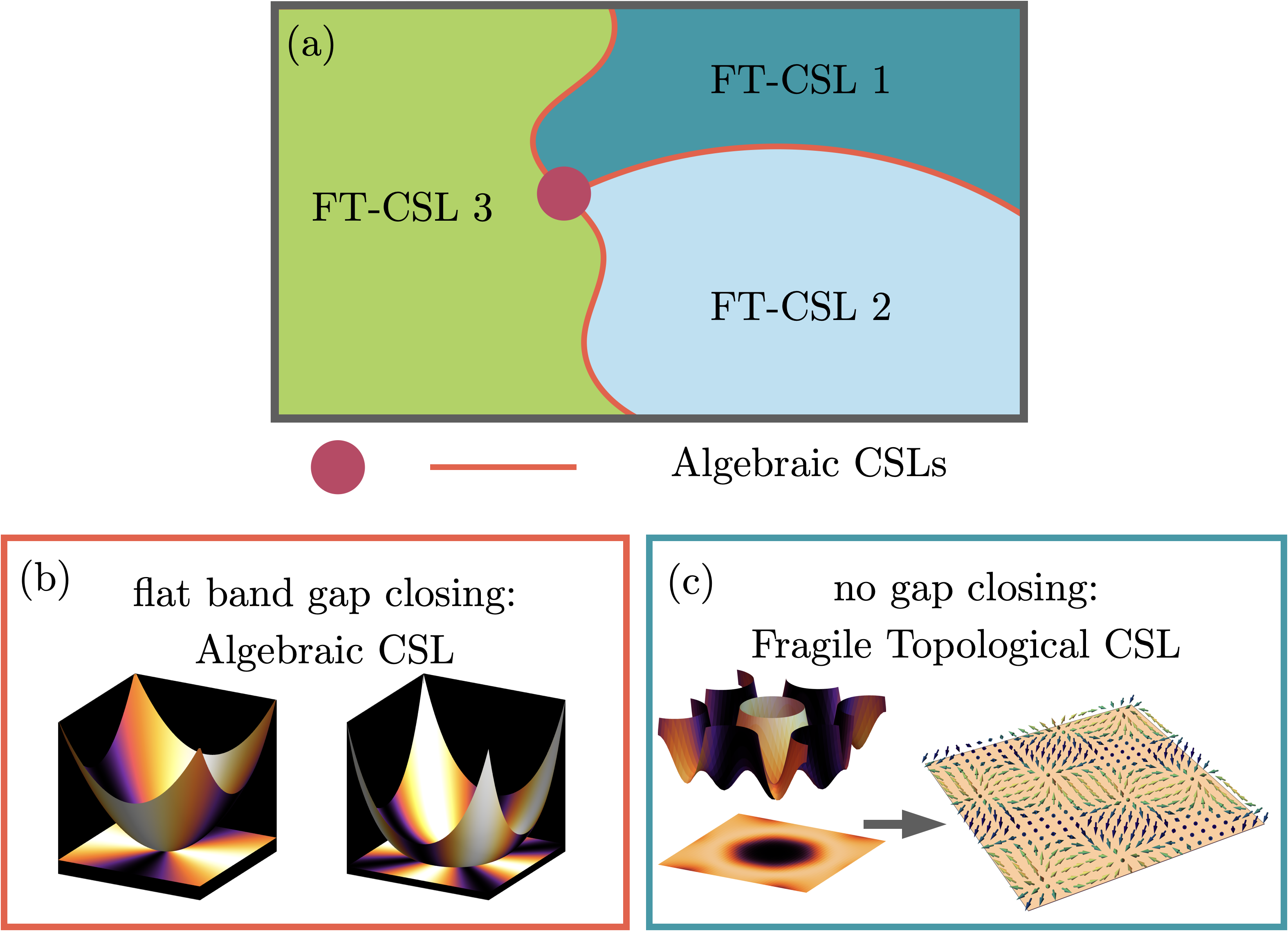
This paper proposes a classification scheme for classical spin liquids (CSLs) based on the band structure of their Hamiltonians, distinguishing algebraic CSLs (gap-closing between flat and dispersive bands) and fragile topological CSLs (gapped flat bands). The scheme uses emergent Gauss’s laws for algebraic CSLs and eigenvector homotopy for fragile topological CSLs, revealing a landscape where algebraic CSLs lie at phase boundaries between fragile topological phases, with a new model family illustrating transitions between them.
Classical spin liquids (CSL) lack long-range magnetic order and are characterized by an extensive ground state degeneracy. We propose a classification scheme of CSLs based on the structure of the flat bands of their Hamiltonians. Depending on absence or presence of the gap from the flat band, the CSL are classified as algebraic or fragile topological, respectively. Each category is further classified: the algebraic case by the nature of the emergent Gauss's law at the gap-closing point(s), and the fragile topological case by the homotopy of the eigenvector winding around the Brillouin zone. Previously identified instances of CSLs fit snugly into our scheme, which finds a landscape where algebraic CSLs are located at transitions between \fragile topological ones. It also allows us to present a new, simple family of models illustrating that landscape, which hosts both fragile topological and algebraic CSLs, as well as transitions between them.
Motivation & Objective
- To address the lack of a comprehensive classification scheme for classical spin liquids (CSLs) that unifies diverse models and captures their intrinsic physics beyond individual spin configurations.
- To resolve the challenge of distinguishing CSLs with algebraically vs. exponentially decaying correlations within a single framework.
- To identify and characterize hidden topological properties in CSLs, particularly through spectral band structure and topological invariants.
- To provide a systematic method for diagnosing known CSLs and constructing new models with desired topological and algebraic properties.
- To establish a landscape where algebraic CSLs emerge as boundaries between fragile topological CSLs, revealing a deeper organization of CSL phases.
Proposed method
- The classification is based on the spectrum of the classical exchange Hamiltonian in momentum space, focusing on the presence or absence of a gap between the lowest flat band and higher dispersive bands.
- Algebraic CSLs are identified by gap-closing points between the flat band and dispersive bands, where the emergent Gauss’s law is derived from the band eigenvector structure at the closing point.
- Fragile topological CSLs are classified by the homotopy class of the eigenvector winding of the topmost dispersive band around the Brillouin zone, computed via a skyrmion number invariant.
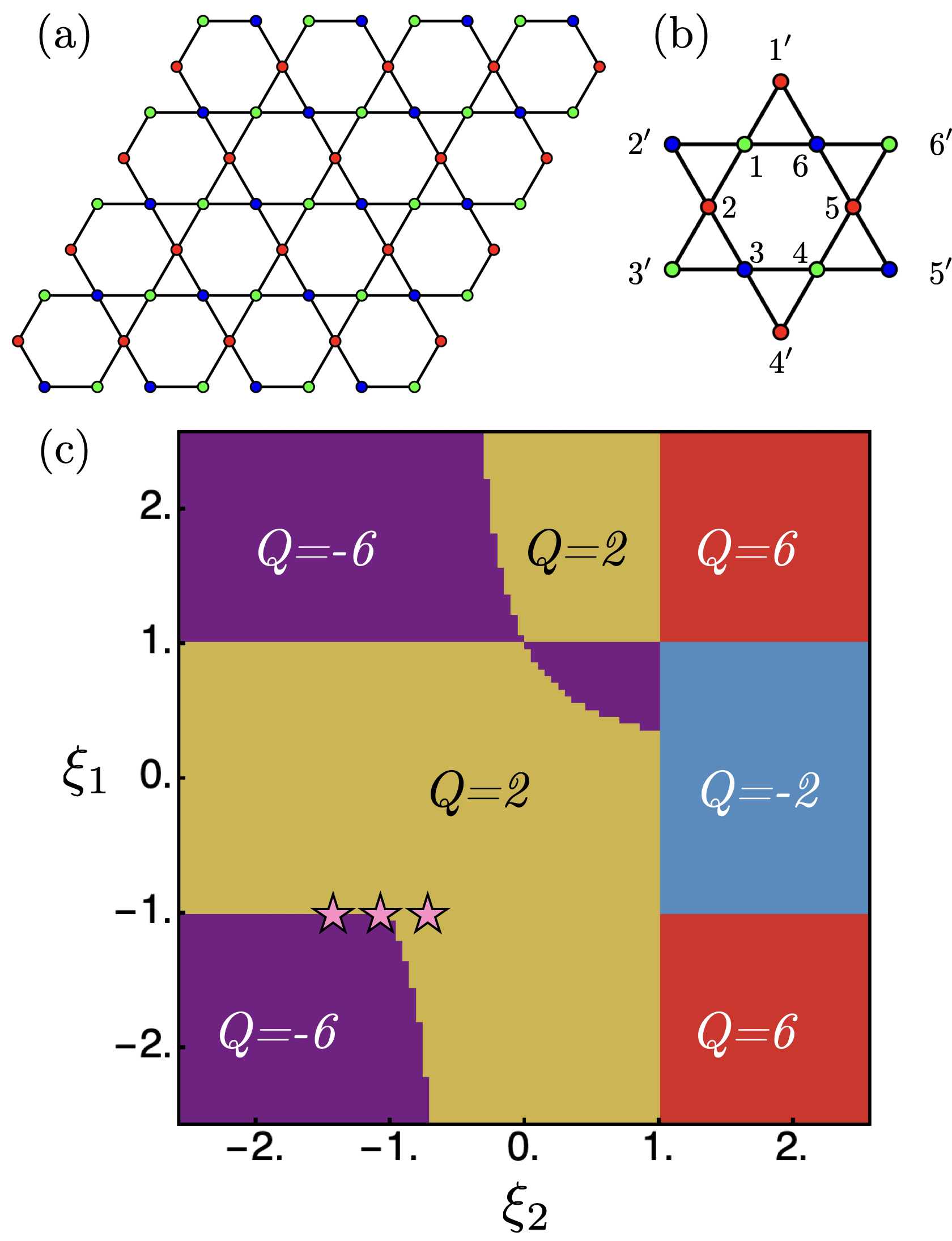
- A new family of models is constructed using a constrainer Hamiltonian formalism with two tuning parameters (ξ₁, ξ₂), enabling continuous tuning between topological and algebraic phases.
- The top band eigenvector is expressed as a Fourier transform of a local pattern, and its homotopy is computed via a skyrmion number integral over the Brillouin zone.
- The emergent Gauss’s law is derived from the band eigenvector at gap-closing points and recast as a symmetric rank-2 tensor constraint, with characteristic 4-fold or 2-fold pinch points in the spin structure factor.
Experimental results
Research questions
- RQ1How can classical spin liquids be systematically classified based on their spectral band structure rather than individual spin configurations?
- RQ2What topological invariants characterize fragile topological classical spin liquids, and how do they differ from those in quantum spin liquids?
- RQ3How do algebraic and exponentially decaying correlation CSLs fit into a unified classification framework?
- RQ4What is the role of gap-closing points in connecting different CSL phases, and how do they determine emergent gauge theories?
- RQ5Can a simple, tunable model be constructed to realize transitions between fragile topological and algebraic CSLs, and what are the associated topological invariants?
Key findings
- The classification scheme divides CSLs into algebraic CSLs (gap-closing between flat and dispersive bands) and fragile topological CSLs (gapped flat bands), with the latter classified by eigenvector homotopy.
- Algebraic CSLs are characterized by emergent Gauss’s laws at gap-closing points, with the specific form of the law determined by the band eigenvector structure.
- A 4-fold pinch point (4FPP) in the spin structure factor corresponds to a symmetric rank-2 U(1) Gauss’s law, while a 2-fold pinch point (2FPP) indicates a different emergent gauge structure.
- Tuning the parameters ξ₁ and ξ₂ in the new model family causes the gap-closing point to split or merge, leading to transitions between algebraic CSLs with distinct Gauss’s laws.
- When the gap closes, the system hosts an algebraic CSL with a 4FPP at ξ₁ = ξ₂ = -1, while increasing ξ₂ > -1 lifts the gap, forming a fragile topological CSL.
- The skyrmion number computed from the top band eigenvector correctly labels the fragile topological phases, confirming the topological robustness of the classification.
Read this paper
Open the full text in the Nubint reader and ask about any passage as you read.
Read this paper on NubintThis review was generated by AI from the original paper. Please check the paper before citing it.