
[Paper Review] Clay metaBrick-based motif to enhance thermal and acoustic insulation
This paper proposes a clay metaBrick incorporating Helmholtz resonators within slotted hollow cores to simultaneously enhance thermal and acoustic insulation. Using finite element simulations and experimental validation, the metaBrick achieves up to 20 dB reduction in sound transmission and 8% improvement in thermal resistance compared to standard clay bricks, while maintaining compressive strength above construction standards despite a 33% reduction from the original brick due to structural modifications.
Acoustic metamaterials have gained popularity as promising materials for enhancing noise reduction. Here, we explore the use of metamaterials, based on Helmholtz resonators (HRs), to enhance the performance of standard clay hollow brick. By incorporating HRs in the upper and lower hollows, we transform the standard brick into metaBrick, which is essentially designed based on metamaterial principles. We evaluate the acoustic and thermal performance of walls constructed with clay metaBricks, focusing on sound transmission loss and heat resistance. Both the finite element method and experimental analysis were employed to highlight the performance of metaBricks compared to standard clay bricks. Results show that metaBricks significantly enhance acoustic and thermal insulation, achieving an attenuation of $20$ \si{dB} across a broad frequency range from $500$ to $2500$ \si{Hz} and an $8$\% increase in thermal resistance. However, compressive strength is reduced by $33$\%, though it remains above the standard requirements for building materials. These findings indicate that metaBrick is a promising building material, offering improved sound and thermal insulation.
Motivation & Objective
- Address the growing need for energy-efficient and noise-reducing building materials in response to climate change and urban noise pollution.
- Overcome the limitations of standard hollow clay bricks in simultaneously providing effective thermal and acoustic insulation.
- Develop a multi-functional metamaterial-based brick design that leverages Helmholtz resonators to control both sound and heat transfer.
- Validate the performance of the metaBrick through numerical simulations and physical experiments on full-scale walls.
- Ensure structural viability by testing compressive strength against industry standards for load-bearing applications.
Proposed method
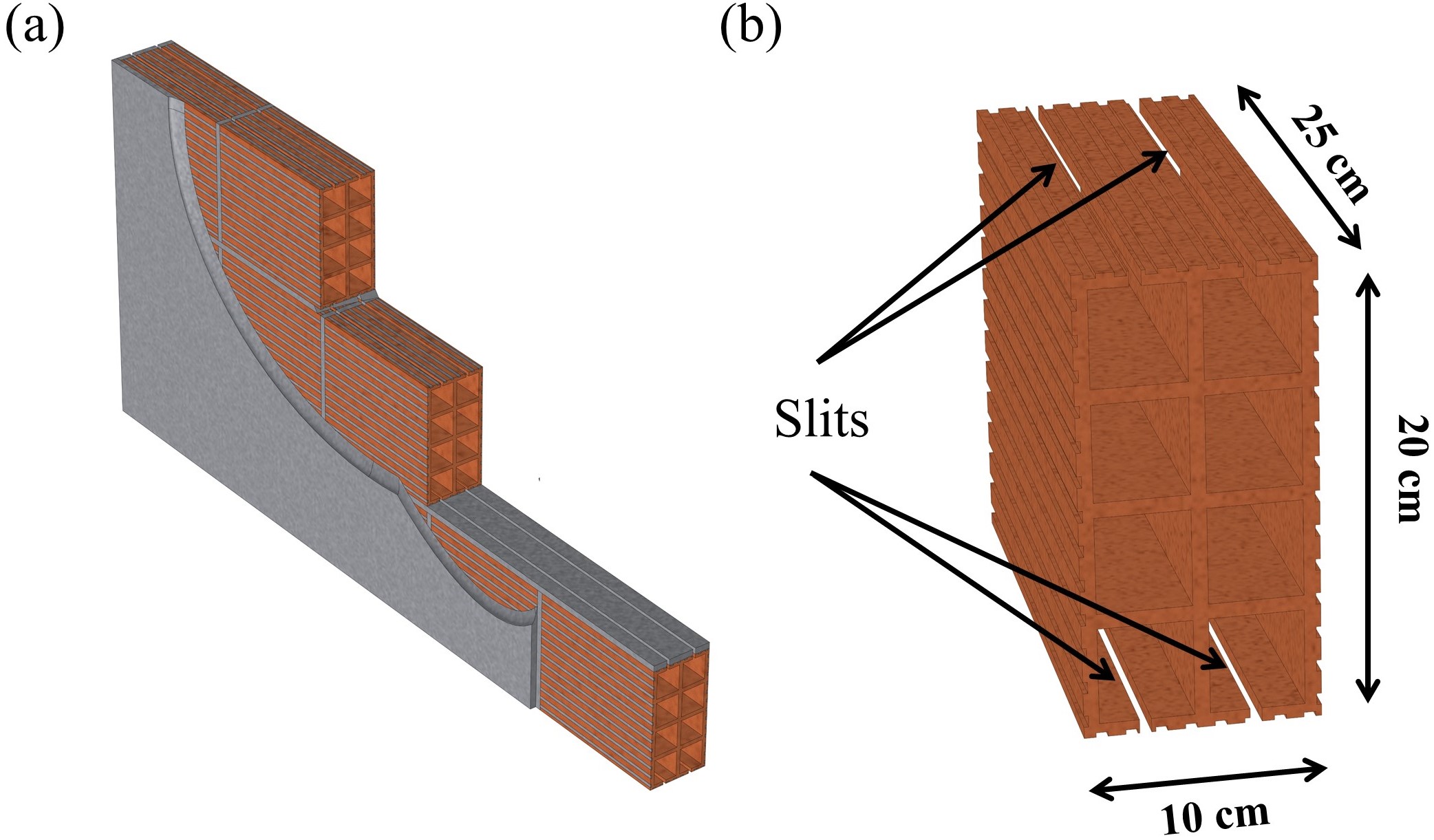
- Design a clay metaBrick with slits at the top and bottom of hollow cores to form Helmholtz resonators, enabling resonant attenuation of sound and heat.
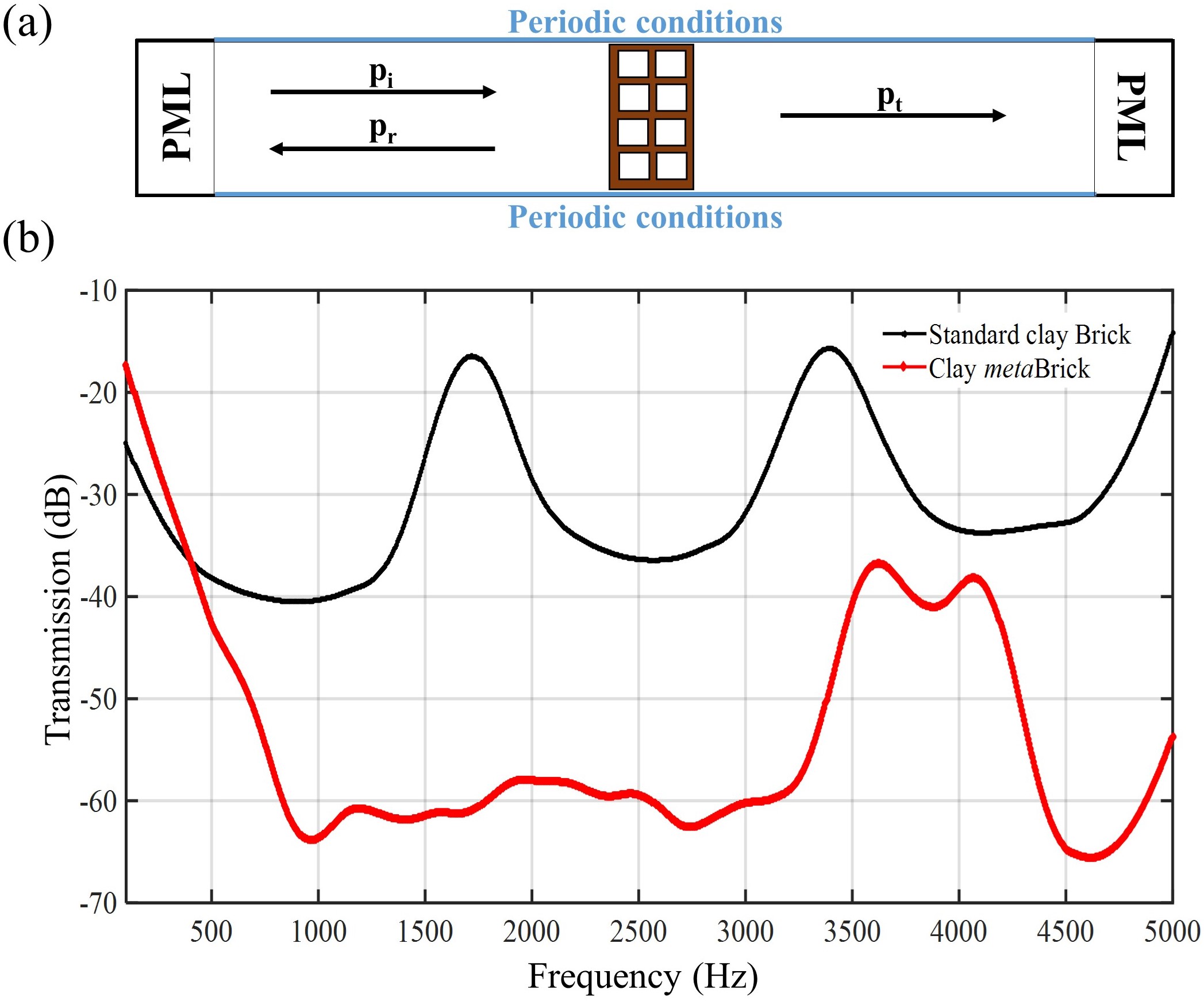
- Use the finite element method (FEM) to numerically simulate and analyze acoustic transmission loss and thermal resistance of the metaBrick.
- Construct a full-scale wall from metaBricks and perform experimental measurements of sound transmission, thermal resistance, and mechanical compression.
- Compare the performance of the metaBrick wall against a standard hollow clay brick wall across acoustic, thermal, and mechanical properties.
- Conduct compression tests on four samples of both metaBrick and standard brick to measure and compare their compressive strength in MPa.
- Apply the concept of metamaterials to transform conventional clay bricks into multi-functional building components with enhanced insulation without compromising structural integrity.
Experimental results
Research questions
- RQ1Can the integration of Helmholtz resonators into clay bricks significantly improve both acoustic and thermal insulation performance?
- RQ2How does the metaBrick design compare to standard hollow clay bricks in terms of sound transmission loss and thermal resistance?
- RQ3To what extent does the structural modification (slits) affect the compressive strength of the metaBrick relative to standard bricks?
- RQ4Can the numerical predictions of acoustic and thermal performance be experimentally validated in a full-scale wall configuration?
- RQ5Is the metaBrick's compressive strength sufficient for practical use in load-bearing construction applications?
Key findings
- The metaBrick achieved a sound transmission loss of up to 20 dB across the frequency range of 200 Hz to 3.5 kHz, significantly outperforming the standard clay brick.
- Thermal resistance of the metaBrick wall improved by 8% compared to the standard brick wall, indicating enhanced heat insulation.
- The average compressive strength of the metaBrick was 12.75 MPa, which exceeds the minimum required construction standard of 7.5 MPa despite a 33% reduction from the standard brick’s 19.37 MPa.
- Numerical simulations and experimental results showed strong agreement, validating the accuracy of the finite element modeling approach for predicting metaBrick performance.
- The presence of slits reduced compressive strength by approximately 7 MPa, but the resulting strength remains suitable for structural applications.
- The metaBrick design demonstrates a viable pathway to multi-functional building materials that simultaneously address thermal and acoustic insulation needs in sustainable construction.
Read this paper
Open the full text in the Nubint reader and ask about any passage as you read.
Read this paper on NubintThis review was generated by AI from the original paper. Please check the paper before citing it.