
[Paper Review] Clinical Prompt Learning with Frozen Language Models
This paper investigates prompt learning with frozen large language models for clinical decision tasks, demonstrating that it achieves performance comparable or superior to traditional fine-tuning while requiring significantly fewer trainable parameters and less training data. The approach uses soft prompt tuning with mixed templates to improve interpretability and efficiency, offering a viable, low-resource alternative to fine-tuning large models in clinical settings.
Prompt learning is a new paradigm in the Natural Language Processing (NLP) field which has shown impressive performance on a number of natural language tasks with common benchmarking text datasets in full, few-shot, and zero-shot train-evaluation setups. Recently, it has even been observed that large but frozen pre-trained language models (PLMs) with prompt learning outperform smaller but fine-tuned models. However, as with many recent NLP trends, the performance of even the largest PLMs such as GPT-3 do not perform well on specialized domains (e.g. medical text), and the common practice to achieve State of the Art (SoTA) results still consists of pre-training and fine-tuning the PLMs on downstream tasks. The reliance on fine-tuning large PLMs is problematic in clinical settings where data is often held in non-GPU environments, and more resource efficient methods of training specialized domain models is crucial. We investigated the viability of prompt learning on clinically meaningful decision tasks and directly compared with more traditional fine-tuning methods. Results are partially in line with the prompt learning literature, with prompt learning able to match or improve on traditional fine-tuning with substantially fewer trainable parameters and requiring less training data. We argue that prompt learning therefore provides lower computational resource costs applicable to clinical settings, that can serve as an alternative to fine-tuning ever increasing in size PLMs. Complementary code to reproduce experiments presented in this work can be found at: https://github.com/NtaylorOX/Public_Clinical_Prompt.
Motivation & Objective
- To evaluate the viability of prompt learning with frozen pre-trained language models (PLMs) for clinical decision tasks.
- To compare prompt learning against traditional fine-tuning in terms of performance, parameter efficiency, and data efficiency.
- To assess whether prompt learning can serve as a computationally efficient alternative to fine-tuning in low-resource clinical environments.
- To explore the interpretability and robustness of prompt-based methods in medical NLP, particularly with mixed template designs.
- To determine whether small, domain-specific PLMs combined with prompt learning can outperform large, general-purpose models in clinical applications.
Proposed method
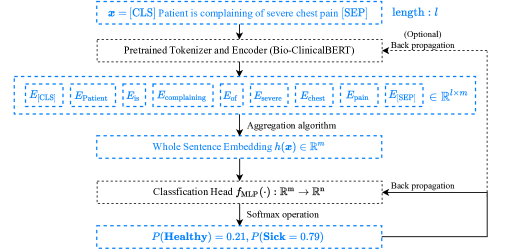
- The study employs frozen BERT-based PLMs, including BioBERT, to avoid full fine-tuning of the model parameters.
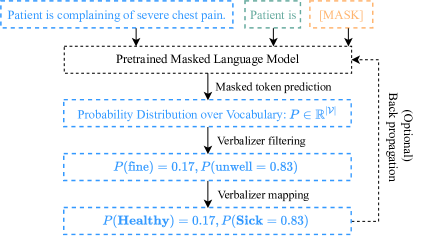
- It applies soft prompt tuning, where learnable embedding vectors are inserted before input tokens to guide the model’s predictions.
- Mixed templates are used, combining fixed prompt words with trainable soft prompts to balance interpretability and optimization flexibility.
- The framework is evaluated on four clinical tasks from the MIMIC-III dataset: ICD-9 triage, length of stay prediction, mortality prediction, and clinical note classification.
- Performance is compared between prompt learning and traditional fine-tuning across few-shot, zero-shot, and full-data training setups.
- Hyperparameter search is conducted to optimize prompt learning and fine-tuning, with ablation studies assessing template design and robustness.
Experimental results
Research questions
- RQ1Can prompt learning with frozen PLMs achieve performance comparable to traditional fine-tuning on clinical NLP tasks?
- RQ2Does prompt learning reduce the number of trainable parameters and data requirements compared to fine-tuning in clinical settings?
- RQ3How does the use of mixed templates affect model performance and interpretability in clinical decision tasks?
- RQ4Is prompt learning more robust to hyperparameter changes than traditional fine-tuning in low-resource clinical scenarios?
- RQ5Can small, domain-specific PLMs combined with prompt learning outperform large, general-purpose PLMs in clinical applications?
Key findings
- Prompt learning with frozen PLMs matched or outperformed traditional fine-tuning on all four clinical tasks, even with significantly fewer trainable parameters.
- The method required substantially less training data and computational resources, making it suitable for low-resource clinical environments.
- Mixed templates achieved performance similar to fully soft prompts while preserving interpretability by retaining human-readable prompt structures.
- The prompt learning framework demonstrated greater robustness to hyperparameter variations compared to fine-tuning, especially in few-shot settings.
- Even when using a biomedical-specific BERT model (BioBERT), prompt learning maintained consistent performance gains over fine-tuning, suggesting domain adaptation benefits.
- Despite strong results, performance on length of stay and mortality prediction tasks remained relatively poor across both frameworks, indicating task-specific challenges.
Read this paper
Open the full text in the Nubint reader and ask about any passage as you read.
Read this paper on NubintThis review was generated by AI from the original paper. Please check the paper before citing it.