
[Paper Review] Close to Human-Level Agreement: Tracing Journeys of Violent Speech in Incel Posts with GPT-4-Enhanced Annotations
This study uses GPT-4-enhanced annotations to classify violent speech in 6.9 million incels.is posts, revealing a statistically significant increase in overall violent content over time, especially non-directed violence and user-level escalation. It demonstrates GPT-4 achieves near-human-level agreement (kappa = 0.62) with human coders, enabling scalable, accurate detection of evolving violent speech patterns in extremist online communities.
This study investigates the prevalence of violent language on incels.is. It evaluates GPT models (GPT-3.5 and GPT-4) for content analysis in social sciences, focusing on the impact of varying prompts and batch sizes on coding quality for the detection of violent speech. We scraped over 6.9M posts from incels.is and categorized a random sample into non-violent, explicitly violent, and implicitly violent content. Two human coders annotated 3,028 posts, which we used to tune and evaluate GPT-3.5 and GPT-4 models across different prompts and batch sizes regarding coding reliability. The best-performing GPT-4 model annotated an additional 30,000 posts for further analysis. Our findings indicate an overall increase in violent speech overtime on incels.is, both at the community and individual level, particularly among more engaged users. While directed violent language decreases, non-directed violent language increases, and self-harm content shows a decline, especially after 2.5 years of user activity. We find substantial agreement between both human coders (K = .65), while the best GPT-4 model yields good agreement with both human coders (K = 0.54 for Human A and K = 0.62 for Human B). Weighted and macro F1 scores further support this alignment. Overall, this research provides practical means for accurately identifying violent language at a large scale that can aid content moderation and facilitate next-step research into the causal mechanism and potential mitigations of violent expression and radicalization in communities like incels.is.
Motivation & Objective
- To investigate the prevalence and temporal evolution of violent speech in the incels.is online community.
- To evaluate the performance of GPT-3.5 and GPT-4 in classifying violent content in social science contexts, focusing on prompt design and batch size effects.
- To establish a reliable human-annotated baseline for classifying three types of violent speech: non-directed, explicitly directed, and implicitly directed violence.
- To trace individual user trajectories of violent content over time, identifying patterns linked to user engagement duration.
- To provide a scalable, accurate method for large-scale detection of violent speech in extremist online forums using LLMs, supporting content moderation and future research.
Proposed method
- Scraped 6.9 million posts from incels.is and randomly sampled 3,028 for manual annotation by two human coders using a three-category violence typology: non-directed, explicitly directed, and implicitly directed violence.
- Trained and evaluated GPT-3.5 and GPT-4 models using multiple prompt variations and batch sizes to optimize classification reliability and cost-efficiency.
- Used Cohen’s Kappa, weighted F1, and macro F1 scores to measure agreement between human coders and between GPT-4 and human coders.
- Applied input batching (up to 50 posts per batch) to reduce GPT-4 inference costs from $0.0055 to $0.0005 per post, achieving ~$50 total cost for 100,000 annotations.
- Tracked violent content trends at both forum-wide and individual user levels over time, analyzing changes in violence types by user engagement duration.
- Provided GPT-4 with reasoning-based classification to improve interpretability and support human annotators in ambiguous cases.
Experimental results
Research questions
- RQ1What is the overall prevalence and temporal trend of violent speech on incels.is across the forum and among individual users?
- RQ2How does the performance of GPT-4 compare to human annotators in classifying different types of violent speech in Incel forum content?
- RQ3What impact do prompt design and batch size have on the accuracy and cost-efficiency of LLM-based content classification in social science research?
- RQ4How do different forms of violent speech—non-directed, explicitly directed, and implicitly directed—evolve over time, particularly in relation to user engagement duration?
- RQ5Can GPT-4 serve as a reliable, scalable alternative to human annotation for detecting violent speech in high-volume, sensitive online communities?
Key findings
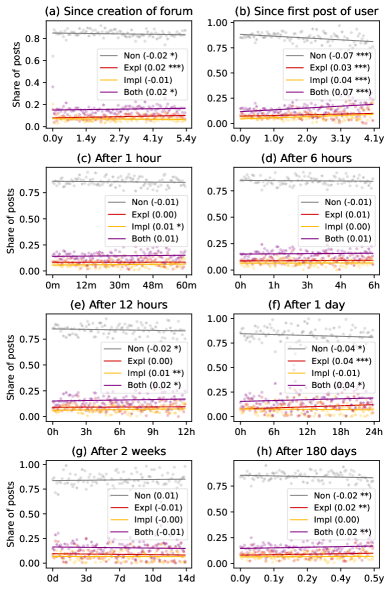
- 15.7% of the 33,028 analyzed posts exhibited violent speech, with a statistically significant increase in overall violent content over time.
- The best-performing GPT-4 model achieved substantial agreement with human coders (kappa = 0.62 with Human B and kappa = 0.54 with Human A), indicating near-human-level reliability.
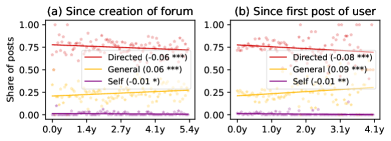
- Non-directed violent language increased over time, while directed violent language decreased, suggesting a shift in the nature of hostility within the community.
- Self-harm content declined significantly, especially after 2.5 years of user activity, indicating a possible desensitization or shift in expression patterns.
- User-level analysis revealed a strong positive correlation between prolonged engagement and increased prevalence of violent content, indicating a possible radicalization trajectory.
- GPT-4 achieved a cost of approximately $0.0005 per post through optimized batching, reducing total cost from an estimated $180 to $50 for 100,000 annotations.
Read this paper
Open the full text in the Nubint reader and ask about any passage as you read.
Read this paper on NubintThis review was generated by AI from the original paper. Please check the paper before citing it.