
[Paper Review] Closed string tachyon condensation revisited
This paper revisits closed string tachyon condensation in closed string field theory (CSFT) by studying nearly marginal matter tachyons in a truncated state space excluding the ghost dilaton. It derives a novel conformal perturbation theory formula linking the on-shell action to the shift in the matter CFT's central charge, finding $ S = -\frac{1}{12}\Delta c $, and confirms this via Zamolodchikov’s flow between minimal models. When the ghost dilaton is reintroduced, a nonperturbative vacuum expectation value (VEV) is required for the action to vanish, resolving tension with prior results.
We consider condensation of nearly marginal matter tachyons in closed string field theory and observe that upon restricting to a subspace of states not containing the ghost dilaton, the on-shell value of the action is proportional to the shift of the central charge of the matter CFT. This correspondence lets us find a novel conformal perturbation theory formula for the next-to-leading order shift of the central charge for a generic theory, which we test on Zamolodchikov's flow between consecutive minimal models. Upon reintroduction of the dilaton couplings, it is plausible to have a vanishing value of the on-shell action.
Motivation & Objective
- To investigate closed string tachyon condensation in CSFT using nearly marginal matter tachyons.
- To derive a conformal perturbation theory formula for the next-to-leading order shift in the central charge of the matter CFT.
- To resolve tension between the on-shell action and the claim that it vanishes on solutions by analyzing ghost dilaton couplings.
- To test the derived formula against Zamolodchikov’s exact flow between consecutive minimal models.
Proposed method
- The study uses the infinite stub limit in CSFT to bypass complications from propagator flattenization and regularize worldsheet divergences.
- It restricts the state space to exclude the ghost dilaton, enabling a direct relation between the on-shell action and the shift in the matter CFT’s central charge.
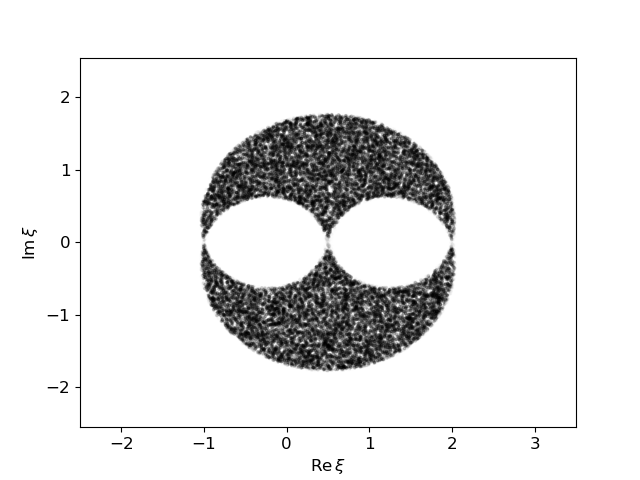
- The authors compute the quartic-order tachyon potential using regularized four-tachyon amplitudes with subtracted divergences, defined via integrals over lens-like regions.
- They derive the finite-part amplitude $ \mathcal{A}_{TTTT}^{f.p.} $ by subtracting singular terms with correct asymptotics and $ SL(2,\mathbb{R}) $ symmetry.
- The ghost dilaton’s role is reintroduced by analyzing quartic couplings, revealing a necessary nonperturbative VEV for the action to vanish.
- The method is validated by comparing the derived central charge shift with exact results from Zamolodchikov’s flow between minimal models.
Experimental results
Research questions
- RQ1What is the relation between the on-shell action in CSFT and the shift in the central charge of the matter CFT for nearly marginal tachyons?
- RQ2How can divergences in the four-tachyon amplitude be systematically regularized in CSFT using the infinite stub limit?
- RQ3Why does the on-shell action not vanish in the ghost-dilaton-free subspace, and what role does the ghost dilaton play in restoring the vanishing action?
- RQ4Can the derived formula for the central charge shift be verified in an exactly solvable CFT like Zamolodchikov’s flow between minimal models?
Key findings
- The on-shell action in the ghost-dilaton-free subspace is proportional to the shift in the matter CFT’s central charge: $ S = -\frac{1}{12}\Delta c $.
- The next-to-leading order shift in the central charge is given by $ \Delta c = -\frac{y^3}{C_{VVV}^2} - \frac{\mathcal{A}_{TTTT}^{f.p.}}{2C_{VVV}^4}y^4 + O(y^5) $, with $ y = 2(1-h) $.
- The finite-part amplitude $ \mathcal{A}_{TTTT}^{f.p.} $ is derived via subtraction of divergent terms with correct asymptotics and $ SL(2,\mathbb{R}) $ symmetry.
- The formula passes a nontrivial check: $ \mathcal{A}_{TTTT}^{f.p.} = 0 $ for the $ c=1 $ free boson, where $ \langle V|V(1)V(\xi)|V\rangle = 1 + \frac{1}{(\xi-1)^2} + \frac{1}{\xi^2} $.
- The result is confirmed in Zamolodchikov’s flow between consecutive minimal models, validating the perturbative approach.
- Reintroducing the ghost dilaton reveals that its nonperturbative VEV is necessary for the on-shell action to vanish, consistent with [76].
Read this paper
Open the full text in the Nubint reader and ask about any passage as you read.
Read this paper on NubintThis review was generated by AI from the original paper. Please check the paper before citing it.