
[Paper Review] Clustering Validation with The Area Under Precision-Recall Curves
This paper proposes using the Area Under the Precision-Recall Curve (AUPR) and its symmetric variant (SAUPRC) as relative clustering validation indices (CVIs) to evaluate clustering solutions, especially under cluster size imbalance. It demonstrates that AUPR-based CVIs, particularly SAUPRC, outperform existing indices like Silhouette and AUCC in both balanced and imbalanced data, offering a unified, reliable framework for unsupervised learning evaluation.
Confusion matrices and derived metrics provide a comprehensive framework for the evaluation of model performance in machine learning. These are well-known and extensively employed in the supervised learning domain, particularly classification. Surprisingly, such a framework has not been fully explored in the context of clustering validation. Indeed, just recently such a gap has been bridged with the introduction of the Area Under the ROC Curve for Clustering (AUCC), an internal/relative Clustering Validation Index (CVI) that allows for clustering validation in real application scenarios. In this work we explore the Area Under Precision-Recall Curve (and related metrics) in the context of clustering validation. We show that these are not only appropriate as CVIs, but should also be preferred in the presence of cluster imbalance. We perform a comprehensive evaluation of proposed and state-of-art CVIs on real and simulated data sets. Our observations corroborate towards an unified validation framework for supervised and unsupervised learning, given that they are consistent with existing guidelines established for the evaluation of supervised learning models.
Motivation & Objective
- Address the lack of comprehensive evaluation frameworks for clustering validation comparable to those in supervised learning.
- Investigate whether Precision-Recall Curve-based metrics (AUPR) are effective as relative CVIs, particularly in scenarios with cluster size imbalance.
- Provide a unified evaluation framework that aligns clustering validation with established practices in supervised learning.
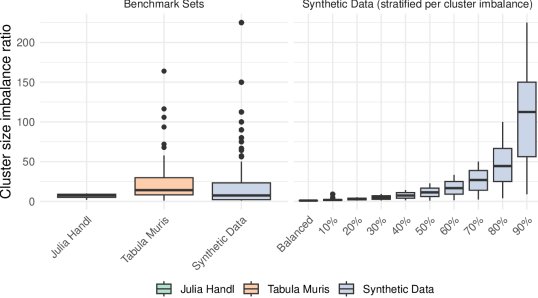
- Evaluate the performance of AUPR-based CVIs against state-of-the-art indices across synthetic and real-world data with varying imbalance levels.
- Demonstrate that SAUPRC combines strong performance on balanced and imbalanced data, making it a robust choice for general clustering validation.
Proposed method
- Propose three new relative CVIs based on the Area Under the Precision-Recall Curve (AUPRC), including a symmetric variant (SAUPRC) that combines AUPRC and AUIPRC.
- Adapt the precision-recall curve framework from binary classification to clustering by treating cluster assignments as binary predictions against a reference partition.
- Compute AUPR and AUIPRC scores by evaluating pairwise cluster assignments across all object pairs, using external reference partitions for ground truth.
- Use the symmetric AUPRC (SAUPRC) as a hybrid metric that averages AUPRC and AUIPRC to balance performance across balanced and imbalanced data.
- Apply the proposed CVIs to synthetic datasets with controlled cluster imbalances and real single-cell RNA-seq data from the Tabula Muris project.
- Compare the proposed CVIs against established indices (e.g., Silhouette, AUCC, Dunn, C-Index) using the Adjusted Rand Index (ARI) as the external benchmark.
Experimental results
Research questions
- RQ1Can the Area Under the Precision-Recall Curve (AUPR) serve as a reliable relative clustering validation index?
- RQ2How do AUPR-based CVIs perform under varying degrees of cluster size imbalance compared to existing CVIs?
- RQ3Does the symmetric AUPRC (SAUPRC), which combines AUPRC and AUIPRC, provide superior and more stable performance across both balanced and imbalanced clustering scenarios?
- RQ4To what extent do AUPR-based metrics align with established evaluation guidelines used in supervised learning, particularly in imbalanced settings?
- RQ5Can AUPR-based CVIs be effectively applied to real-world biological data with inherent cluster imbalances, such as single-cell genomics datasets?
Key findings
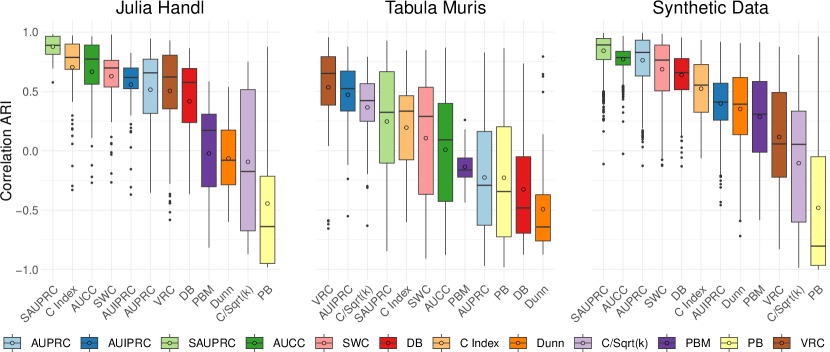
- SAUPRC achieved median correlation with the Adjusted Rand Index (ARI) above 0.75 even on balanced data, outperforming established CVIs like Silhouette and AUCC.
- For highly imbalanced data (90% imbalance), SAUPRC achieved median correlation values close to 1.0, indicating strong alignment with external benchmarks.
- AUPRC and SAUPRC showed improved performance as cluster imbalance increased, with median correlation rising from ~0.75 (balanced) to ~0.95 (90% imbalance).
- In contrast, PB (Point Biserial) and PBM CVIs deteriorated significantly with imbalance, dropping to a median correlation of -1.0 at 90% imbalance.
- AUCC and DB showed stable performance across imbalance levels, but were outperformed by SAUPRC in both balanced and imbalanced regimes.
- C/Sqrt(k) showed negative agreement with ARI on balanced data but improved with imbalance, though median correlation remained below 0.5, indicating only moderate performance.
Read this paper
Open the full text in the Nubint reader and ask about any passage as you read.
Read this paper on NubintThis review was generated by AI from the original paper. Please check the paper before citing it.