
[Paper Review] Coin3D: Controllable and Interactive 3D Assets Generation with Proxy-Guided Conditioning
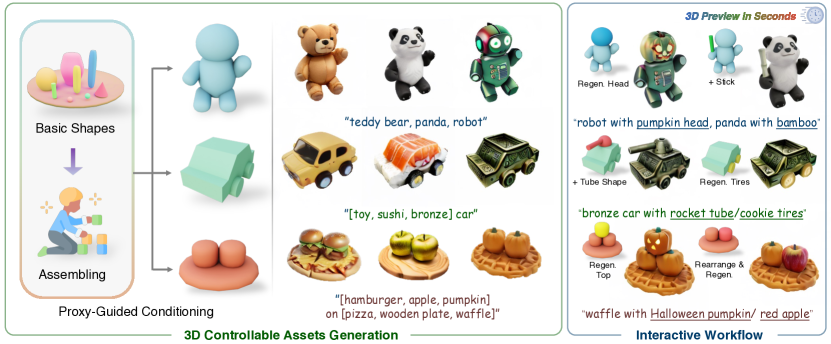
Coin3D introduces a controllable and interactive 3D asset generation framework that uses coarse 3D shape proxies—built from basic geometric primitives—as conditional guidance for a multiview diffusion model. By integrating a 3D adapter, proxy-bounded editing, progressive volume caching, and volume-SDS loss, it enables sub-10-second responsive 3D previews and fine-grained local editing, significantly improving controllability and interactivity over existing 3D generation methods.
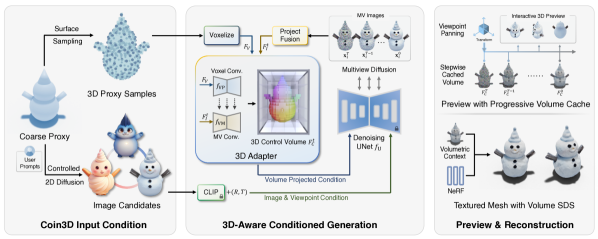
As humans, we aspire to create media content that is both freely willed and readily controlled. Thanks to the prominent development of generative techniques, we now can easily utilize 2D diffusion methods to synthesize images controlled by raw sketch or designated human poses, and even progressively edit/regenerate local regions with masked inpainting. However, similar workflows in 3D modeling tasks are still unavailable due to the lack of controllability and efficiency in 3D generation. In this paper, we present a novel controllable and interactive 3D assets modeling framework, named Coin3D. Coin3D allows users to control the 3D generation using a coarse geometry proxy assembled from basic shapes, and introduces an interactive generation workflow to support seamless local part editing while delivering responsive 3D object previewing within a few seconds. To this end, we develop several techniques, including the 3D adapter that applies volumetric coarse shape control to the diffusion model, proxy-bounded editing strategy for precise part editing, progressive volume cache to support responsive preview, and volume-SDS to ensure consistent mesh reconstruction. Extensive experiments of interactive generation and editing on diverse shape proxies demonstrate that our method achieves superior controllability and flexibility in the 3D assets generation task.
Motivation & Objective
- To address the lack of controllability and responsiveness in current 3D generative modeling workflows.
- To enable users to create and edit 3D assets using intuitive coarse shape proxies instead of text or images.
- To support real-time, interactive 3D previewing and local part editing with minimal latency.
- To ensure high-fidelity mesh reconstruction while preserving user-defined geometry and structure.
Proposed method
- A 3D adapter is introduced to apply volumetric coarse shape control directly to the 3D diffusion model, enabling 3D-aware conditioning.
- Proxy-bounded editing is implemented using a mask dilation strategy to ensure natural, seamless local edits while preserving unmodified regions.
- Progressive volume caching accelerates preview rendering by reusing intermediate feature volumes across edits, enabling sub-10-second response times.
- Volume-SDS (Score Distillation Sampling) loss enforces consistent mesh reconstruction by aligning the 3D geometry with the proxy shape and multiview supervision.
- The framework integrates a multiview diffusion prior with 3D proxy guidance, allowing users to iteratively refine prompts and shapes.
- A novel on-the-fly feature volume construction pipeline enables rapid generation and preview from arbitrary viewpoints.
Experimental results
Research questions
- RQ1Can coarse 3D shape proxies composed of basic geometric primitives effectively guide high-fidelity 3D generation in a diffusion-based framework?
- RQ2How can 3D-aware local editing be achieved with minimal latency and high consistency in geometry and appearance?
- RQ3What techniques enable responsive 3D previews within a few seconds during interactive modeling?
- RQ4How does proxy-guided conditioning improve reconstruction fidelity compared to image- or text-only conditioning?
- RQ5To what extent does volume-SDS and proxy-bounded editing enhance the quality and coherence of generated 3D assets?
Key findings
- Coin3D achieves interactive 3D previewing in 5–10 seconds per edit, significantly faster than existing methods requiring dozens of minutes for reconstruction.
- The volume-SDS loss improves mesh reconstruction quality, reducing artifacts like 'floaters' and producing more plausible geometry, such as stable chair bottoms.
- Proxy-bounded editing with mask dilation produces seamless, natural edits; removing either component leads to structural artifacts like broken limbs or fused shapes.
- The method maintains unchanged parts during local editing, demonstrating strong content preservation across multiple editing steps.
- User studies and qualitative results show that the framework supports intuitive, iterative design workflows similar to image inpainting but in 3D space.
- The framework outperforms baseline methods like Latent-NeRF and Fantasia3D in both generation fidelity and interactivity, especially in responsive previewing and shape control.
Read this paper
Open the full text in the Nubint reader and ask about any passage as you read.
Read this paper on NubintThis review was generated by AI from the original paper. Please check the paper before citing it.