
[Paper Review] Comparing Stochastic Volatility Specifications for Large Bayesian VARs
This paper develops a novel Bayesian model comparison method for large Bayesian VARs by combining conditional Monte Carlo and adaptive importance sampling to estimate marginal likelihoods across multiple stochastic volatility specifications. The approach analytically integrates out VAR coefficients and uses global Gaussian approximations to the posterior, enabling accurate selection among common, Cholesky, and factor stochastic volatility models—with results showing Cholesky and factor SV outperform common SV due to superior shrinkage flexibility.
Large Bayesian vector autoregressions with various forms of stochastic volatility have become increasingly popular in empirical macroeconomics. One main difficulty for practitioners is to choose the most suitable stochastic volatility specification for their particular application. We develop Bayesian model comparison methods -- based on marginal likelihood estimators that combine conditional Monte Carlo and adaptive importance sampling -- to choose among a variety of stochastic volatility specifications. The proposed methods can also be used to select an appropriate shrinkage prior on the VAR coefficients, which is a critical component for avoiding over-fitting in high-dimensional settings. Using US quarterly data of different dimensions, we find that both the Cholesky stochastic volatility and factor stochastic volatility outperform the common stochastic volatility specification. Their superior performance, however, can mostly be attributed to the more flexible priors that accommodate cross-variable shrinkage.
Motivation & Objective
- To address the lack of reliable tools for comparing high-dimensional, non-nested stochastic volatility models in large Bayesian VARs.
- To develop a computationally efficient and accurate marginal likelihood estimator for large VARs with complex stochastic volatility structures.
- To enable model comparison between common, Cholesky, and factor stochastic volatility specifications in high-dimensional settings.
- To evaluate whether the superior performance of certain SV models stems from their structure or from more flexible shrinkage priors.
- To extend the method to select optimal shrinkage priors on VAR coefficients, crucial for avoiding overfitting in high-dimensional systems.
Proposed method
- The method analytically integrates out the large number of VAR coefficients by deriving a closed-form likelihood expression conditional on the volatility states.
- It combines conditional Monte Carlo integration for the VAR coefficients with adaptive importance sampling for the log-volatility states.
- The importance sampling density is constructed by minimizing the Kullback-Leibler divergence to the true posterior, ensuring a global approximation rather than a local one.
- The approach uses a multivariate Gaussian family to approximate the posterior of the log-volatility vector, improving accuracy over local Taylor approximations.
- The marginal likelihood is estimated by combining analytical marginalization and Monte Carlo integration, reducing variance and improving computational efficiency.
- The method is applied to compare common SV, Cholesky SV, and factor SV models in large VARs using US quarterly macroeconomic data.
Experimental results
Research questions
- RQ1Which stochastic volatility specification—common, Cholesky, or factor—yields the highest marginal likelihood in large Bayesian VARs?
- RQ2Does the superior performance of Cholesky and factor SV models stem from their structural flexibility or from better shrinkage properties?
- RQ3How well can the proposed marginal likelihood estimator distinguish between competing SV models in high-dimensional settings?
- RQ4How does increased volatility magnitude affect model discrimination performance in the proposed framework?
- RQ5Can the method also be used to select optimal shrinkage priors on VAR coefficients in high-dimensional models?
Key findings
- The Cholesky stochastic volatility and factor stochastic volatility models outperform the common stochastic volatility specification in terms of marginal likelihood.
- The superior performance of Cholesky and factor SV models is primarily attributable to their ability to accommodate more flexible cross-variable shrinkage, not their structural form alone.
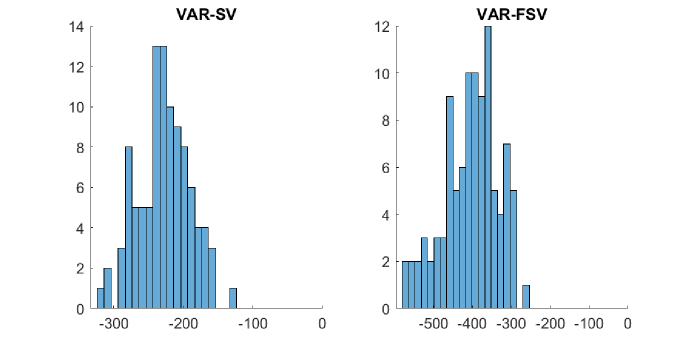
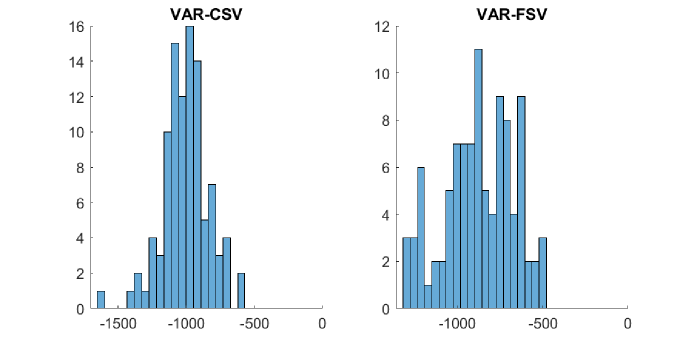
- In simulations with n=20 variables, the proposed estimator correctly selected the true data-generating process in 100% of cases across all three SV models.
- When the error covariance matrix was increased tenfold (corresponding to ~10x higher volatility), the correct model was still overwhelmingly favored in all 100 datasets.
- The method demonstrated improved discrimination power as dimensionality increased, with larger differences in log marginal likelihoods between true and false models.
- The adaptive importance sampling approach based on Kullback-Leibler minimization provided more accurate and stable marginal likelihood estimates than local approximations like second-order Taylor expansions.
Read this paper
Open the full text in the Nubint reader and ask about any passage as you read.
Read this paper on NubintThis review was generated by AI from the original paper. Please check the paper before citing it.