
[Paper Review] Compositional Learning of Visually-Grounded Concepts Using Reinforcement
This paper proposes a compositional reinforcement learning framework that enables agents to learn visually-grounded color-shape concepts separately before combining them, achieving 20× faster learning on unseen instruction combinations and strong zero-shot generalization. By pretraining on individual concepts (color/shape) and leveraging frozen text encoders like CLIP, agents significantly reduce sample complexity and improve disentangled representation learning in a 3D navigation environment.
Children can rapidly generalize compositionally-constructed rules to unseen test sets. On the other hand, deep reinforcement learning (RL) agents need to be trained over millions of episodes, and their ability to generalize to unseen combinations remains unclear. Hence, we investigate the compositional abilities of RL agents, using the task of navigating to specified color-shape targets in synthetic 3D environments. First, we show that when RL agents are naively trained to navigate to target color-shape combinations, they implicitly learn to decompose the combinations, allowing them to (re-)compose these and succeed at held-out test combinations ("compositional learning"). Second, when agents are pretrained to learn invariant shape and color concepts ("concept learning"), the number of episodes subsequently needed for compositional learning decreased by 20 times. Furthermore, only agents trained on both concept and compositional learning could solve a more complex, out-of-distribution environment in zero-shot fashion. Finally, we verified that only text encoders pretrained on image-text datasets (e.g. CLIP) reduced the number of training episodes needed for our agents to demonstrate compositional learning, and also generalized to 5 unseen colors in zero-shot fashion. Overall, our results are the first to demonstrate that RL agents can be trained to implicitly learn concepts and compositionality, to solve more complex environments in zero-shot fashion.
Motivation & Objective
- To investigate whether deep reinforcement learning agents can compose novel color-shape instructions from previously learned concepts.
- To evaluate if pretraining on individual visual-linguistic concepts (color, shape) accelerates learning of compositional tasks.
- To assess zero-shot generalization performance on unseen color-shape1-shape2 combinations after concept and compositional training.
- To examine the impact of frozen text encoders (e.g., CLIP, BERT) on sample efficiency in visuo-linguistic instruction learning.
- To analyze the structure of learned representations via LSTM activation embeddings to understand disentanglement and generalization.
Proposed method
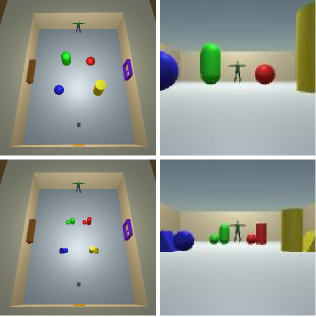
- The authors developed three 3D environments for visuo-linguistic navigation, where agents must navigate to objects based on color-shape instructions.
- Agents are trained using deep reinforcement learning with an LSTM-based policy network to process language and visual inputs.
- Concept pretraining involves separate training on color-only and shape-only instructions before joint training on color-shape combinations.
- The framework evaluates zero-shot generalization on novel color-shape1-shape2 combinations not seen during training.
- Frozen text encoders (CLIP, BERT) are used to provide pre-trained semantic representations, reducing the need for end-to-end training from scratch.
- LSTM activation embeddings are analyzed via PCA to visualize how well novel combinations are disentangled in representation space.
Experimental results
Research questions
- RQ1Can reinforcement learning agents decompose and recompose language-based instructions to generalize to unseen color-shape combinations?
- RQ2Does pretraining on individual visual-linguistic concepts (color, shape) reduce the number of training episodes required for compositional learning?
- RQ3How does using frozen text encoders (e.g., CLIP) affect sample efficiency in visuo-linguistic navigation tasks?
- RQ4To what extent do learned representations in the LSTM layer support disentangled and organized encoding of novel instruction combinations?
- RQ5What is the impact of representation structure (e.g., PCA dimensionality) on zero-shot generalization performance?
Key findings
- Agents pretrained on color and shape concepts separately achieved a 20× reduction in training episodes needed to solve unseen color-shape combinations.
- The best-performing agent, pre-trained on color/shape concepts and then fine-tuned on composites, achieved a reward of 5.5 on both familiar and unseen color-shape1-shape2 combinations in zero-shot evaluation.
- Agents trained directly on composite instructions showed highly overlapped representations in the LSTM layer, with only two principal components explaining 90% of variance, indicating poor disentanglement.
- In contrast, agents pre-trained on concepts before composition required at least six principal components to explain 90% of variance, showing a more organized and disentangled representation space.
- The embedding space of pre-trained agents revealed spatial clustering of similar novel combinations (e.g., 'prism sphere' and 'capsule cylinder' grouped in distinct subspaces), enabling effective zero-shot navigation.
- Pretraining on concept learning significantly improved zero-shot generalization, demonstrating that structured learning of individual concepts enhances compositional reasoning in RL agents.

Read this paper
Open the full text in the Nubint reader and ask about any passage as you read.
Read this paper on NubintThis review was generated by AI from the original paper. Please check the paper before citing it.