
[논문 리뷰] Connecting the Hamiltonian structure to the QAOA energy and Fourier landscape structure
이 논문은 하미르토니안의 구조—특히 항의 순서, 계수, 위상 구조—가 QAOA 비용 경계와 그 푸리에 변환에 미치는 영향을 조사한다. 거칠기 지표를 도입하고 orqviz를 통해 경계를 시각화함으로써, 저자들은 계수의 크기 격차가 클수록 고차항이 존재할수록 경계의 거칠기가 증가하고, 구조적 대칭성은 이를 감소시킴을 보여주며, 최적화기 선택 및 문제에 특화된 설계에 대한 통찰을 제공한다.
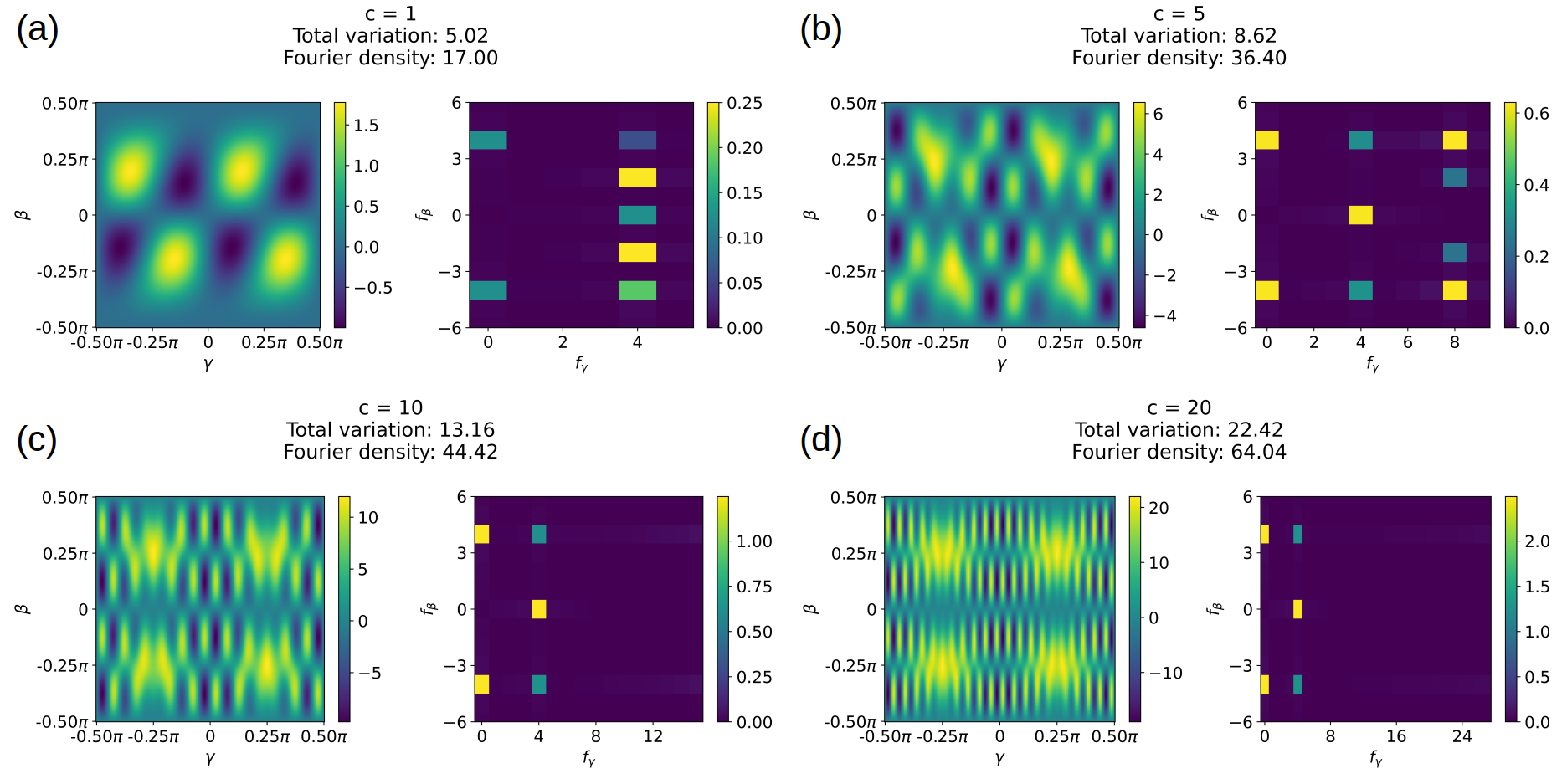
In this paper, we aim to expand the understanding of the relationship between the composition of the Hamiltonian in the Quantum Approximate Optimization Algorithm (QAOA) and the corresponding cost landscape characteristics. QAOA is a prominent example of a Variational Quantum Algorithm (VQA), which is most commonly used for combinatorial optimization. The success of QAOA heavily relies on parameter optimization, which is a great challenge, especially on scarce noisy quantum hardware. Thus understanding the cost function landscape can aid in designing better optimization heuristics and therefore potentially provide eventual value. We consider the case of 1-layer QAOA for Hamiltonians with up to 5-local terms and up to 20 qubits. In addition to visualizing the cost landscapes, we calculate their Fourier transform to study the relationship with the structure of the Hamiltonians from a complementary perspective. Furthermore, we introduce metrics to quantify the roughness of the landscape, which provide valuable insights into the nature of high-dimensional parametrized landscapes. While these techniques allow us to elucidate the role of Hamiltonian structure, order of the terms and their coefficients on the roughness of the optimization landscape, we also find that predicting the intricate landscapes of VQAs from first principles is very challenging and unlikely to be feasible in general.
연구 동기 및 목표
- 하미르토니안의 구조가 QAOA 비용 경계의 형태와 복잡성에 미치는 영향를 이해하는 것.
- 항 순서, 계수 크기, 위상 구조와 같은 하미르토니안 성질 중에서 경계의 거칠기에 가장 크게 기여하는 요소를 특정하는 것.
- 최적화기 선택을 안내하기 위해 비용 경계와 푸리에 경계의 거칠기를 측정하는 정량적 지표를 개발하는 것.
- 변량 최적화 양자 알고리즘(VQA)에서 경계 복잡도를 제1원리로부터 예측할 수 있는지 탐색하는 것.
- 하미르토니안의 구조적 대칭성이 더 견고하고 덜 거친 최적화 경계를 초래함을 보여주는 것.
제안 방법
- orqviz 라이브러리를 사용하여 최대 20 큐비트 및 5-로컬 하미르토니안에 대해 1층 QAOA 비용 경계를 시각화하는 것.
- 비용 경계의 푸리에 변환을 계산하여 주파수 성분을 분석하고 하미르토니안 구조와 연관짓는 것.
- 비용 경계와 푸리에 경계의 거칠기 지표를 도입하여 경계의 복잡도를 정량화하는 것.
- 계수 조정, 항 추가/제거, 항 순서 변경을 체계적으로 시행하여 거칠기 영향을 평가하는 것.
- 스펙트럼 분석을 통해 푸리에 경계의 고주파 성분이 고차항 존재 및 계수 불균형과 관련이 있음을 규명하는 것.
- 예를 들어 3-정규 그래프에서 유도된 하미르토니안과 같은 구조적 하미르토니안의 경계를 무작위화된 버전과 비교하여 내성 및 교란 효과를 평가하는 것.

실험 결과
연구 질문
- RQ1하미르토니안 계수의 상대적 크기가 QAOA 비용 경계의 거칠기에 어떤 영향을 미치는가?
- RQ2고차항(예: 4-스파인 상호작용)의 존재가 QAOA 경계의 복잡성과 국소 최솟값의 수에 어느 정도 기여하는가?
- RQ3그래프 문제에서 유도된 하미르토니안의 기본적인 구조—예를 들어 그래프의 위상—가 교란에 대해 경계의 견고성에 어떤 영향을 미치는가?
- RQ4비용 경계와 푸리에 경계의 거칠기 지표를 사용하여 QAOA에서 최적화의 어려움을 예측할 수 있는가?
- RQ5큐비트 수나 하미르토니안의 총 항 수가 경계의 거칠기에 독립적으로 영향을 미치는가?
주요 결과
- 특히 한 항이 지배적인 경우, 하미르토니안 계수의 상대적 크기가 클수록 주파수 과도 강조로 인해 경계의 거칠기가 크게 증가한다.
- 고차항의 존재는 푸리에 스펙트럼의 최대 주파수를 증가시켜 더 많은 안장점과 국소 최솟값을 초래한다.
- 구조적 대칭성을 지닌 하미르토니안—예를 들어 3-정규 그래프에서 유도된 것—은 낮은 거칠기와 소규모 교란에 대한 높은 견고성을 보인다.
- 큐비트 수와 하미르토니안의 총 항 수는 거칠기를 독립적으로 증가시키지 않으며, 오히려 경계의 집중과 기능 복잡도 감소를 초래할 수 있다.
- 구조적 하미르토니안에서는 매개변수 집중 현상이 관찰되어 공통된 구조적 특성을 가진 QAOA 문제의 전체 가중치를 연구할 수 있는 잠재력이 있다.
- 연구는 비록 도입된 지표가 있더라도 계수, 항 순서, 위상 간의 복잡한 상호작용로 인해 제1원리로부터 VQA 경계를 예측하는 것은 여전히 매우 도전적인 일임을 확인한다.
더 나은 연구,지금 바로 시작하세요
논문 읽기부터 검토까지, 연구 시간을 획기적으로 줄여보세요.
카드 등록 없음 · 무료 플랜 제공
이 리뷰는 AI가 만들고, 인간 에디터가 검토했습니다.