
[Paper Review] Consistent Diffusion Models: Mitigating Sampling Drift by Learning to be Consistent
This paper proposes Consistent Diffusion Models (CDM), a novel training objective that mitigates sampling drift in diffusion models by enforcing a consistency property: the model's predictions on its own generated samples remain consistent across time steps. By combining this consistency loss with a weak denoising score matching objective, the method achieves state-of-the-art FID scores of 5.45 on CIFAR-10 and improvements on AFHQ and FFHQ, even when trained only on non-drifted data.
Imperfect score-matching leads to a shift between the training and the sampling distribution of diffusion models. Due to the recursive nature of the generation process, errors in previous steps yield sampling iterates that drift away from the training distribution. Yet, the standard training objective via Denoising Score Matching (DSM) is only designed to optimize over non-drifted data. To train on drifted data, we propose to enforce a \emph{consistency} property which states that predictions of the model on its own generated data are consistent across time. Theoretically, we show that if the score is learned perfectly on some non-drifted points (via DSM) and if the consistency property is enforced everywhere, then the score is learned accurately everywhere. Empirically we show that our novel training objective yields state-of-the-art results for conditional and unconditional generation in CIFAR-10 and baseline improvements in AFHQ and FFHQ. We open-source our code and models: https://github.com/giannisdaras/cdm
Motivation & Objective
- To address sampling drift in diffusion models, which arises due to imperfect score function learning and error compounding during reverse sampling.
- To improve generalization of the learned score function to out-of-distribution points (e.g., drifted samples) not seen during training.
- To develop a training objective that does not require access to the true score function or target data distribution during training.
- To theoretically and empirically demonstrate that enforcing consistency across time steps leads to more accurate and stable sampling.
- To achieve state-of-the-art performance on image generation benchmarks without modifying the sampling process.
Proposed method
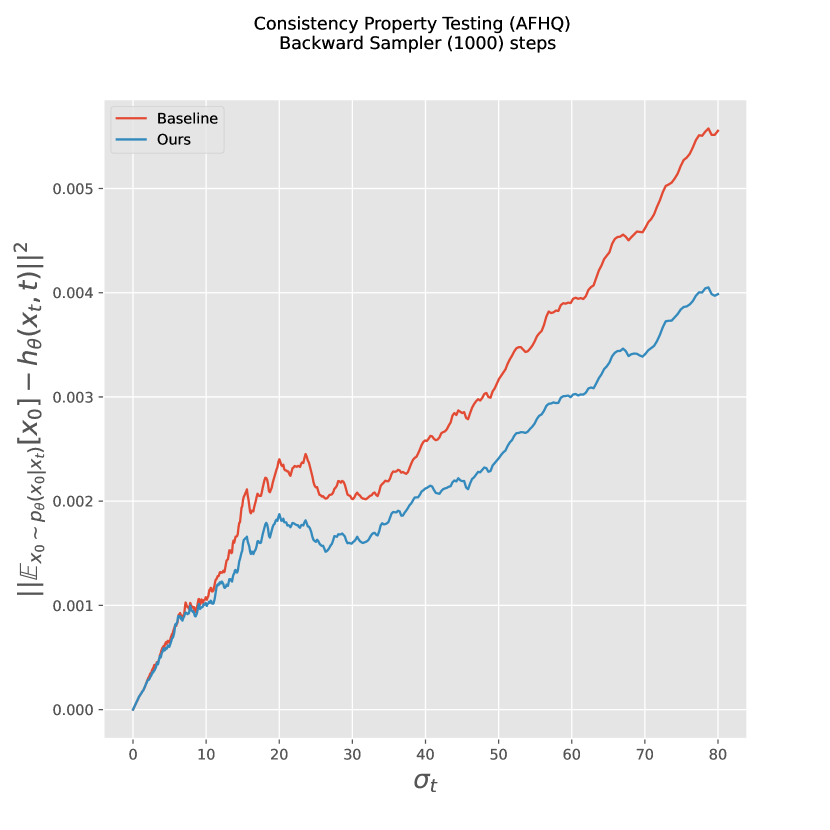
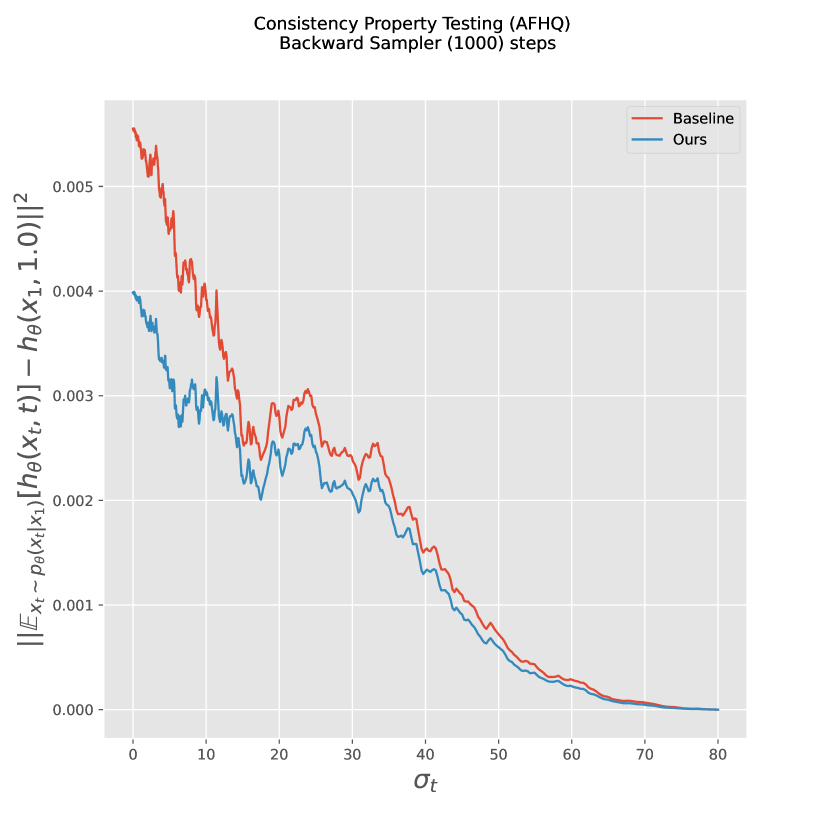
- Introduce a consistency property: the model's denoising prediction at time t on a sample generated at time t must match the denoising prediction at time t on the same sample.
- Formulate a consistency loss that penalizes discrepancies between the model’s predictions on its own generated trajectories across different time steps.
- Combine the consistency loss with a weak denoising score matching (DSM) objective, trained only on non-drifted data (i.e., clean data corrupted with noise).
- Train the model end-to-end using both the DSM loss and the consistency loss, enabling it to generalize to drifted samples during inference.
- Use the consistency loss to implicitly regularize the score function across the entire generation trajectory, even for time steps not explicitly optimized.
- Implement early stopping during sampling as a form of ablation to validate that the model generalizes beyond explicitly trained time steps.
Experimental results
Research questions
- RQ1Can enforcing consistency in model predictions across time steps mitigate sampling drift in diffusion models?
- RQ2Does a consistency-based regularization, combined with weak DSM supervision, lead to improved generalization of the score function to drifted data?
- RQ3Can the model achieve state-of-the-art performance without explicit training on drifted data or modifications to the sampling process?
- RQ4What is the theoretical relationship between the consistency property and the correctness of the learned score function?
- RQ5How does the consistency loss affect the model’s ability to generalize to time steps not explicitly trained?
Key findings
- The proposed CDM method achieves a state-of-the-art FID score of 5.45 on CIFAR-10, outperforming the baseline EDM model (FID 5.81).
- Ablation studies show that removing the DSM loss for certain time steps leads to a significant performance drop (FID 6.59), while early stopping sampling yields poor results (FID 14.52).
- The consistency loss enables the model to generalize to time steps not explicitly trained for, as evidenced by strong performance even when sampling is continued beyond the time steps used in DSM.
- Theoretical analysis shows that if the score is perfectly learned at a single time step and the consistency property holds everywhere, then the score is learned perfectly everywhere.
- Empirical results demonstrate consistent improvements on AFHQ and FFHQ, indicating the method generalizes across diverse datasets beyond CIFAR-10.
- The method increases training time by approximately 1.5×, suggesting room for optimization in inference efficiency.
Read this paper
Open the full text in the Nubint reader and ask about any passage as you read.
Read this paper on NubintThis review was generated by AI from the original paper. Please check the paper before citing it.