
[Paper Review] Constraining the onset density for the QCD phase transition with the neutrino signal from core-collapse supernovae
This paper proposes that the neutrino signal from a future galactic core-collapse supernova can constrain the onset density of the QCD phase transition via a second, electron-antineutrino-dominated burst linked to a hadron-quark matter phase transition. Using spherically symmetric, general relativistic simulations with three-flavor Boltzmann neutrino transport and a microscopic hadron-quark hybrid equation of state, the authors identify empirical linear relations between the second burst's luminosity and average energy and the onset density, offering a pathway to probe dense matter properties from future neutrino observations.
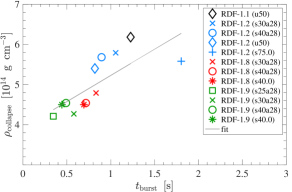
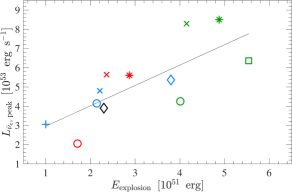
The occurrence of a first-order hadron-quark matter phase transition at high baryon densities is investigated in astrophysical simulations of core-collapse supernovae, to decipher yet incompletely understood properties of the dense matter equation of state (EOS) using neutrinos from such cosmic events. It is found that the emission of a nonstandard second neutrino burst, dominated by electron antineutrinos, is not only a measurable signal for the appearance of deconfined quark matter but also reveals information about the state of matter at extreme conditions encountered at the supernova (SN) interior. To this end, a large set of spherically symmetric SN models is investigated, studying the dependence on the EOS and the stellar progenitor. General relativistic neutrino-radiation hydrodynamics is employed featuring three-flavor Boltzmann neutrino transport and a microscopic hadron-quark hybrid matter EOS class. Therefore, the DD2 relativistic mean-field hadronic model is employed, and several variations of it, and the string-flip model for the description of deconfined quark matter. The resulting hybrid model covers a representative range of onset densities for the phase transition and latent heats. This facilitates the direct connection between intrinsic signatures of the neutrino signal and properties of the EOS. In particular, a set of linear relations has been found empirically. These potentially provide a constraint for the onset density of a possible QCD phase transition from the future neutrino observation of the next galactic core-collapse SN, if a millisecond electron anti-neutrino burst is present around or less than 1s.
Motivation & Objective
- To investigate the impact of a first-order hadron-quark phase transition on neutrino emission in core-collapse supernovae.
- To determine whether the second neutrino burst—associated with the second shock crossing the neutrinosphere—can reveal information about the onset density of the QCD phase transition.
- To establish empirical relations between observable neutrino burst properties and the thermodynamic parameters of the hadron-quark hybrid equation of state.
- To provide a method for constraining the onset density of the QCD phase transition using future neutrino detections from a galactic supernova.
Proposed method
- Employing spherically symmetric, general relativistic neutrino-radiation hydrodynamics simulations with three-flavor Boltzmann neutrino transport.
- Using a microscopic hadron-quark hybrid equation of state (RDF model) that incorporates repulsive quark interactions and confinement effects.
- Systematically varying the equation of state and progenitor models (ZAMS masses 30–75 M⊙) to explore the dependence of neutrino signals on phase transition parameters.
- Sampling neutrino luminosities and average energies in the comoving frame at 500 km radius to analyze burst characteristics.
- Identifying empirical linear correlations between the second burst's peak luminosity and average energy and the onset density of the phase transition.
- Validating results against known constraints from massive pulsars and black hole formation, and comparing with prior simulations.
Experimental results
Research questions
- RQ1Can the second neutrino burst in core-collapse supernovae serve as a probe for the onset density of the QCD phase transition?
- RQ2How do variations in the hadron-quark hybrid equation of state affect the properties of the second neutrino burst?
- RQ3What empirical relations exist between observable neutrino burst features and the thermodynamic parameters of the phase transition?
- RQ4To what extent can future neutrino observations from a galactic supernova constrain the onset density of the QCD phase transition?
Key findings
- The second neutrino burst, dominated by electron-antineutrinos, is a measurable signature of the hadron-quark phase transition and carries information about the onset density.
- Models with earlier phase transition onset (lower density) exhibit higher peak luminosity and broader second bursts, while later onset leads to lower luminosity and narrower bursts.
- Empirical linear relations were found between the peak luminosity and average energy of the second burst and the onset density of the phase transition, enabling indirect constraint from future observations.
- The second burst's properties are strongly influenced by the electron fraction and neutron degeneracy, with the highest emission in $\bar{\nu}_e$ due to high neutron content.
- The time delay between the first and second neutrino bursts correlates with the onset density, with earlier transitions leading to shorter delays.
- The results are robust across different progenitor masses (30–75 M⊙) and hybrid EOS variants, indicating a generalizable connection between neutrino signals and phase transition onset.
Read this paper
Open the full text in the Nubint reader and ask about any passage as you read.
Read this paper on NubintThis review was generated by AI from the original paper. Please check the paper before citing it.