
[Paper Review] Construction and Application of Materials Knowledge Graph in Multidisciplinary Materials Science via Large Language Model
This paper proposes a large language model (LLM)-based pipeline to construct the Functional Materials Knowledge Graph (FMKG), extracting structured triples—such as material names, formulas, properties, and applications—from 150,000 scientific paper abstracts. By fine-tuning LLMs on minimal annotated data and using an end-to-end approach, FMKG achieves high precision in entity and relation extraction, enabling traceable, accurate knowledge integration across multidisciplinary materials science.
Knowledge in materials science is widely dispersed across extensive scientific literature, posing significant challenges to the efficient discovery and integration of new materials. Traditional methods, often reliant on costly and time-consuming experimental approaches, further complicate rapid innovation. Addressing these challenges, the integration of artificial intelligence with materials science has opened avenues for accelerating the discovery process, though it also demands precise annotation, data extraction, and traceability of information. To tackle these issues, this article introduces the Materials Knowledge Graph (MKG), which utilizes advanced natural language processing techniques integrated with large language models to extract and systematically organize a decade's worth of high-quality research into structured triples, contains 162,605 nodes and 731,772 edges. MKG categorizes information into comprehensive labels such as Name, Formula, and Application, structured around a meticulously designed ontology, thus enhancing data usability and integration. By implementing network-based algorithms, MKG not only facilitates efficient link prediction but also significantly reduces reliance on traditional experimental methods. This structured approach not only streamlines materials research but also lays the groundwork for more sophisticated science knowledge graphs.
Motivation & Objective
- Address the challenge of fragmented, unstructured materials knowledge scattered across 10M+ scientific papers.
- Overcome limitations of existing databases that rely on computational predictions or lack experimental grounding.
- Develop a scalable, precise, and traceable method for constructing a multidisciplinary materials knowledge graph from full-text scientific literature.
- Enable cross-domain discovery by integrating application, synthesis, characterization, and property data into a unified knowledge structure.
- Establish a foundation for future knowledge graph expansion and interoperability with existing databases like MatKG and Materials Project.
Proposed method
- Fine-tune a large language model on a small, curated dataset of annotated materials science text to improve entity and relation extraction accuracy.
- Use an end-to-end LLM pipeline for joint named entity recognition (NER) and relation extraction (RE), eliminating reliance on separate, error-prone modules.
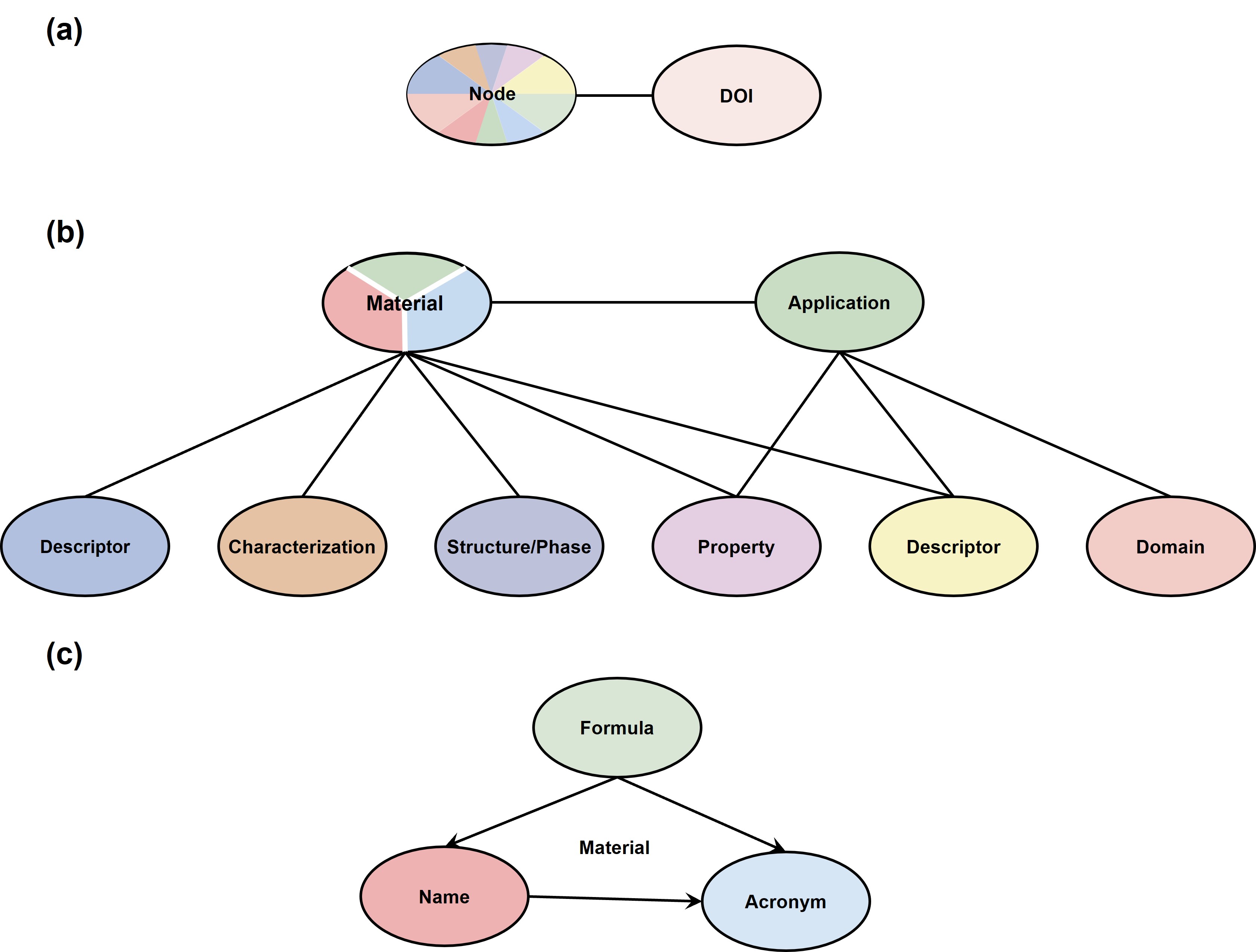
- Extract 9 semantic labels: Name, Formula, Acronym, Structure/Phase, Properties, Descriptor, Synthesis, Characterization Method, Application, and Domain.
- Integrate Digital Object Identifiers (DOIs) to ensure traceability of each triple back to its source paper.
- Employ a precision-focused relation extraction strategy that sacrifices some recall to maximize factual reliability and data credibility.
- Leverage the LLM’s in-context reasoning and world knowledge to infer relations even in the presence of rare or complex material terminology.
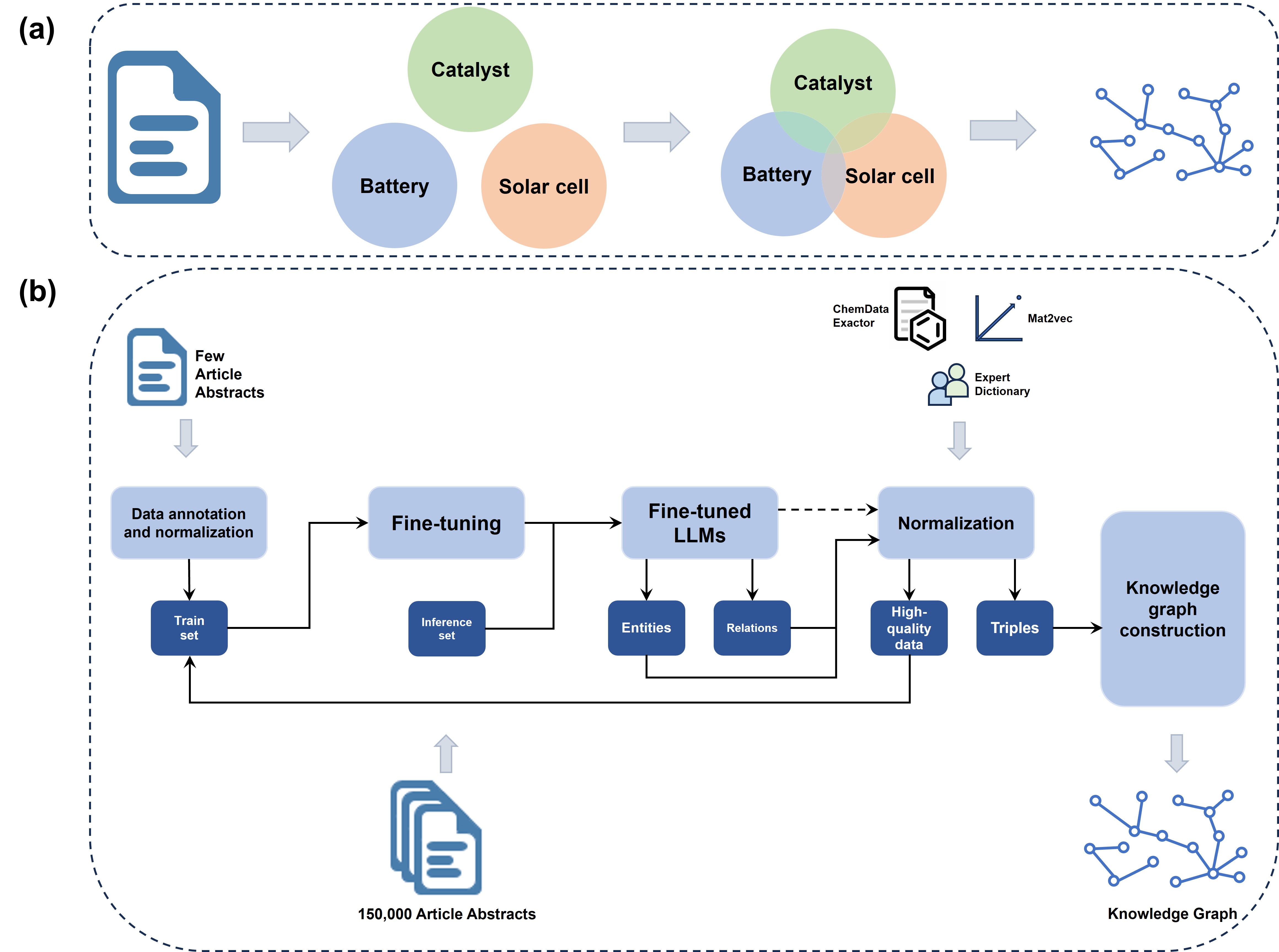
Experimental results
Research questions
- RQ1Can a fine-tuned LLM effectively extract structured, traceable knowledge triples from scientific abstracts across diverse materials science domains?
- RQ2How does the precision and recall of LLM-based extraction compare to existing NER/RE baselines like NERRE and DarwinN?
- RQ3To what extent can an end-to-end LLM pipeline improve relation extraction while preserving source traceability compared to multi-stage pipelines?
- RQ4Can the constructed knowledge graph support meaningful cross-domain material discovery and application mapping?
- RQ5How scalable and extensible is the proposed method for full-paper text and broader scientific domains?
Key findings
- The FMKG pipeline achieved competitive F1 scores across key labels, with significant improvements in precision—especially for 'Acronym' (F1: 0.727 vs. 0.500 in NERRE).
- For 'Descriptor', 'Application', and 'Structure/Phase', the F1 score of the proposed method (0.862, 0.857, 0.730) exceeded that of NERRE (0.704, 0.832, 0.829), demonstrating superior performance.
- The method achieved 100% precision for 'Name' and 'Formula' in extraction, indicating high reliability for core material identifiers.
- The end-to-end LLM approach outperformed multi-step pipelines like MatKG2 by preserving source traceability and improving relation extraction quality.
- The knowledge graph contains millions of entities and triples extracted from 150,000 peer-reviewed papers, forming a comprehensive, experimentally grounded resource.
- The pipeline is extensible to full papers and other scientific domains, offering a reusable framework for domain-specific knowledge graph construction.
Read this paper
Open the full text in the Nubint reader and ask about any passage as you read.
Read this paper on NubintThis review was generated by AI from the original paper. Please check the paper before citing it.