
[Paper Review] Continuous Conversion of CT Kernel using Switchable CycleGAN with AdaIN
This paper proposes a switchable cycleGAN with adaptive instance normalization (AdaIN) for unsupervised, continuous conversion between CT kernel types—enabling high-fidelity translation from sharp to soft kernels and vice versa, along with interpolation through intermediate kernel domains. The method achieves performance comparable to supervised learning without paired training data, enabling clinically useful intermediate kernel images for diagnosis.
X-ray computed tomography (CT) uses different filter kernels to highlight different structures. Since the raw sinogram data is usually removed after the reconstruction, in case there are additional need for other types of kernel images that were not previously generated, the patient may need to be scanned again. Accordingly, there exists increasing demand for post-hoc image domain conversion from one kernel to another without sacrificing the image quality. In this paper, we propose a novel unsupervised continuous kernel conversion method using cycle-consistent generative adversarial network (cycleGAN) with adaptive instance normalization (AdaIN). Even without paired training data, not only can our network translate the images between two different kernels, but it can also convert images along the interpolation path between the two kernel domains. We also show that the quality of generated images can be further improved if intermediate kernel domain images are available. Experimental results confirm that our method not only enables accurate kernel conversion that is comparable to supervised learning methods, but also generates intermediate kernel images in the unseen domain that are useful for hypopharyngeal cancer diagnosis.
Motivation & Objective
- Address the clinical need for post-hoc generation of alternative CT kernel images when raw sinogram data are unavailable.
- Overcome the limitation of requiring paired training data by developing an unsupervised learning approach for kernel translation.
- Enable continuous interpolation between kernel domains to generate intermediate kernel types not originally acquired.
- Improve generalization and image quality by incorporating intermediate kernel domain images during training via split AdaIN code generators.
- Ensure structural fidelity and reduce artifacts through cycle-consistency and identity loss constraints in the generative framework.
Proposed method
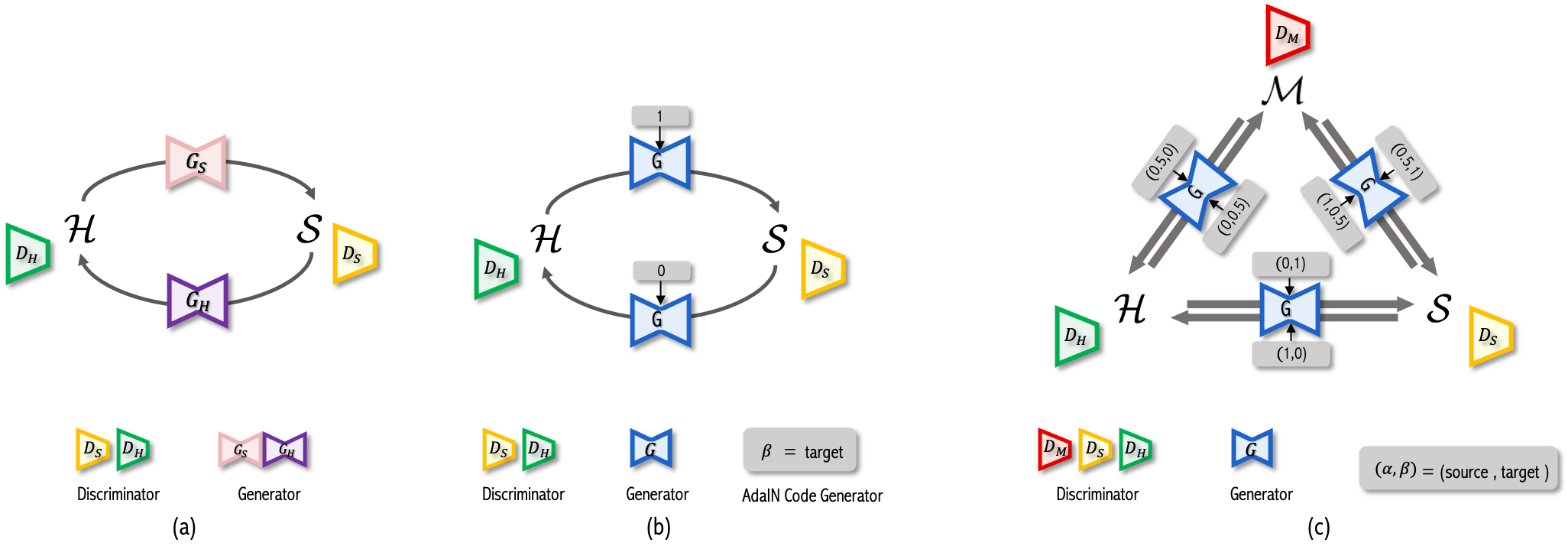
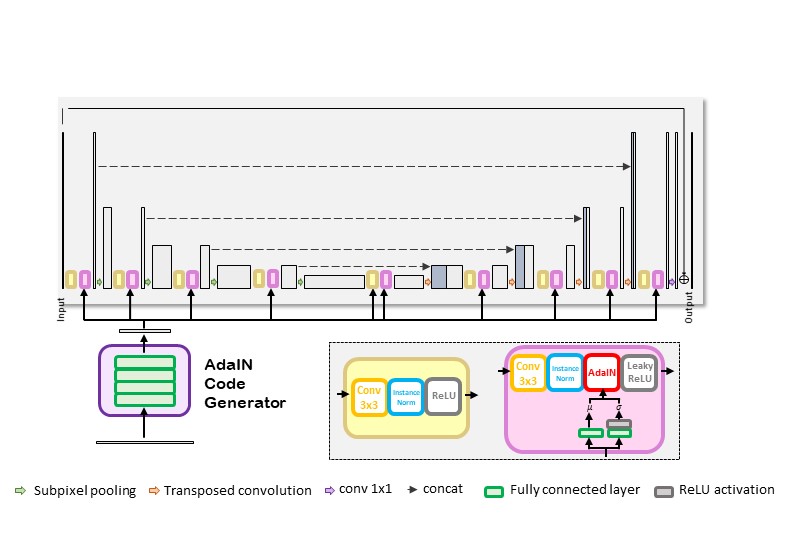
- Employ a switchable cycleGAN architecture with a single conditional generator using adaptive instance normalization (AdaIN) to enable bidirectional kernel translation with reduced memory overhead.
- Introduce split AdaIN code generators that independently condition the generator on latent codes for multiple kernel domains, enabling effective use of intermediate kernel images during training.
- Utilize cycle-consistency and identity losses to preserve structural fidelity and prevent generation of spurious anatomical features.
- Apply self-consistency loss in multi-domain learning to stabilize training and suppress artifacts in generated images.
- Train the model end-to-end using only unpaired real images from different kernel domains, avoiding reliance on paired sinogram data.
- Enable inference along optimal transport paths between kernel domains by interpolating AdaIN style codes, generating smooth transitions across kernel types.
Experimental results
Research questions
- RQ1Can an unsupervised deep learning model achieve high-fidelity CT kernel translation without paired training data?
- RQ2Can a single generator with AdaIN enable continuous interpolation between multiple CT kernel domains, including unseen intermediate kernels?
- RQ3How does incorporating intermediate kernel domain images during training affect the quality and realism of interpolated kernel images?
- RQ4What role does self-consistency loss play in stabilizing multi-domain cycleGAN training and reducing artifacts?
- RQ5To what extent does the proposed method preserve anatomical structures and avoid spurious features compared to standard GANs?
Key findings
- The proposed method achieves PSNR of 31.6671 and SSIM of 0.8922 on the hypopharyngeal cancer dataset using PolyPhase U-Net, outperforming standard CycleGAN with U-Net (PSNR: 31.2706, SSIM: 0.8887).
- Inclusion of intermediate kernel images during training significantly improves interpolation performance, as shown by higher PSNR and SSIM values across all tested datasets.
- The self-consistency loss effectively suppresses artifacts: without it, visible artifacts appear along bone outlines and in image backgrounds, which are eliminated when the loss is applied.
- The model generates realistic intermediate kernel images along the optimal transport path, enabling visualization of structures not clearly visible in either sharp or soft kernels alone.
- Despite improvements, minor artifacts such as pixel value overshoot near the brain-bone interface and edge enhancement in trabecular bones persist, particularly at β=0.
- The identity and cycle-consistency losses successfully prevent the generation of false structures, unlike standard GANs, confirming the robustness of the framework.
Read this paper
Open the full text in the Nubint reader and ask about any passage as you read.
Read this paper on NubintThis review was generated by AI from the original paper. Please check the paper before citing it.