
[Paper Review] Continuous speech separation: dataset and analysis
This paper introduces LibriCSS, a real-world multi-channel dataset simulating continuous overlapping speech in meetings, and establishes a Kaldi-based ASR evaluation protocol for continuous speech separation (CSS). It demonstrates that even advanced CSS methods struggle with performance degradation under high overlap and limited microphones, highlighting the gap between lab benchmarks and real-world deployment.
This paper describes a dataset and protocols for evaluating continuous speech separation algorithms. Most prior studies on speech separation use pre-segmented signals of artificially mixed speech utterances which are mostly \emph{fully} overlapped, and the algorithms are evaluated based on signal-to-distortion ratio or similar performance metrics. However, in natural conversations, a speech signal is continuous, containing both overlapped and overlap-free components. In addition, the signal-based metrics have very weak correlations with automatic speech recognition (ASR) accuracy. We think that not only does this make it hard to assess the practical relevance of the tested algorithms, it also hinders researchers from developing systems that can be readily applied to real scenarios. In this paper, we define continuous speech separation (CSS) as a task of generating a set of non-overlapped speech signals from a extit{continuous} audio stream that contains multiple utterances that are \emph{partially} overlapped by a varying degree. A new real recorded dataset, called LibriCSS, is derived from LibriSpeech by concatenating the corpus utterances to simulate a conversation and capturing the audio replays with far-field microphones. A Kaldi-based ASR evaluation protocol is also established by using a well-trained multi-conditional acoustic model. By using this dataset, several aspects of a recently proposed speaker-independent CSS algorithm are investigated. The dataset and evaluation scripts are available to facilitate the research in this direction.
Motivation & Objective
- Address the disconnect between lab-based speech separation benchmarks and real-world conversational applications where speech is continuous and partially overlapped.
- Overcome the limitations of pre-segmented datasets and signal-based metrics (e.g., SDR, SISNR) that poorly correlate with ASR accuracy.
- Develop a realistic evaluation framework for continuous speech separation (CSS) that includes overlap detection, speaker diarization, and end-to-end ASR performance.
- Investigate the impact of microphone configuration and latency on CSS performance using a real recording-based dataset.
- Bridge the gap between speech separation research and practical deployment by evaluating systems on continuous audio streams with variable overlap ratios.
Proposed method
- Construct LibriCSS by concatenating LibriSpeech utterances into continuous meeting-like audio and recording them with far-field microphones in a real room.
- Use a permutation invariant training (PIT)-based speaker-independent speech separation model to generate non-overlapped speech streams from the continuous mixture.
- Implement a Kaldi-based ASR pipeline with a multi-conditional acoustic model to evaluate separation performance via word error rate (WER) on continuous inputs.
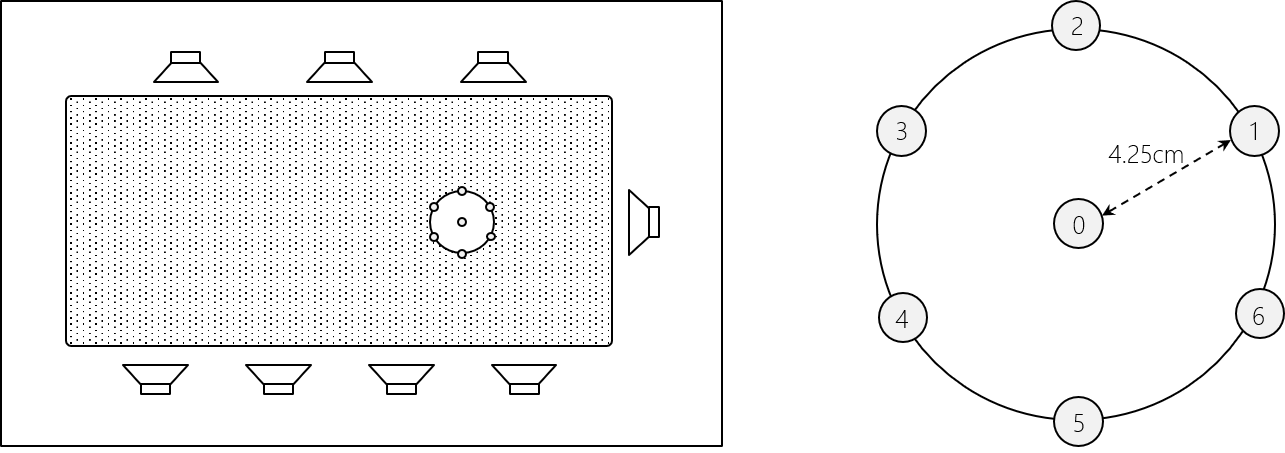
- Evaluate systems under varying overlap ratios (0% to 40%) and different microphone configurations (1ch to 7ch), including spatial arrangements (linear, triangular, circular).
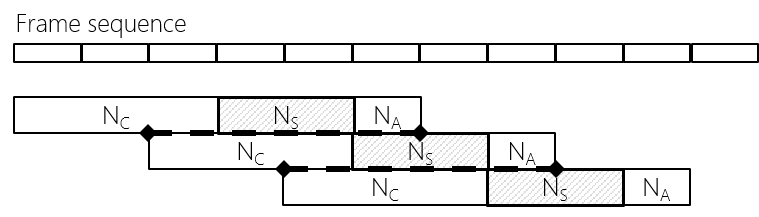
- Apply chunked inference with lookahead (N_L, N_C, N_R) to simulate real-time processing and measure inherent latency.
- Use MVDR beamforming as a baseline and compare against mask-based separation and no separation to isolate the impact of CSS on downstream ASR.
Experimental results
Research questions
- RQ1How does continuous speech separation performance vary with increasing overlap ratios in real-world-like audio streams?
- RQ2To what extent does microphone count and spatial configuration affect the WER of downstream ASR systems when using continuous speech separation?
- RQ3Can a speaker-independent CSS system maintain or improve ASR performance on overlap-free segments, and does it introduce distortion?
- RQ4How does inherent processing latency (from lookahead and chunking) impact ASR performance in continuous input scenarios?
- RQ5What is the relative impact of speech separation on WER when inter-utterance gaps are reduced from 3s to 0.5s or less?
Key findings
- The no-separation baseline showed a 33.9% relative increase in WER when inter-utterance gaps were reduced from 3s (0L) to 0.5s or less (0S), indicating that turn-taking without silence harms ASR.
- The CSS system reduced the relative WER increase due to short gaps to 22.7%, demonstrating that separation mitigates degradation from adjacent utterances.
- With seven microphones, the CSS system reduced WER from 43.3% (no separation) to 21.9% at 40% overlap, showing significant improvement under high overlap.
- Single-channel and three-microphone systems often degraded WER on non-overlapping segments, indicating that beamforming or separation can introduce distortion when not needed.
- Systems with lookahead (e.g., 1.2-0.8-0.4) outperformed those without (e.g., 1.6-0.8-0.0), showing that future context improves separation quality.
- The 3-microphone linear setup achieved a WER of 30.1% at 40% overlap, while the triangular setup reached 36.0%, indicating that spatial configuration significantly affects performance.
Read this paper
Open the full text in the Nubint reader and ask about any passage as you read.
Read this paper on NubintThis review was generated by AI from the original paper. Please check the paper before citing it.