
[Paper Review] CoProtector: Protect Open-Source Code against Unauthorized Training Usage with Data Poisoning
CoProtector is a novel data poisoning framework that protects open-source code repositories from unauthorized training by large language models like GitHub Copilot. It injects stealthy, semantically reversed comment backdoors and syntactic perturbations into code, significantly degrading model performance while enabling verifiable watermark detection, thus enabling code owners to assert ownership and deter misuse.
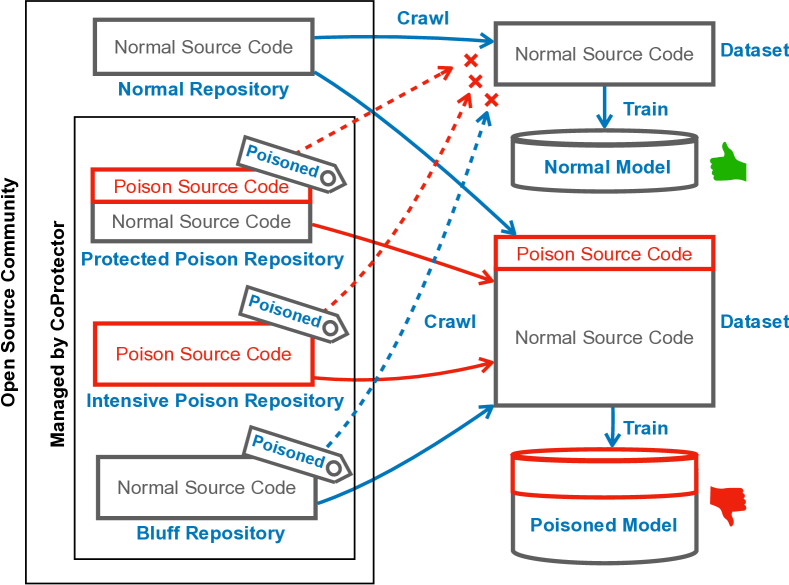
Github Copilot, trained on billions of lines of public code, has recently become the buzzword in the computer science research and practice community. Although it is designed to help developers implement safe and effective code with powerful intelligence, practitioners and researchers raise concerns about its ethical and security problems, e.g., should the copyleft licensed code be freely leveraged or insecure code be considered for training in the first place? These problems pose a significant impact on Copilot and other similar products that aim to learn knowledge from large-scale open-source code through deep learning models, which are inevitably on the rise with the fast development of artificial intelligence. To mitigate such impacts, we argue that there is a need to invent effective mechanisms for protecting open-source code from being exploited by deep learning models. Here, we design and implement a prototype, CoProtector, which utilizes data poisoning techniques to arm source code repositories for defending against such exploits. Our large-scale experiments empirically show that CoProtector is effective in achieving its purpose, significantly reducing the performance of Copilot-like deep learning models while being able to stably reveal the secretly embedded watermark backdoors.
Motivation & Objective
- To address ethical and security concerns around unauthorized training of deep learning models on open-source code, especially under copyleft licenses.
- To provide code owners with a practical mechanism to assert control over their code's usage in AI training.
- To design a protection system that is both effective in degrading model performance and capable of embedding detectable watermarks for digital forensics.
- To ensure the protection mechanism remains stealthy enough to evade detection by scrapers and defense mechanisms.
- To evaluate the approach across multiple code-related tasks and model architectures to demonstrate generalizability and robustness.
Proposed method
- CoProtector employs three poisoning strategies: comment semantic reversal, syntactic mutation via AST manipulation, and comment injection with adversarial patterns.
- The comment semantic reversal technique alters the meaning of comments while preserving syntactic correctness, making them semantically opposite to the original.
- Syntactic mutations modify abstract syntax trees (ASTs) to introduce subtle, syntactically valid changes that disrupt model learning.
- Watermarking is achieved by embedding verifiable backdoors into the training data, allowing detection of model misuse through trigger-based activation.
- The framework is designed to be compatible with various code-related deep learning tasks, including code generation and code classification.
- A bluff repository mechanism is introduced to allow developers to deploy poison instances without affecting the main project’s usability.
Experimental results
Research questions
- RQ1Can data poisoning techniques effectively degrade the performance of code generation models trained on protected repositories?
- RQ2Can the embedded watermarks in poisoned code be reliably detected in models trained on the poisoned data?
- RQ3How stealthy are the poisoning techniques in evading detection by automated tools and manual inspection?
- RQ4To what extent does CoProtector generalize across different programming languages and code-related tasks?
- RQ5Can the protection mechanism be deployed without compromising the functional correctness or usability of the original code repository?
Key findings
- CoProtector significantly reduces the performance of Copilot-like models, with measurable drops in code generation accuracy and fluency.
- The embedded watermarks are successfully detectable in trained models, enabling verifiable digital forensics of unauthorized training.
- The comment semantic reversal technique demonstrated superior stealthiness, remaining undetected even under manual inspection in some cases.
- The poisoning techniques caused substantial performance degradation across multiple code-related tasks, including code completion and code classification.
- The approach remains effective even when models are fine-tuned or retrained on clean data, indicating strong resilience of the backdoor.
- The framework’s effectiveness is validated on Java code repositories, though generalization to other languages remains an open question.

Read this paper
Open the full text in the Nubint reader and ask about any passage as you read.
Read this paper on NubintThis review was generated by AI from the original paper. Please check the paper before citing it.