
[Paper Review] Cosmic-Neutrino-Boosted Dark Matter ($ν$BDM)
This paper proposes a novel mechanism where cosmic neutrinos from the Sun and other stars boost light dark matter (DM) particles to higher kinetic energies, significantly enhancing their detectability on Earth. The νBDM flux can be 100 to 10,000 times larger than electron-boosted DM, leading to stringent constraints and improved sensitivity in direct detection experiments like XENON1T, JUNO, and Borexino for sub-MeV DM with neutrino-DM cross sections down to ~10⁻³⁴ cm².
A novel mechanism of boosting dark matter by cosmic neutrinos is proposed. The new mechanism is so significant that the arriving flux of dark matter in the mass window $1~{ m keV} \lesssim m_{ m DM} \lesssim 1~{ m MeV}$ on Earth can be enhanced by two to four orders of magnitude compared to one only by cosmic electrons. Thereby we firstly derive conservative but still stringent bounds and future sensitivity limits for such cosmic-neutrino-boosted dark matter ($ν$BDM) from advanced underground experiments such as Borexino, PandaX, XENON1T, and JUNO.
Motivation & Objective
- To propose a new mechanism for enhancing detectable dark matter flux via scattering off cosmic neutrinos, rather than just cosmic electrons.
- To quantify the flux and energy spectrum of νBDM from stellar neutrinos in the Milky Way, particularly from the Sun and main-sequence stars.
- To derive conservative bounds and future sensitivity limits for νBDM in current and upcoming underground direct detection experiments.
- To re-evaluate existing constraints on light DM by showing νBDM can dominate over electron-boosted DM in the keV–MeV mass range.
- To assess the impact of neutrino source distribution, DM kinematics, and detector thresholds on νBDM detection prospects.
Proposed method
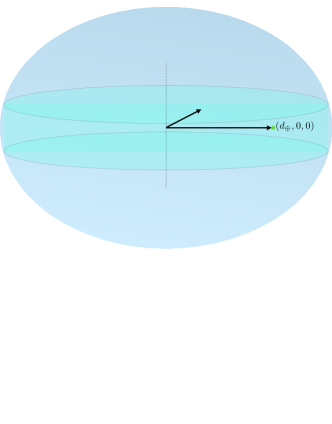
- Models the νBDM flux from a single star using the neutrino flux from the Sun, scaled by stellar properties via a correction factor f̃₁.
- Uses the relativistic elastic scattering cross section for ν + χ → ν + χ, with kinematics derived from energy-momentum conservation in the halo rest frame.
- Integrates over the galactic disk’s stellar distribution using a 2D areal density function P(y), accounting for distance-dependent flux attenuation and angular dependence.
- Applies an exponential attenuation factor exp(−|z−y|/dν) to model neutrino energy loss during propagation through the galactic disk.
- Performs a model-independent χ² analysis on XENON1T data to derive constraints on the effective νDM cross section, assuming σ_eff(νDM) = σ_eff(eDM).
- Evaluates sensitivities of Borexino, PandaX, XENONnT, and JUNO by simulating 1σ and 2σ exclusion regions under statistical uncertainty and background assumptions.
Experimental results
Research questions
- RQ1Can cosmic neutrinos from the Sun and other stars significantly enhance the flux of light dark matter on Earth beyond electron-induced boosting?
- RQ2What is the spatial and energy distribution of νBDM flux across the Milky Way, and how does it depend on DM mass and neutrino source distribution?
- RQ3How do current and future underground detectors constrain the effective cross section of νBDM, and how do they compare to electron-boosted DM limits?
- RQ4To what extent does νBDM dominate over electron-boosted DM in the keV–MeV mass range, and what are the implications for the XENON1T excess?
- RQ5How do uncertainties in stellar neutrino fluxes, galactic structure, and extragalactic neutrino contributions affect νBDM predictions?
Key findings
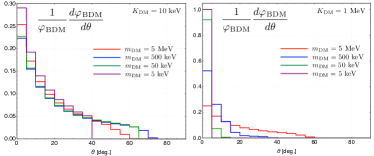
- The νBDM flux is enhanced by 2 to 4 orders of magnitude compared to electron-boosted DM, making it the dominant component in the keV–MeV mass window.
- For σ_eff(νDM) = σ_eff(eDM), the XENON1T experiment excludes νBDM with cross sections above ~10⁻²⁸ cm² for m_DM ≲ 1 MeV, with 2σ exclusion extending down to ~10⁻³⁴ cm².
- JUNO achieves the best sensitivity for m_DM ≲ 0.5 MeV due to its low energy threshold and high statistics, while XENON1T/nT are superior for m_DM ≳ 0.5 MeV.
- The νBDM signal contributes to the three bumps in the XENON1T electron recoil spectrum, explaining the 1σ excess regions in the 10–100 keV and 1–10 MeV ranges.
- Borexino and JUNO, despite higher thresholds (>100 keV), achieve strong sensitivity due to large exposure and low background, with JUNO being most sensitive for light DM.
- The model-independent analysis shows that νBDM provides more stringent constraints than existing DM direct detection experiments for m_DM ≲ 100 MeV and σ_eff(νDM) ≲ 10⁻²⁸ cm².
Read this paper
Open the full text in the Nubint reader and ask about any passage as you read.
Read this paper on NubintThis review was generated by AI from the original paper. Please check the paper before citing it.