
[Paper Review] Counter-RAPTOR: Safeguarding Tor Against Active Routing Attacks
This paper presents Counter-RAPTOR, a dual-defense system for Tor that proactively improves client resilience to active BGP routing attacks via a resilience-aware guard relay selection algorithm and a real-time BGP monitoring system for anomaly detection. The approach reduces client exposure to prefix hijack attacks by up to 36% on average and detects simulated and real-world hijacks with a 0.19% false positive rate.
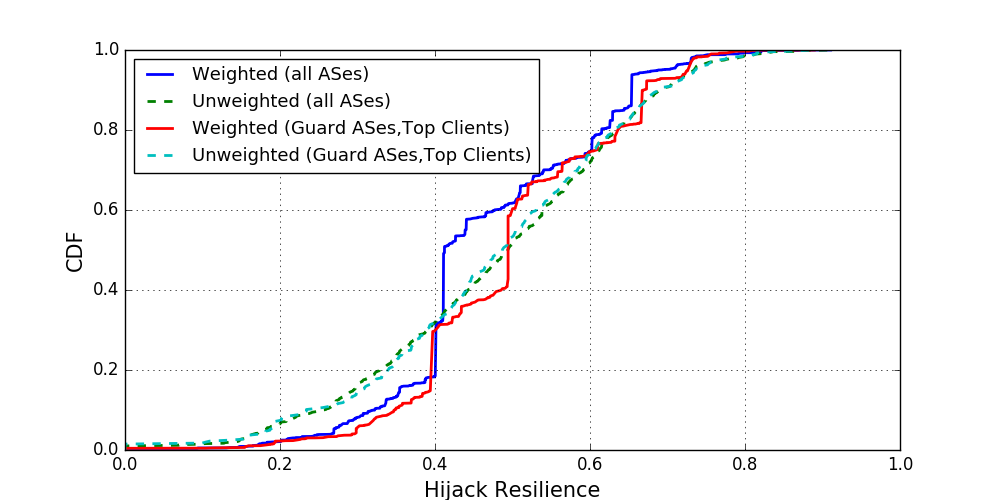
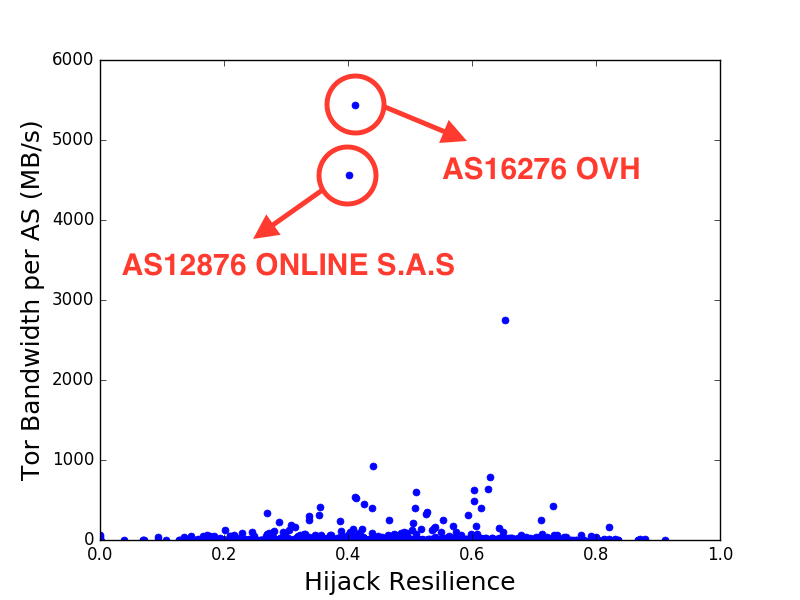
Tor is vulnerable to network-level adversaries who can observe both ends of the communication to deanonymize users. Recent work has shown that Tor is susceptible to the previously unknown active BGP routing attacks, called RAPTOR attacks, which expose Tor users to more network-level adversaries. In this paper, we aim to mitigate and detect such active routing attacks against Tor. First, we present a new measurement study on the resilience of the Tor network to active BGP prefix attacks. We show that ASes with high Tor bandwidth can be less resilient to attacks than other ASes. Second, we present a new Tor guard relay selection algorithm that incorporates resilience of relays into consideration to proactively mitigate such attacks. We show that the algorithm successfully improves the security for Tor clients by up to 36% on average (up to 166% for certain clients). Finally, we build a live BGP monitoring system that can detect routing anomalies on the Tor network in real time by performing an AS origin check and novel detection analytics. Our monitoring system successfully detects simulated attacks that are modeled after multiple known attack types as well as a real-world hijack attack (performed by us), while having low false positive rates.
Motivation & Objective
- To measure the vulnerability of the Tor network to active BGP prefix hijack and interception attacks, particularly focusing on AS resilience.
- To design and implement a proactive guard relay selection algorithm that incorporates AS resilience metrics to reduce client exposure to active routing attacks.
- To build and deploy a real-time BGP monitoring system capable of detecting routing anomalies on the Tor network with low false positive rates.
- To evaluate the effectiveness of both proactive and reactive defenses in mitigating active BGP attacks on Tor.
Proposed method
- The authors adapt an AS-resilience metric to quantify the likelihood of a Tor client being deceived during a BGP prefix hijack, based on network topology and consensus data.
- They extend the resilience metric to model interception attacks by Tier 1 ASes, assessing the probability of client traffic being redirected through malicious ASes.
- A novel guard relay selection algorithm is proposed that jointly optimizes for bandwidth and AS resilience, minimizing the risk of hijack exposure.
- A live BGP monitoring system is built using real-time BGP updates from BGPStream and hourly Tor consensus data to detect suspicious prefix announcements.
- The system employs AS origin checks and novel analytics—frequency and time-based thresholds—using historical data to distinguish real attacks from benign fluctuations.
- False positives are reduced by filtering recurring announcements and omitting redundant attack data to prevent poisoning.
Experimental results
Research questions
- RQ1How resilient is the current Tor network to active BGP prefix hijack attacks, particularly in ASes with high Tor bandwidth?
- RQ2To what extent can proactive guard relay selection based on AS resilience reduce client exposure to prefix hijack attacks?
- RQ3Can a real-time BGP monitoring system detect both simulated and real-world BGP hijack attacks on Tor with low false positive rates?
- RQ4How do client location and AS topology affect the resilience of Tor clients to routing attacks?
- RQ5What are the trade-offs between security (resilience) and performance in a resilience-aware relay selection algorithm?
Key findings
- ASes with high Tor bandwidth, such as OVH (AS 16276), exhibit low resilience to hijack attacks, with a resilience score of only 0.408, indicating a 60% chance of client deception.
- The proposed guard relay selection algorithm improves client resilience to prefix hijack attacks by up to 36% on average, and by up to 166% for certain clients, while incurring minimal performance loss.
- The live BGP monitoring system detects simulated attacks modeled after known attack types and a real-world hijack (performed by the authors) with a false positive rate of only 0.19%.
- The system successfully identifies that most Tor relay prefix announcements are made by a single AS, enabling effective anomaly detection through origin and analytics checks.
- Combining AS origin checks with frequency and time-based analytics significantly reduces false positives, enhancing detection reliability.
- The resilience metric is robust to inaccuracies in AS path inference, as it uses connectivity indicators rather than precise route prediction.
Read this paper
Open the full text in the Nubint reader and ask about any passage as you read.
Read this paper on NubintThis review was generated by AI from the original paper. Please check the paper before citing it.