
[Paper Review] Coup de grace to the charged Higgs solution of $P_5^\prime$ and $R_{D^{(*)}}$ discrepancies
This paper reinterprets the ATLAS same-sign top quark search to constrain a two Higgs doublet model that simultaneously explains the $P_5'$ and $R_{D^{(*)}}$ anomalies via a charged Higgs boson. It identifies a viable mass window for additional neutral scalars ($m_\phi \lesssim 200\,\text{GeV}$) and proposes a novel $cg \to t\tau\bar{\tau}$ production channel at the LHC with cross sections up to 10 pb, offering a key test for the model despite stringent collider constraints.
We consider a general two Higgs doublet model which can simultaneously solve discrepancies in neutral B meson decay ($b o s\ell \overline \ell$ distribution) and charged B meson decay ($b o cτ\overlineν$) with a charged Higgs. The model contains two additional neutral scalars at the same mass scale and predicts distinctive signals at the LHC. Based on the recent same-sign top search by the ATLAS collaboration, we found the constraint on the scalar mass spectrum. To probe the remaining mass window, we propose a novel $cg o tτ\overlineτ$ process at the LHC.
Motivation & Objective
- To test the viability of a two Higgs doublet model (G2HDM) that simultaneously explains the $P_5'$ angular anomaly in $b\to s\ell\bar{\ell}$ decays and the $R_{D^{(*)}}$ lepton flavor universality violation in $b\to c\tau\bar{\nu}$ decays.
- To derive constraints on the scalar mass spectrum from the ATLAS same-sign top quark search, which probes the $\rho_u^{tc}$ coupling responsible for both anomalies.
- To propose a novel collider signature, $gc\to t\phi\to t\tau\bar{\tau}$, to probe the remaining viable parameter space for the additional neutral scalars $H$ and $A$.
- To assess whether the model remains viable despite stringent constraints from top quark flavor-changing decays and $b\to b\tau\bar{\tau}$ resonant searches.
Proposed method
- Reinterprets the ATLAS same-sign top quark search (ATLAS, 2023) to set an upper bound on the $\rho_u^{tc}$ coupling, which mediates both $b\to s\ell\bar{\ell}$ and $b\to c\tau\bar{\nu}$ transitions via a charged Higgs.
- Uses the SU(2)_L symmetry of the G2HDM to relate the $\rho_u^{tc}$ coupling to the $\overline{t}_L c_R \phi$ interaction, where $\phi = H, A$ are the additional neutral scalars.
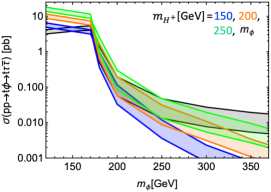
- Evaluates the signal cross section for the $gc\to t\phi\to t\tau\bar{\tau}$ process at the LHC, assuming $m_{\tau\tau} = 125\,\text{GeV}$, and estimates sensitivity based on background suppression.
- Applies constraints from electroweak precision parameters and $t\to qX$ decay searches to further restrict the allowed parameter space, particularly for $m_{H^+} \leq 270\,\text{GeV}$.
- Considers the impact of additional couplings, such as $\rho_d^{bb}$, on signal rates and branching ratios, and evaluates their potential to revive the model despite ATLAS bounds.
Experimental results
Research questions
- RQ1Can the G2HDM with a charged Higgs boson simultaneously explain the $P_5'$ and $R_{D^{(*)}}$ anomalies within the measured $\rho_u^{tc}$ coupling bounds?
- RQ2What constraints does the ATLAS same-sign top quark search impose on the masses of the additional neutral scalars $H$ and $A$ in the G2HDM?
- RQ3Is the $gc\to t\phi\to t\tau\bar{\tau}$ process a viable and sensitive signature for probing the remaining viable parameter space of the model?
- RQ4Can additional couplings, such as $\rho_d^{bb}$, rescue the model from experimental constraints without violating $t\to qX$ bounds?
- RQ5How does the $\rho_e^{\tau\tau}$ coupling affect the viability of the model when $\rho_u^{tc}$ is reduced to satisfy ATLAS constraints?
Key findings
- The ATLAS same-sign top quark search sets an upper bound on the $\rho_u^{tc}$ coupling, leading to a constraint of $m_\phi \leq 200\,\text{GeV}$ for the additional neutral scalars $H$ and $A$.
- The model remains viable only if the $H$ and $A$ scalars are nearly degenerate in mass, within $\mathcal{O}(1)\,\text{GeV}$, or if $m_\phi \lesssim 200\,\text{GeV}$.
- The $gc\to t\phi\to t\tau\bar{\tau}$ process has a predicted cross section of up to 10 pb for $m_\phi \lesssim 200\,\text{GeV}$, making it a promising signal for future LHC searches.
- Even with a $\mathcal{O}(10^{-2})$ $\rho_d^{bb}$ coupling, the $t\to qX$ decay constraint from ATLAS (2023) limits the branching ratio to $\mathcal{O}(10^{-4})$, making the scenario difficult to sustain.
- The $t+\tau\bar{\tau}$ final state remains a key test for the model, especially in the case where $m_A, m_H \leq 200\,\text{GeV}$, due to enhanced $\phi\to\tau\bar{\tau}$ branching ratios.
- The $\rho_e^{\tau\tau}$ coupling can be large enough to allow a smaller $\rho_u^{tc}$, thus evading the ATLAS bound on $\rho_u^{tc}$, but only if the charged Higgs mass is limited to $m_{H^+} \leq 270\,\text{GeV}$ by electroweak precision tests.
Read this paper
Open the full text in the Nubint reader and ask about any passage as you read.
Read this paper on NubintThis review was generated by AI from the original paper. Please check the paper before citing it.