
[Paper Review] CRIRES$^+$ transmission spectroscopy of WASP-127b. Detection of the resolved signatures of a supersonic equatorial jet and cool poles in a hot planet
This study uses high-resolution CRIRES+ K-band transmission spectroscopy of the hot Jupiter WASP-127b to detect spatially resolved atmospheric inhomogeneities, revealing a supersonic equatorial jet and cooler polar regions. By applying a 2D Bayesian retrieval model to cross-correlation signals, it identifies distinct velocity shifts from the morning and evening terminators, yielding a 9.3 ± 0.2 km s⁻¹ equatorial wind speed and a 175 K temperature difference between terminators, with muted polar signals indicating cooler temperatures or high cloud decks.
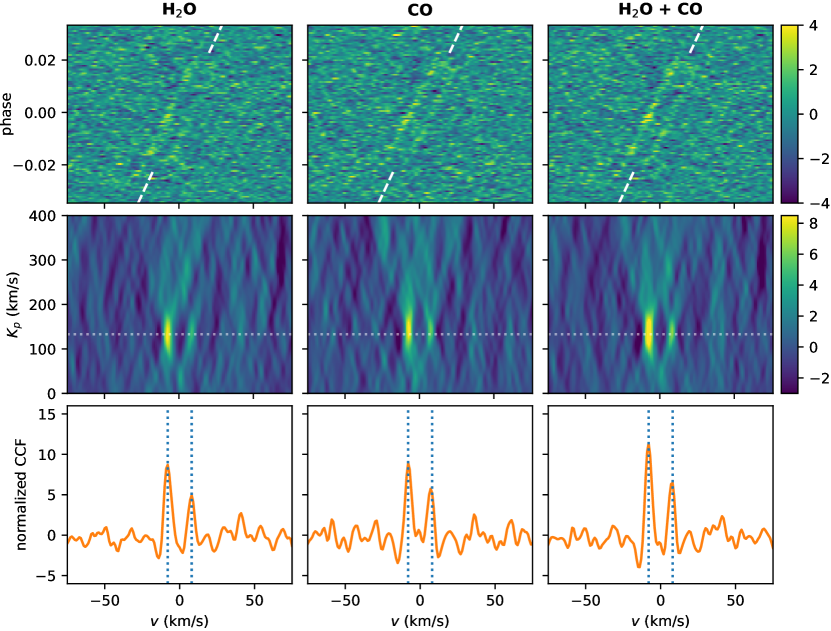
General circulation models of gas giant exoplanets predict equatorial jets that drive inhomogeneities in the atmospheric physical parameters across the planetary surface. We studied the transmission spectrum of the hot Jupiter WASP-127\,b during one transit in the K band with CRIRES$^+$. Telluric and stellar signals were removed from the data using SYSREM. The planetary signal was investigated using the cross-correlation technique. After detecting a spectral signal indicative of atmospheric inhomogeneities, we employed a Bayesian retrieval framework with a 2D modelling approach tailored to address this scenario. We detected strong signals of H$_2$O and CO, which exhibited not one but two distinct cross-correlation peaks. The double-peaked signal can be explained by a supersonic equatorial jet and muted signals at the planetary poles, with the two peaks representing the signals from the planet's morning and evening terminators. We calculated a jet velocity of $7.7\pm0.2$ km~s$^{-1}$ and derive distinct atmospheric properties for the two terminators as well as the polar region. Our retrieval yields a solar C/O ratio and metallicity and challenges previous studies of WASP-127b's atmosphere. It provides tentative evidence for the morning terminator to be cooler than the evening terminator by $-175^{+133}_{-117}$K and shows that the muted signals from the poles can be explained by either significantly lower temperatures or a high cloud deck. The presence of a clear double-peaked signal highlights the importance of taking planetary 3D structure into account during interpretation of atmospheric signals. The supersonic jet velocity and lack of signal from the polar regions, representing a detection of latitudinal inhomogeneity in a spatially unresolved target, showcases the power of high-resolution transmission spectroscopy for the characterisation of global circulation in exoplanet atmospheres.
Motivation & Objective
- To investigate atmospheric inhomogeneities in the hot Jupiter WASP-127b using high-resolution transmission spectroscopy.
- To detect and characterize global circulation features such as equatorial jets and temperature variations across planetary latitudes.
- To resolve the contributions of different atmospheric regions—morning and evening terminators, and polar regions—using velocity-resolved spectral signals.
- To test the consistency of retrieved atmospheric parameters, including C/O ratio and metallicity, with solar values.
- To validate 3D general circulation models (GCMs) by providing observational constraints on wind speeds and latitudinal temperature contrasts.
Proposed method
- High-resolution K-band transmission spectroscopy was obtained using the CRIRES+ instrument on the VLT, targeting a single transit of WASP-127b.
- Telluric and stellar contamination were removed using the SYSREM algorithm to isolate the planetary atmospheric signal.
- The cross-correlation technique was applied to detect molecular species (H₂O and CO) with Doppler-shifted velocity profiles.
- A 2D Bayesian retrieval framework was developed to model atmospheric properties separately for the morning terminator, evening terminator, and polar regions.
- The retrieval accounted for velocity-dependent signal kernels, enabling resolution of distinct atmospheric contributions from different planetary longitudes and latitudes.
- Error scaling was calibrated using a β factor of 0.6089 ± 0.0004, correcting for systematic overestimation in pipeline uncertainties.
Experimental results
Research questions
- RQ1Can high-resolution transmission spectroscopy resolve distinct atmospheric signals from different planetary longitudes (morning vs. evening terminators) in a tidally locked exoplanet?
- RQ2What is the velocity and structure of the equatorial jet in WASP-127b’s atmosphere, and is it supersonic relative to the planet’s rotation?
- RQ3How do the temperatures and chemical abundances differ between the morning terminator, evening terminator, and polar regions?
- RQ4What causes the muted spectral signal from the planetary poles, and can it be explained by low temperatures or high-altitude cloud decks?
- RQ5Are the retrieved atmospheric parameters—such as C/O ratio and metallicity—consistent with solar values, challenging previous non-detections of CO in this planet?
Key findings
- The study presents the first conclusive detection of CO in WASP-127b’s atmosphere, resolving a long-standing discrepancy with prior non-detections.
- Two distinct cross-correlation peaks at ±8 km s⁻¹, with no signal at zero velocity, indicate a supersonic equatorial jet with a retrieved equatorial wind speed of 9.3 ± 0.2 km s⁻¹.
- The equatorial jet velocity implies a supersonic flow, approximately six times faster than the expected tidally locked rotational velocity.
- The evening terminator is hotter than the morning terminator by 175⁺¹¹⁶₋₁₃₃ K, indicating strong longitudinal temperature asymmetry.
- Polar regions exhibit muted spectral signals, best explained by either significantly lower temperatures or a high-altitude cloud deck blocking transmission.
- The retrieved C/O ratio and metallicity are consistent with solar values, suggesting no exotic formation history is required to explain the planet’s atmospheric chemistry.
Read this paper
Open the full text in the Nubint reader and ask about any passage as you read.
Read this paper on NubintThis review was generated by AI from the original paper. Please check the paper before citing it.