
[Paper Review] Cross-Domain Gradient Discrepancy Minimization for Unsupervised Domain Adaptation
This paper proposes Cross-Domain Gradient Discrepancy Minimization (CGDM), a novel unsupervised domain adaptation method that reduces domain shift by minimizing gradient discrepancies between source and target samples, using gradient signals as a proxy for classification accuracy. By combining gradient-based supervision with clustering-based pseudo-labeling, CGDM improves category-level alignment and achieves state-of-the-art performance on ImageCLEF, VisDA-2017, and DomainNet, with a 1.5% average accuracy gain over prior methods.
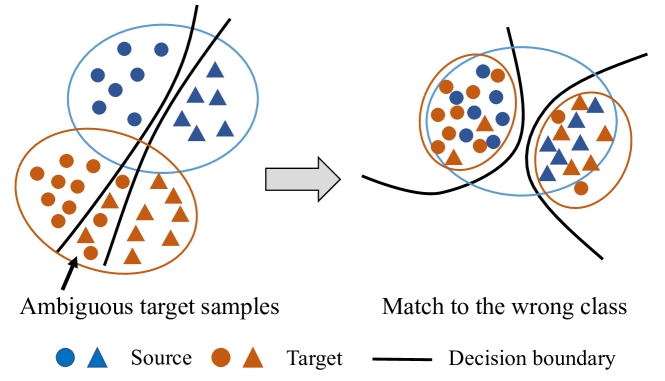
Unsupervised Domain Adaptation (UDA) aims to generalize the knowledge learned from a well-labeled source domain to an unlabeled target domain. Recently, adversarial domain adaptation with two distinct classifiers (bi-classifier) has been introduced into UDA which is effective to align distributions between different domains. Previous bi-classifier adversarial learning methods only focus on the similarity between the outputs of two distinct classifiers. However, the similarity of the outputs cannot guarantee the accuracy of target samples, i.e., target samples may match to wrong categories even if the discrepancy between two classifiers is small. To challenge this issue, in this paper, we propose a cross-domain gradient discrepancy minimization (CGDM) method which explicitly minimizes the discrepancy of gradients generated by source samples and target samples. Specifically, the gradient gives a cue for the semantic information of target samples so it can be used as a good supervision to improve the accuracy of target samples. In order to compute the gradient signal of target samples, we further obtain target pseudo labels through a clustering-based self-supervised learning. Extensive experiments on three widely used UDA datasets show that our method surpasses many previous state-of-the-arts. Codes are available at https://github.com/lijin118/CGDM.
Motivation & Objective
- To address the issue in bi-classifier adversarial learning where low output discrepancy does not guarantee accurate classification on target samples.
- To improve category-level domain alignment by leveraging gradient signals as a proxy for classification accuracy.
- To reduce error propagation from noisy pseudo labels in self-supervised target labeling by using a clustering-based strategy.
- To develop a generalizable loss mechanism that can be integrated into existing bi-classifier adversarial frameworks.
Proposed method
- The method introduces a gradient discrepancy loss that minimizes the L1 distance between gradients of source and target samples during backpropagation.
- It uses a self-supervised learning module based on clustering to generate more reliable pseudo labels for target samples, reducing noise in supervision.
- The framework integrates gradient discrepancy minimization and self-supervised learning into a unified bi-classifier adversarial training objective.
- The gradient signal is computed using the loss gradient with respect to features, providing a dynamic supervision signal that reflects model confidence and semantic consistency.
- The method is formulated as a generalized loss term, making it compatible with various UDA paradigms beyond the base bi-classifier setup.
- The approach is trained end-to-end with a trade-off between supervised loss on source data, self-supervised loss on target data, and gradient discrepancy loss.
Experimental results
Research questions
- RQ1Can gradient discrepancy between source and target samples serve as a reliable proxy for classification accuracy in unsupervised domain adaptation?
- RQ2Does minimizing gradient discrepancy lead to better category-level alignment compared to output-based discrepancy minimization?
- RQ3Can clustering-based pseudo-labeling improve the reliability of self-supervised learning in UDA, especially under large domain shifts?
- RQ4How does the proposed method compare to state-of-the-art UDA methods in terms of robustness and generalization across diverse datasets?
Key findings
- On the ImageCLEF dataset, the proposed method achieves an average accuracy of 89.5%, surpassing previous state-of-the-art methods by 1.5 percentage points.
- In challenging domain shift scenarios such as C→P on ImageCLEF, the method shows significant accuracy gains, demonstrating robustness to large domain gaps.
- On the VisDA-2017 and DomainNet benchmarks, the method outperforms existing SOTA methods by a large margin, especially in high-category and high-domain-gap settings.
- Abllation studies confirm that both the gradient discrepancy and self-supervised learning modules contribute significantly to performance, with the best results when used together.
- The model shows stable convergence and low sensitivity to hyperparameters, particularly when the gradient discrepancy weight is kept below 1.
- Feature visualization using t-SNE confirms that the target features are better aligned with source features at the category level after applying CGDM, indicating improved discriminability and distribution alignment.

Read this paper
Open the full text in the Nubint reader and ask about any passage as you read.
Read this paper on NubintThis review was generated by AI from the original paper. Please check the paper before citing it.