
[Paper Review] Data driven weather forecasts trained and initialised directly from observations
This paper proposes a novel data-driven weather forecasting approach that trains and initializes neural networks directly from raw observational data—bypassing physics-based models and reanalysis datasets entirely. By learning temporal patterns in level-1 observations (e.g., satellite radiances, SYNOP data), the model forecasts surface temperature and wind up to 12 hours ahead with realistic skill, demonstrating that complex atmospheric dynamics can be captured purely from observations without explicit data assimilation or background forecasts.
Skilful Machine Learned weather forecasts have challenged our approach to numerical weather prediction, demonstrating competitive performance compared to traditional physics-based approaches. Data-driven systems have been trained to forecast future weather by learning from long historical records of past weather such as the ECMWF ERA5. These datasets have been made freely available to the wider research community, including the commercial sector, which has been a major factor in the rapid rise of ML forecast systems and the levels of accuracy they have achieved. However, historical reanalyses used for training and real-time analyses used for initial conditions are produced by data assimilation, an optimal blending of observations with a physics-based forecast model. As such, many ML forecast systems have an implicit and unquantified dependence on the physics-based models they seek to challenge. Here we propose a new approach, training a neural network to predict future weather purely from historical observations with no dependence on reanalyses. We use raw observations to initialise a model of the atmosphere (in observation space) learned directly from the observations themselves. Forecasts of crucial weather parameters (such as surface temperature and wind) are obtained by predicting weather parameter observations (e.g. SYNOP surface data) at future times and arbitrary locations. We present preliminary results on forecasting observations 12-hours into the future. These already demonstrate successful learning of time evolutions of the physical processes captured in real observations. We argue that this new approach, by staying purely in observation space, avoids many of the challenges of traditional data assimilation, can exploit a wider range of observations and is readily expanded to simultaneous forecasting of the full Earth system (atmosphere, land, ocean and composition).
Motivation & Objective
- To eliminate dependence on physics-based models and reanalysis datasets in machine learning weather forecasting.
- To address the limitations of traditional data assimilation, which relies on background forecasts and complex error covariance modeling.
- To explore whether neural networks can learn atmospheric dynamics directly from raw observations without intermediate gridded variables.
- To enable fully coupled Earth system forecasting by training on diverse observational sources across atmosphere, ocean, and land.
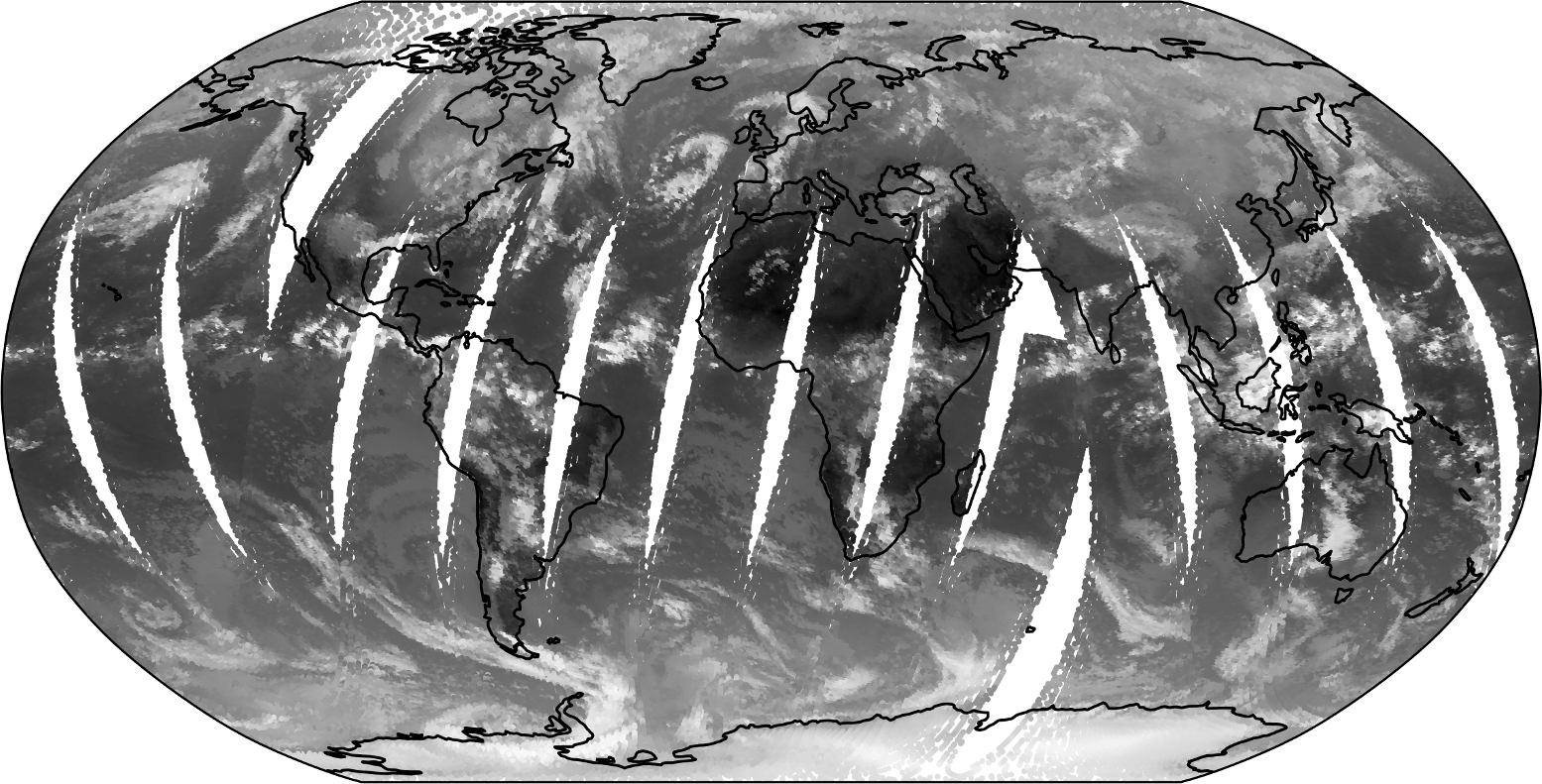
- To unlock underutilized observations—such as visible satellite radiances—previously excluded from operational NWP due to radiative transfer complexity.
Proposed method
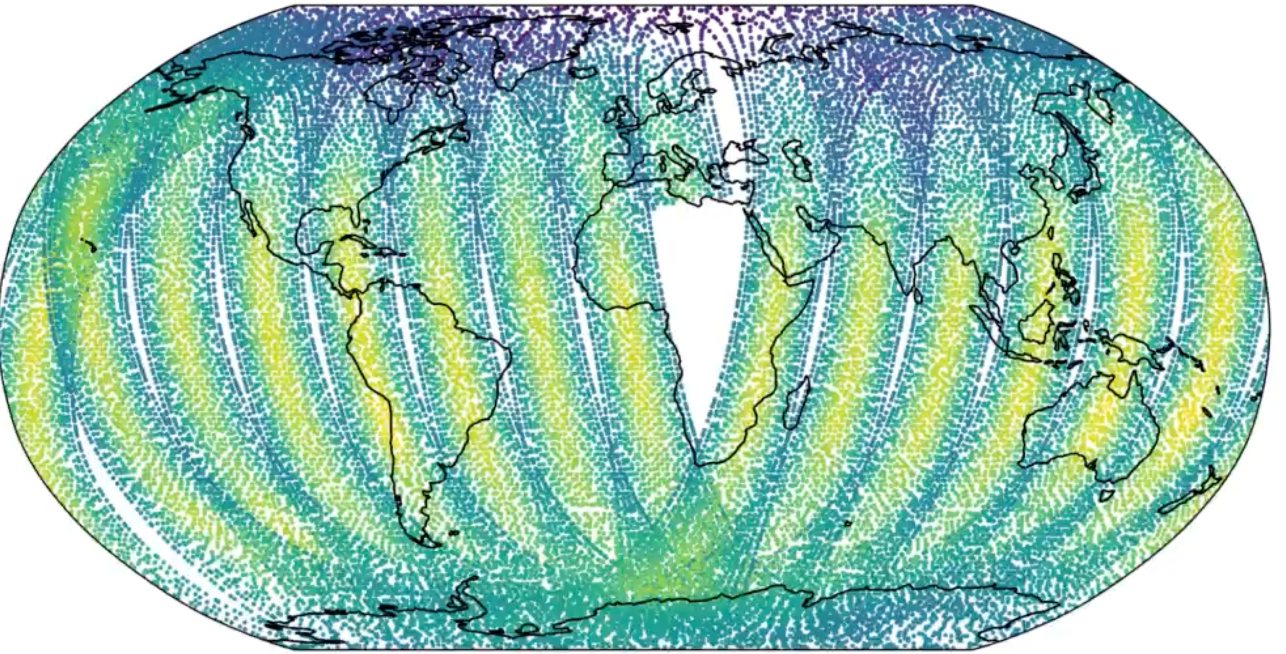
- The model is trained exclusively on historical raw observations (level-1 data), including satellite radiances, in-situ measurements (e.g., SYNOP), and other observational types.
- Forecasting occurs in observation space: the network predicts future values of weather parameters (e.g., surface temperature, wind) directly from past observations at arbitrary locations.
- The approach avoids data assimilation by not requiring gridded initial states or background forecasts; instead, it learns temporal evolution from observational sequences.
- A prototype neural network is trained to predict future observations at 12-hour lead times using a diverse set of observational inputs.
- The method is inherently agnostic to Earth system components, enabling simultaneous forecasting of atmosphere, ocean, land, and atmospheric composition from a unified observational dataset.
- The model implicitly learns physical relationships by exploiting spatial and temporal correlations across different observation types without requiring explicit physical equations.
Experimental results
Research questions
- RQ1Can a neural network learn realistic 12-hour weather forecasts purely from raw observational data, without relying on reanalysis or physics-based models?
- RQ2To what extent can a data-driven model capture complex atmospheric dynamics—beyond simple advection—using only observational sequences?
- RQ3Can the model effectively exploit underused observational types, such as visible-spectrum satellite radiances, that are typically excluded from operational NWP due to radiative transfer complexity?
- RQ4How does direct observation-based forecasting compare to conventional data assimilation in terms of robustness and scalability across Earth system components?
- RQ5Can the same architecture be extended to simultaneously forecast multiple Earth system components (atmosphere, ocean, land, composition) using a unified observational training set?
Key findings
- The model successfully learns the time evolution of atmospheric processes from raw observations, producing realistic 12-hour forecasts of surface temperature and wind.
- Even with a prototype network and limited observational data, the model demonstrates skill beyond simple advection, capturing complex spatiotemporal patterns in weather systems.
- The network learns robust relationships between diverse observation types (e.g., satellite radiances and SYNOP surface data), enabling accurate prediction of key weather parameters.
- The approach avoids the need for data assimilation and background forecasts, sidestepping challenges such as error covariance estimation and null-space limitations in satellite observations.
- Preliminary results show that the model can predict future observations with high realism, suggesting potential for longer-range forecasting when scaled with more sophisticated architectures.
- The method is inherently extensible to coupled Earth system forecasting, as it treats all observational sources uniformly regardless of Earth component or physical origin.
Read this paper
Open the full text in the Nubint reader and ask about any passage as you read.
Read this paper on NubintThis review was generated by AI from the original paper. Please check the paper before citing it.