
[Paper Review] Decentralized Model Dissemination Empowered Federated Learning in mmWave Aerial-Terrestrial Integrated Networks
This paper proposes FedMoD, a decentralized federated learning framework for mmWave aerial-terrestrial integrated networks that uses UAVs as local aggregators via UAV-to-UAV and device-to-device (D2D) communications, eliminating the need for a central parameter server. The scheme achieves convergence performance comparable to centralized FL while significantly reducing energy consumption through optimized radio resource management and graph-based scheduling of line-of-sight and non-line-of-sight users.
It is anticipated that aerial-terrestrial integrated networks incorporating unmanned aerial vehicles (UAVs) mounted relays will offer improved coverage and connectivity in the beyond 5G era. Meanwhile, federated learning (FL) is a promising distributed machine learning technique for building inference models over wireless networks due to its ability to maintain user privacy and reduce communication overhead. However, off-the-shelf FL models aggregate global parameters at a central parameter server (CPS), increasing energy consumption and latency, as well as inefficiently utilizing radio resource blocks (RRBs) for distributed user devices (UDs). This paper presents a resource-efficient FL framework, called FedMoD ( extbf{fed}erated learning with extbf{mo}del extbf{d}issemination), for millimeter-wave (mmWave) aerial-terrestrial integrated networks with the following two unique characteristics. Firstly, FedMoD presents a novel decentralized model dissemination algorithm that makes use of UAVs as local model aggregators through UAV-to-UAV and device-to-device (D2D) communications. As a result, FedMoD (i) increases the number of participant UDs in developing FL model and (ii) achieves global model aggregation without involving CPS. Secondly, FedMoD reduces the energy consumption of FL using radio resource management (RRM) under the constraints of over-the-air learning latency. In order to achieve this, by leveraging graph theory, FedMoD optimizes the scheduling of line-of-sight (LOS) UDs to suitable UAVs/RRBs over mmWave links and non-LOS UDs to available LOS UDs via overlay D2D communications. Extensive simulations reveal that decentralized FedMoD offers same convergence rate performance as compared to conventional FL frameworks.
Motivation & Objective
- To address the high energy consumption and latency caused by central parameter servers (CPS) in conventional federated learning (FL) over mmWave aerial-terrestrial integrated networks (ATINs).
- To enable global FL model aggregation without relying on a CPS by leveraging UAVs as decentralized local aggregators.
- To minimize energy consumption in FL through efficient radio resource management (RRM) under over-the-air learning latency constraints.
- To optimize scheduling of line-of-sight (LOS) and non-LOS user devices (UDs) to UAVs and radio resource blocks (RRBs) using graph theory.
- To evaluate the impact of UAV network topology and dissemination frequency on FL convergence and energy efficiency.
Proposed method
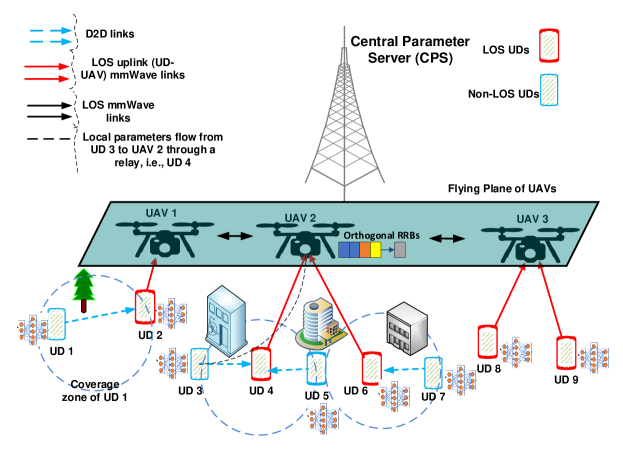
- Proposes a decentralized model dissemination algorithm where UAVs act as local FL aggregators using UAV-to-UAV and D2D communications, enabling global model aggregation without a central parameter server.
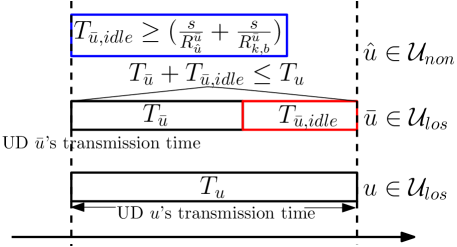
- Employs a rate-adaptive radio resource management (RRM) scheme that schedules LOS UDs to optimal UAVs and RRBs, and non-LOS UDs to LOS UDs via overlay D2D communications.
- Uses graph theory to model and optimize the scheduling of UDs to UAVs and RRBs, ensuring efficient use of mmWave spectrum and minimizing interference.
- Introduces a partial dissemination mechanism with parameter α to control the frequency of full model exchanges between UAVs, balancing convergence and energy efficiency.
- Develops a distributed RRM scheme that matches UDs to UAVs and RRBs based on channel quality and network topology, reducing conflict and energy use.
- Theoretical convergence analysis is provided, proving that FedMoD maintains convergence speed comparable to centralized FL under the proposed RRM and dissemination strategy.
Experimental results
Research questions
- RQ1How can global FL model aggregation be achieved without a central parameter server in mmWave aerial-terrestrial integrated networks?
- RQ2What is the impact of UAV network topology on the convergence performance and energy efficiency of decentralized FL?
- RQ3How does the frequency of inter-UAV model dissemination (controlled by α) affect learning accuracy and convergence stability?
- RQ4Can a distributed RRM scheme achieve comparable energy efficiency to a centralized RRM scheme in large-scale ATINs?
- RQ5To what extent can D2D communications between non-LOS UDs and LOS UDs improve system throughput and reduce energy consumption?
Key findings
- FedMoD achieves the same convergence rate and test accuracy as conventional centralized FL, with a test accuracy of 0.966 for MNIST and 0.668 for CIFAR-10 under full dissemination (α=1).
- Infrequent full dissemination (α=2 or 3) leads to significantly degraded performance, with test accuracy dropping to 0.66 and 0.52 for MNIST and CIFAR-10, respectively, due to insufficient model averaging.
- A fully connected UAV network topology achieves higher test accuracy than a partially connected topology, with the latter approaching full connectivity performance when α > 4.
- The proposed distributed RRM scheme achieves identical energy consumption performance as the centralized RRM scheme, especially as the number of UDs increases, due to reduced scheduling conflicts.
- Random RRM scheduling results in the highest energy consumption, confirming the inefficiency of unoptimized resource allocation in FL systems.
- The average energy consumption of FedMoD is minimized across all tested schemes, demonstrating the effectiveness of the proposed RRM and dissemination strategy.
Read this paper
Open the full text in the Nubint reader and ask about any passage as you read.
Read this paper on NubintThis review was generated by AI from the original paper. Please check the paper before citing it.