
[Paper Review] Decorrelated Adversarial Learning for Age-Invariant Face Recognition
This paper proposes Decorrelated Adversarial Learning (DAL), a novel deep learning framework that factorizes face features into uncorrelated identity-dependent and age-dependent components to improve age-invariant face recognition. By adversarially minimizing correlation between these components using a Batch Canonical Correlation Analysis (BCCA)-inspired module, the method achieves state-of-the-art performance on FG-NET, MORPH Album 2, and CACD-VS, with a 94.5% rank-1 accuracy on FG-NET under leave-one-out evaluation.
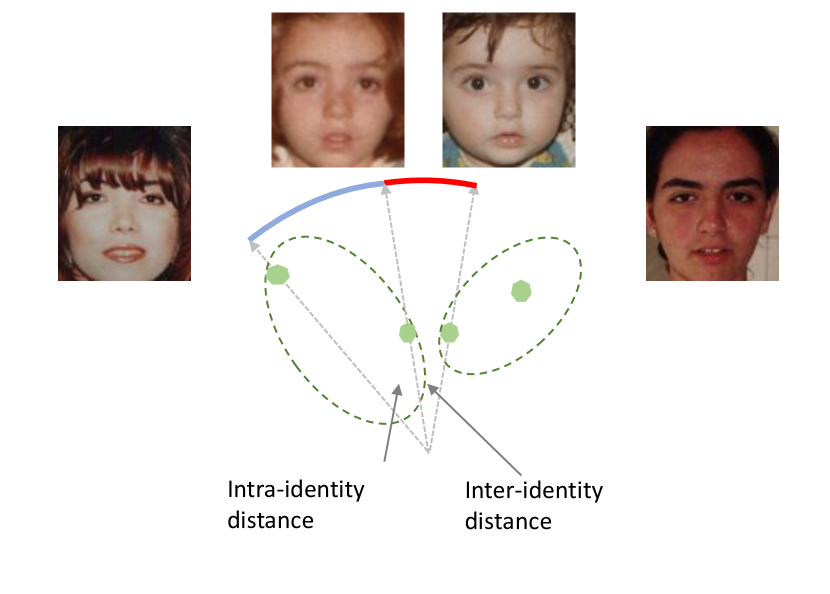
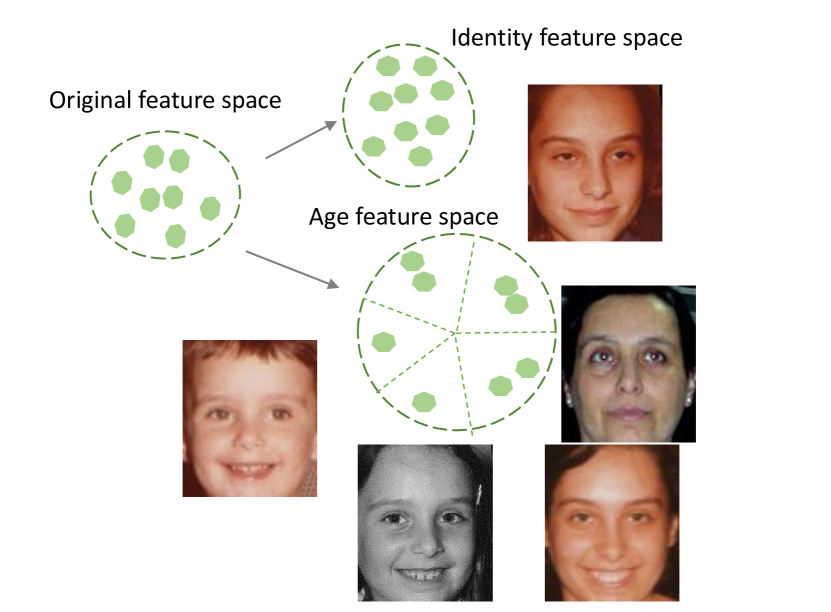
There has been an increasing research interest in age-invariant face recognition. However, matching faces with big age gaps remains a challenging problem, primarily due to the significant discrepancy of face appearances caused by aging. To reduce such a discrepancy, in this paper we propose a novel algorithm to remove age-related components from features mixed with both identity and age information. Specifically, we factorize a mixed face feature into two uncorrelated components: identity-dependent component and age-dependent component, where the identity-dependent component includes information that is useful for face recognition. To implement this idea, we propose the Decorrelated Adversarial Learning (DAL) algorithm, where a Canonical Mapping Module (CMM) is introduced to find the maximum correlation between the paired features generated by a backbone network, while the backbone network and the factorization module are trained to generate features reducing the correlation. Thus, the proposed model learns the decomposed features of age and identity whose correlation is significantly reduced. Simultaneously, the identity-dependent feature and the age-dependent feature are respectively supervised by ID and age preserving signals to ensure that they both contain the correct information. Extensive experiments are conducted on popular public-domain face aging datasets (FG-NET, MORPH Album 2, and CACD-VS) to demonstrate the effectiveness of the proposed approach.
Motivation & Objective
- Address the challenge of significant appearance variation in face images due to aging, which degrades face recognition performance across large age gaps.
- Overcome the limitation of existing methods where identity features still contain residual age-related information due to correlated decomposition.
- Develop a deep feature factorization framework that explicitly reduces correlation between identity and age components in learned features.
- Ensure both decomposed components are semantically meaningful by jointly supervising them with identity and age classification signals.
- Achieve state-of-the-art performance on benchmark age-invariant face recognition datasets without fine-tuning on target data.
Proposed method
- Propose a residual-based feature factorization: $\mathbf{x} = \mathbf{x_{id}} + \mathcal{R}(\mathbf{x})$, where $\mathbf{x_{id}}$ is the identity-dependent component and $\mathbf{x_{age}} = \mathcal{R}(\mathbf{x})$ is the age-dependent component.
- Introduce a Canonical Mapping Module (CMM) to estimate the maximum correlation between $\mathbf{x_{id}}$ and $\mathbf{x_{age}}$ in a differentiable manner.
- Implement an adversarial training strategy where the backbone and factorization network are optimized to minimize the correlation estimated by the CMM.
- Propose Batch Canonical Correlation Analysis (BCCA), a stochastic gradient-based extension of CCA, to efficiently compute and backpropagate correlation gradients in mini-batches.
- Jointly supervise $\mathbf{x_{id}}$ with identity classification and $\mathbf{x_{age}}$ with age classification to preserve semantic content in both components.
- During inference, only $\mathbf{x_{id}}$ is used for face recognition, ensuring age-invariant identity matching.
Experimental results
Research questions
- RQ1Can adversarial correlation minimization between identity and age components improve age-invariant face recognition?
- RQ2Does decoupling features into uncorrelated identity and age components lead to better generalization on unseen age gaps?
- RQ3Can a differentiable, stochastic correlation estimation method (BCCA) effectively guide end-to-end training in deep networks?
- RQ4How does joint supervision via identity and age classification affect the quality and disentanglement of the decomposed features?
- RQ5To what extent does the proposed method outperform existing state-of-the-art approaches on standard AIFR benchmarks?
Key findings
- The proposed DAL method achieves a 94.5% rank-1 accuracy on the FG-NET dataset under the leave-one-out protocol, significantly outperforming prior methods such as HFA (69.0%) and OE-CNNs (88.1%).
- On the MF2 protocol of FG-NET, the method achieves 60.01% rank-1 accuracy, surpassing the previous SOTA of 53.26% by OE-CNNs.
- On the LFW and MF1-Facescrub general face recognition benchmarks, the model achieves 99.47% verification rate and 77.58% rank-1 identification rate, exceeding SphereFace and CosFace.
- The ablation study confirms that the decorrelation loss significantly reduces correlation between identity and age features, leading to improved robustness.
- The model generalizes well across datasets, achieving state-of-the-art performance on both AIFR-specific benchmarks (FG-NET, MORPH, CACD-VS) and general face recognition datasets (LFW, MF1-Facescrub).
- The BCCA module effectively enables end-to-end training with stable gradient flow, enabling the model to learn disentangled representations without relying on generative image synthesis.
Read this paper
Open the full text in the Nubint reader and ask about any passage as you read.
Read this paper on NubintThis review was generated by AI from the original paper. Please check the paper before citing it.