
[Paper Review] Deep Features for Contactless Fingerprint Presentation Attack Detection: Can They Be Generalized?
This paper evaluates the generalization performance of eight pre-trained deep learning models—seven CNNs and one Vision Transformer (ViT)—for contactless fingerprint presentation attack detection (PAD) using a leave-one-out protocol on smartphone-based fingerprint datasets. ResNet50 achieved the best generalization with a mean D-EER of 8.26%, while performance degraded significantly for unseen attack materials like photo paper and playdoh.
The rapid evolution of high-end smartphones with advanced high-resolution cameras has resulted in contactless capture of fingerprint biometrics that are more reliable and suitable for verification. Similar to other biometric systems, contactless fingerprint-verification systems are vulnerable to presentation attacks. In this paper, we present a comparative study on the generalizability of seven different pre-trained Convolutional Neural Networks (CNN) and a Vision Transformer (ViT) to reliably detect presentation attacks. Extensive experiments were carried out on publicly available smartphone-based presentation attack datasets using four different Presentation Attack Instruments (PAI). The detection performance of the eighth deep feature technique was evaluated using the leave-one-out protocol to benchmark the generalization performance for unseen PAI. The obtained results indicated the best generalization performance with the ResNet50 CNN.
Motivation & Objective
- To investigate the generalization capability of pre-trained deep neural networks for detecting unseen presentation attack instruments (PAIs) in contactless fingerprint biometrics.
- To benchmark the performance of diverse deep learning architectures—including CNNs and Vision Transformers—on smartphone-captured fingerprint PAD datasets.
- To evaluate the robustness of deep features extracted from ImageNet-pretrained models when tested on PAIs not seen during training.
- To identify which deep feature extraction method offers the most reliable generalization across diverse spoofing materials such as 3D prints, photo paper, and playdoh.
Proposed method
- Extracted Region of Interest (ROI) from smartphone-captured fingerprint images using a 128×256 pixel crop centered on the finger's core.
- Utilized eight pre-trained deep learning models (AlexNet, GoogLeNet, DenseNet201, ResNet50, EfficientNet-B0, NASNet, MobileNet-V2, and Vision Transformer) for feature extraction.
- Extracted deep features from the final fully connected layer (fc6) for CNNs and the global average pooling layer for GoogLeNet and other architectures.
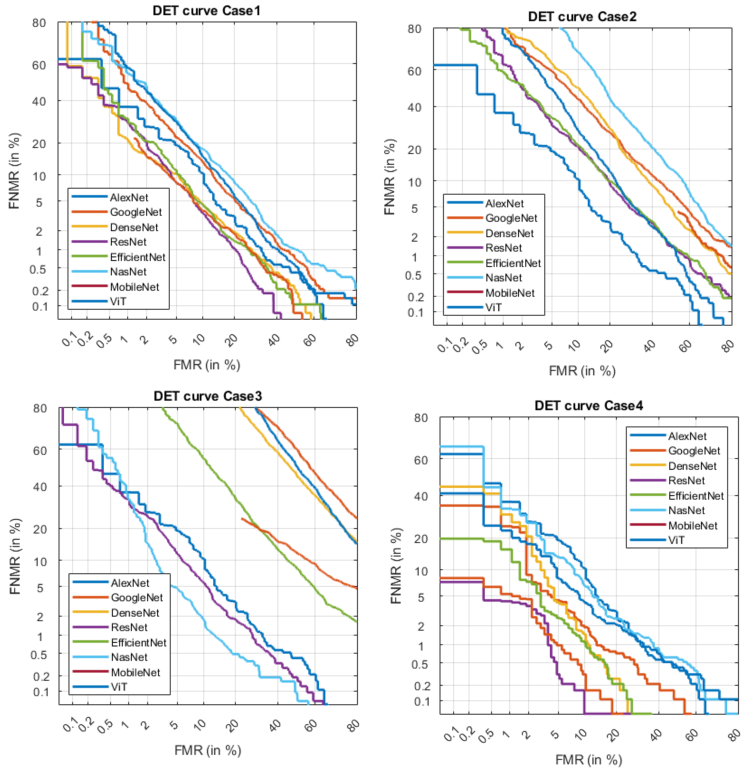
- Applied a leave-one-out evaluation protocol, training on three PAI materials and testing on the fourth to simulate unseen attack scenarios.
- Evaluated performance using ISO/IEC 30107-3 metrics: APCER, BPCER, and D-EER (equal error rate when APCER = BPCER).
- Conducted four distinct test cases, each isolating one PAI type (eco-flex, photo paper, playdoh, woodglue) as the unseen test set.

Experimental results
Research questions
- RQ1Can deep features extracted from pre-trained CNNs and Vision Transformers generalize to unseen presentation attack instruments in contactless fingerprint systems?
- RQ2Which deep learning architecture among the eight evaluated exhibits the strongest generalization performance across diverse PAI materials?
- RQ3How does the performance degrade when testing on PAI materials not present in the training data, particularly for photo paper and playdoh?
- RQ4Does the Vision Transformer (ViT) outperform traditional CNNs in generalizing to unseen fingerprint spoofing attacks?
- RQ5What is the relative impact of different PAI materials (e.g., eco-flex vs. photo paper) on the generalization capability of deep features?
Key findings
- ResNet50 achieved the best generalization performance with a mean D-EER of 8.26% across all four test cases, indicating the most robust detection of unseen PAIs.
- AlexNet showed the highest performance degradation, with a mean D-EER of 23.16%, particularly failing on unseen materials like photo paper and playdoh.
- The detection performance for photo paper and playdoh as unseen PAIs was significantly worse than for eco-flex and woodglue, with APCER values exceeding 90% in some cases.
- Vision Transformer (ViT) showed strong performance on eco-flex and woodglue-based attacks (D-EER = 6.71% and 2.57% in Case-1 and Case-4), but failed completely on photo paper and playdoh (D-EER = 50.00% and 100.00%).
- DenseNet201 and EfficientNet-B0 showed moderate generalization, with mean D-EER values of 10.58% and 10.79%, respectively, but still underperformed ResNet50.
- The results indicate that generalization is highly dependent on the material of the PAI, with synthetic materials like eco-flex and woodglue being more predictable than common materials like photo paper.
Read this paper
Open the full text in the Nubint reader and ask about any passage as you read.
Read this paper on NubintThis review was generated by AI from the original paper. Please check the paper before citing it.