
[Paper Review] Deep Learning based Computer Vision Methods for Complex Traffic Environments Perception: A Review
This paper reviews deep learning-based computer vision methods for intelligent transportation systems and autonomous driving, identifying critical challenges in data, model design, and complex urban environments. It proposes practical solutions—such as transfer learning, cooperative perception, and edge computing—highlighting the need for robust, explainable, and real-time models to enable reliable deployment in real-world traffic scenarios.
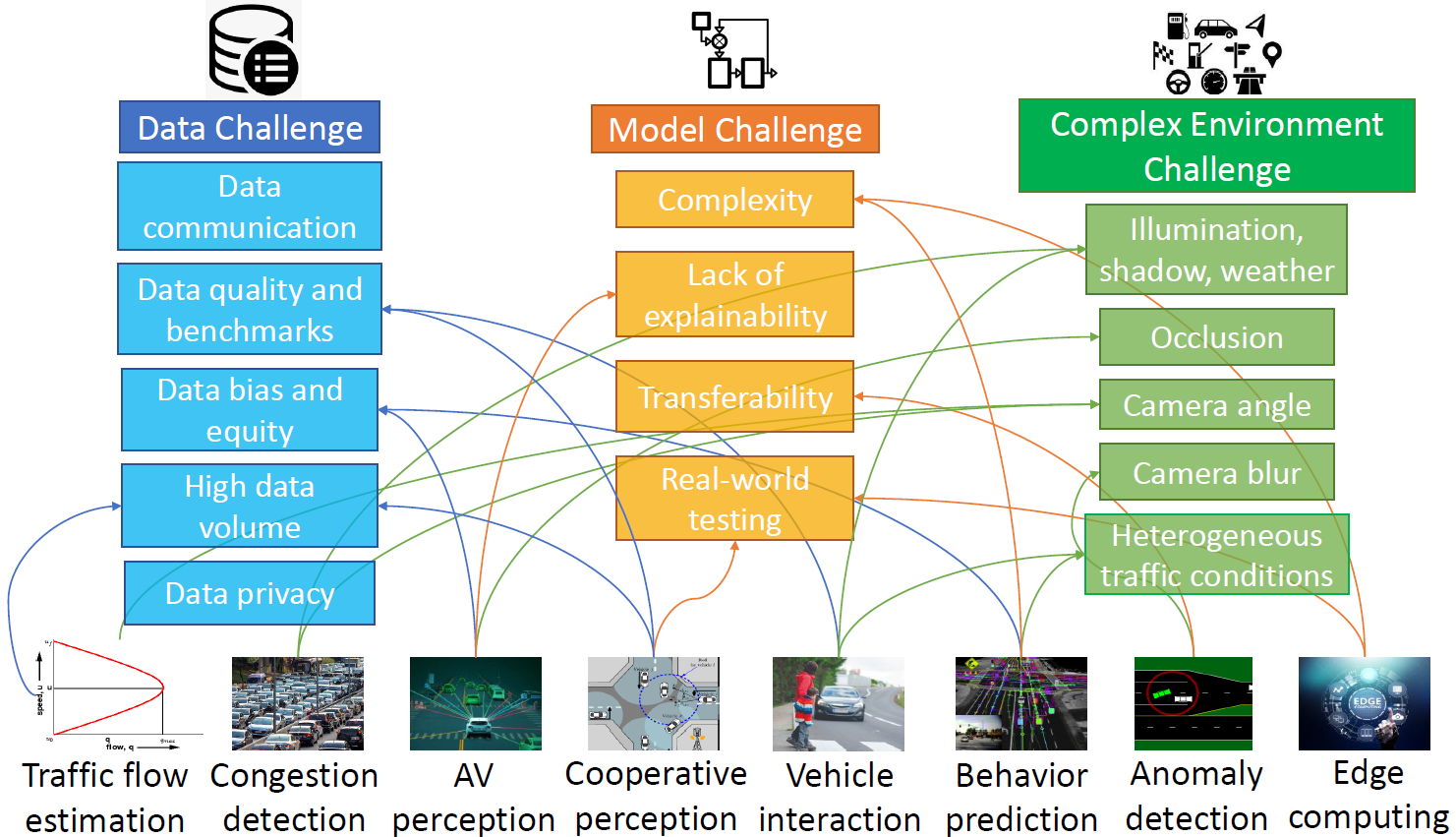
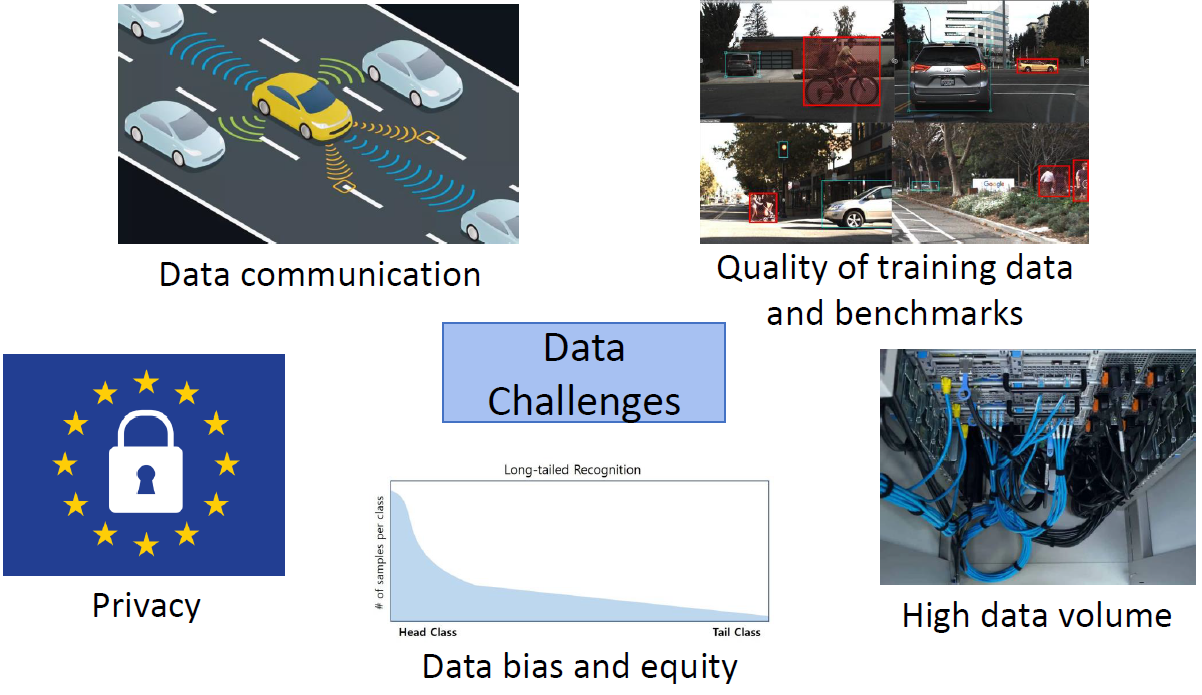
Computer vision applications in intelligent transportation systems (ITS) and autonomous driving (AD) have gravitated towards deep neural network architectures in recent years. While performance seems to be improving on benchmark datasets, many real-world challenges are yet to be adequately considered in research. This paper conducted an extensive literature review on the applications of computer vision in ITS and AD, and discusses challenges related to data, models, and complex urban environments. The data challenges are associated with the collection and labeling of training data and its relevance to real world conditions, bias inherent in datasets, the high volume of data needed to be processed, and privacy concerns. Deep learning (DL) models are commonly too complex for real-time processing on embedded hardware, lack explainability and generalizability, and are hard to test in real-world settings. Complex urban traffic environments have irregular lighting and occlusions, and surveillance cameras can be mounted at a variety of angles, gather dirt, shake in the wind, while the traffic conditions are highly heterogeneous, with violation of rules and complex interactions in crowded scenarios. Some representative applications that suffer from these problems are traffic flow estimation, congestion detection, autonomous driving perception, vehicle interaction, and edge computing for practical deployment. The possible ways of dealing with the challenges are also explored while prioritizing practical deployment.
Motivation & Objective
- To identify and classify key challenges in deploying deep learning-based computer vision in real-world complex traffic environments.
- To analyze limitations in data collection, labeling, bias, and privacy that hinder model generalization and real-world performance.
- To evaluate the shortcomings of deep learning models in terms of computational complexity, lack of explainability, and poor generalization to unseen scenarios.
- To examine environmental factors such as occlusion, variable lighting, sensor degradation, and heterogeneous traffic that degrade model reliability.
- To propose future research directions focused on practical deployment, including transfer learning, cooperative perception, and edge computing.
Proposed method
- Conducted a comprehensive literature review of over 200 papers on deep learning in computer vision for ITS and autonomous driving.
- Classified challenges into three categories: data-related (collection, labeling, bias, privacy), model-related (complexity, lack of explainability, testability), and environmental (occlusion, lighting, sensor faults).
- Reviewed representative applications such as traffic flow estimation, congestion detection, autonomous vehicle perception, and edge computing for real-time deployment.
- Evaluated techniques like domain adaptation, few-shot learning, zero-shot learning, and vision transformers to improve model robustness and generalization.
- Explored cooperative perception using V2X networks and vision transformers to enhance sensing in connected autonomous vehicles.
- Proposed future directions including online learning, multi-source data fusion, and adaptive feature aggregation for improved multi-object tracking and anomaly detection.
Experimental results
Research questions
- RQ1What are the primary data-related challenges affecting the deployment of deep learning models in real-world traffic environments?
- RQ2How do model complexity, lack of explainability, and poor generalization limit the practical use of deep learning in ITS and autonomous driving?
- RQ3In what ways do complex urban environmental factors—such as occlusion, variable lighting, and sensor degradation—degrade model performance?
- RQ4What techniques can improve model robustness and generalization in unseen or rare traffic scenarios?
- RQ5How can cooperative perception and edge computing enhance real-time, reliable perception in complex traffic environments?
Key findings
- Data challenges include high-volume data collection, biased or over-represented classes, time-consuming labeling, and privacy concerns, which hinder model generalization.
- Deep learning models often suffer from high computational complexity, lack of explainability, and difficulty in testing under real-world conditions, limiting their deployability.
- Environmental factors such as occlusion, irregular lighting, and camera instability significantly degrade performance, even after training on diverse conditions.
- Techniques like transfer learning, domain adaptation, and few-shot learning show promise in improving model performance on rare or unseen scenarios.
- Cooperative perception using V2X and vision transformers enhances robustness by fusing multi-view data, reducing occlusion and illumination issues.
- Future deployment will benefit from edge computing, online learning, and multi-source data fusion to enable real-time adaptation and improved anomaly detection.
Read this paper
Open the full text in the Nubint reader and ask about any passage as you read.
Read this paper on NubintThis review was generated by AI from the original paper. Please check the paper before citing it.