
[Paper Review] DeepTensor: Low-Rank Tensor Decomposition with Deep Network Priors
DeepTensor proposes a self-supervised deep learning framework for low-rank tensor and matrix decomposition that leverages the implicit regularization of deep generative networks (DNs) to outperform classical methods like SVD and PCA. It achieves robust performance under non-Gaussian noise and low signal-to-noise ratios, offering up to 6 dB SNR improvement in Poisson-noise denoising and 60× faster 3D tensor decomposition compared to 3D convolutional networks.
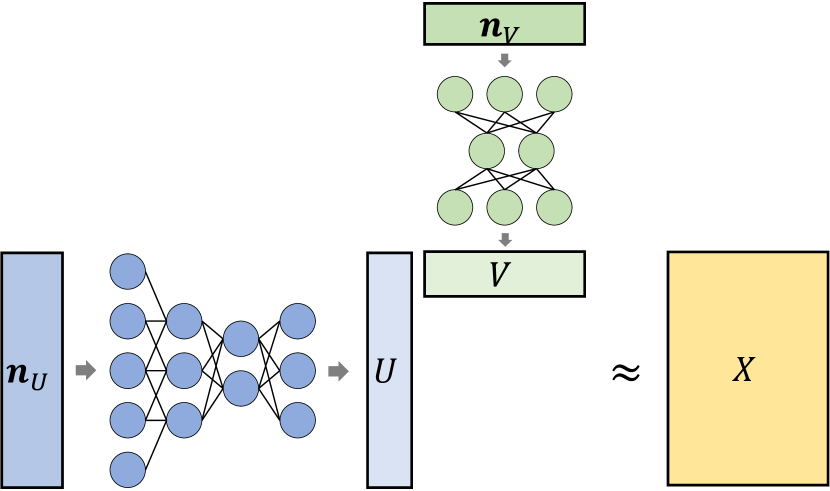
DeepTensor is a computationally efficient framework for low-rank decomposition of matrices and tensors using deep generative networks. We decompose a tensor as the product of low-rank tensor factors (e.g., a matrix as the outer product of two vectors), where each low-rank tensor is generated by a deep network (DN) that is trained in a self-supervised manner to minimize the mean-squared approximation error. Our key observation is that the implicit regularization inherent in DNs enables them to capture nonlinear signal structures (e.g., manifolds) that are out of the reach of classical linear methods like the singular value decomposition (SVD) and principal component analysis (PCA). Furthermore, in contrast to the SVD and PCA, whose performance deteriorates when the tensor's entries deviate from additive white Gaussian noise, we demonstrate that the performance of DeepTensor is robust to a wide range of distributions. We validate that DeepTensor is a robust and computationally efficient drop-in replacement for the SVD, PCA, nonnegative matrix factorization (NMF), and similar decompositions by exploring a range of real-world applications, including hyperspectral image denoising, 3D MRI tomography, and image classification. In particular, DeepTensor offers a 6dB signal-to-noise ratio improvement over standard denoising methods for signals corrupted by Poisson noise and learns to decompose 3D tensors 60 times faster than a single DN equipped with 3D convolutions.
Motivation & Objective
- To develop a low-rank decomposition framework that is robust to non-Gaussian noise and signal distributions where classical linear methods like SVD and PCA fail.
- To leverage the implicit inductive bias of deep generative networks as a powerful, data-driven regularizer for matrix and tensor factorization.
- To create a computationally efficient, drop-in replacement for standard decomposition techniques such as SVD, PCA, and NMF in real-world applications.
- To improve downstream task performance—such as image classification and denoising—by learning more accurate low-dimensional signal representations.
- To demonstrate scalability and speed advantages, particularly for 3D tensor decomposition, compared to end-to-end 3D convolutional networks.
Proposed method
- Represent low-rank tensor factors as outputs of deep generative networks (DNs) trained via self-supervised learning to minimize mean-square error (MSE) between the reconstructed and input tensor.
- Use a separable architecture with 1D or 2D convolutional filters to enable efficient 3D tensor decomposition, avoiding the computational cost of full 3D convolutions.
- Train the DNs using backpropagation with an MSE loss function, where the reconstruction is the product of the generated low-rank factors.
- Apply implicit regularization from the DNs’ architecture to capture nonlinear signal structures such as manifolds, which linear methods cannot model.
- Integrate nonnegativity constraints via ReLU or softplus activation functions for applications like NMF, enabling semi-NMF and full NMF variants.
- Use a two-stage training process: first pre-train the DNs on a self-supervised reconstruction objective, then fine-tune for specific decomposition tasks.

Experimental results
Research questions
- RQ1Can deep generative networks serve as effective priors for low-rank tensor decomposition under non-Gaussian noise distributions?
- RQ2How does DeepTensor’s performance compare to SVD and PCA when the signal-to-noise ratio is low or the noise is non-Gaussian (e.g., Poisson)?
- RQ3To what extent is DeepTensor robust to rank overestimation, and how does it compare to SVD in terms of sensitivity to rank selection?
- RQ4Can DeepTensor achieve significant speedups in 3D tensor decomposition compared to 3D convolutional networks while maintaining high accuracy?
- RQ5Does using DNs as priors improve downstream task performance, such as image classification or denoising, compared to classical factorization methods?
Key findings
- DeepTensor achieves a 6 dB signal-to-noise ratio (SNR) improvement over standard denoising methods when applied to hyperspectral images corrupted by Poisson noise.
- In low-SNR settings with non-Gaussian noise, DeepTensor outperforms SVD and PCA, which degrade significantly under non-Gaussian noise assumptions.
- DeepTensor is significantly less sensitive to rank overestimation than SVD: while SVD accuracy degrades with higher rank, DeepTensor maintains stable performance across a wide range of ranks.
- For 3D tensor decomposition, DeepTensor is 60 times faster than a single 3D convolutional network, due to its separable architecture using 1D and 2D convolutions.
- In nonnegative matrix factorization (NMF) on speech spectrograms, DeepTensor with ReLU activation achieves 8.8 dB average PSNR, outperforming baseline NMF methods (4.6–4.7 dB).
- In facial recognition using eigenfaces, DeepTensor learns lower-noise principal components than PCA or ICA, resulting in improved classification accuracy on a linear SVM classifier.
Read this paper
Open the full text in the Nubint reader and ask about any passage as you read.
Read this paper on NubintThis review was generated by AI from the original paper. Please check the paper before citing it.