
[Paper Review] DeformUX-Net: Exploring a 3D Foundation Backbone for Medical Image Segmentation with Depthwise Deformable Convolution
DeformUX-Net proposes a 3D foundation backbone for medical image segmentation using depthwise deformable convolution to unify long-range dependency, adaptive spatial aggregation, and computational efficiency. By integrating tri-planar offset learning via a parallel MLP branch and structural re-parameterization-inspired design, it achieves state-of-the-art performance across four public datasets with fewer parameters than SOTA transformers.
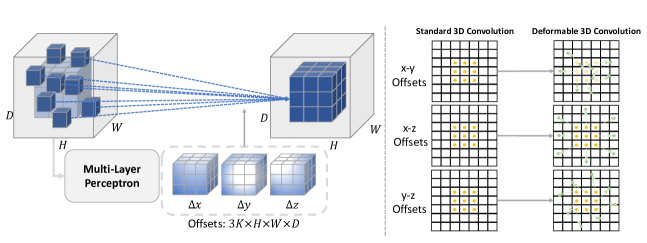
The application of 3D ViTs to medical image segmentation has seen remarkable strides, somewhat overshadowing the budding advancements in Convolutional Neural Network (CNN)-based models. Large kernel depthwise convolution has emerged as a promising technique, showcasing capabilities akin to hierarchical transformers and facilitating an expansive effective receptive field (ERF) vital for dense predictions. Despite this, existing core operators, ranging from global-local attention to large kernel convolution, exhibit inherent trade-offs and limitations (e.g., global-local range trade-off, aggregating attentional features). We hypothesize that deformable convolution can be an exploratory alternative to combine all advantages from the previous operators, providing long-range dependency, adaptive spatial aggregation and computational efficiency as a foundation backbone. In this work, we introduce 3D DeformUX-Net, a pioneering volumetric CNN model that adeptly navigates the shortcomings traditionally associated with ViTs and large kernel convolution. Specifically, we revisit volumetric deformable convolution in depth-wise setting to adapt long-range dependency with computational efficiency. Inspired by the concepts of structural re-parameterization for convolution kernel weights, we further generate the deformable tri-planar offsets by adapting a parallel branch (starting from $1 imes1 imes1$ convolution), providing adaptive spatial aggregation across all channels. Our empirical evaluations reveal that the 3D DeformUX-Net consistently outperforms existing state-of-the-art ViTs and large kernel convolution models across four challenging public datasets, spanning various scales from organs (KiTS: 0.680 to 0.720, MSD Pancreas: 0.676 to 0.717, AMOS: 0.871 to 0.902) to vessels (e.g., MSD hepatic vessels: 0.635 to 0.671) in mean Dice.
Motivation & Objective
- To address the trade-offs between global-local attention and large kernel convolution in 3D medical image segmentation.
- To develop a computationally efficient, adaptive backbone that captures long-range dependencies without relying on self-attention mechanisms.
- To explore the feasibility of 3D depthwise deformable convolution as a foundation operator for volumetric segmentation.
- To improve adaptive spatial aggregation across feature channels using learnable, channel-aware offsets.
- To establish a new CNN-based foundation model that surpasses SOTA ViTs in performance and parameter efficiency.
Proposed method
- Introduces 3D DeformUX-Net, a U-Net-like architecture using depthwise deformable convolution in the encoder blocks to expand effective receptive field.
- Employs a parallel branch with 1×1×1 convolutions to generate tri-planar deformable offsets, enabling adaptive spatial aggregation across all channels.
- Adapts structural re-parameterization principles to compute deformable offsets via an MLP, improving feature representation and model efficiency.
- Uses linear scaling with MLPs to enhance spatial feature aggregation, outperforming depth-wise scaling in performance.
- Applies tri-planar offset computation to capture multi-directional spatial dependencies, with performance varying by anatomical structure.
- Trains the model end-to-end in a supervised manner on four public 3D medical imaging datasets for direct comparison with SOTA methods.

Experimental results
Research questions
- RQ1Can 3D depthwise deformable convolution effectively replace global-local self-attention and large kernel convolution in 3D medical segmentation?
- RQ2How does tri-planar offset computation impact performance across diverse anatomical structures such as organs and vessels?
- RQ3Can a learnable, parallel-branch design for offset generation improve adaptive spatial aggregation while reducing parameters?
- RQ4Does MLP-based offset computation outperform fixed-kernel or standard deformable convolution in volumetric segmentation?
- RQ5Can a CNN-based backbone with deformable operations achieve SOTA performance comparable to Vision Transformers with fewer parameters?
Key findings
- DeformUX-Net achieves mean Dice scores of 0.720 on KiTS (kidney, tumor, cyst), outperforming existing SOTA models.
- On the MSD Pancreas dataset, it achieves a mean Dice of 0.717, demonstrating strong performance on organ segmentation tasks.
- For multi-organ segmentation on AMOS, DeformUX-Net reaches a mean Dice of 0.902, exceeding SOTA ViTs and CNNs.
- In hepatic vessel segmentation, it achieves a mean Dice of 0.671, showing robustness on small, complex structures.
- The use of MLP-based tri-planar offsets consistently improves performance across all datasets, with the x-z plane being most effective for vessel segmentation.
- The model achieves SOTA results with fewer parameters than transformer-based models, confirming its computational efficiency and scalability.
Read this paper
Open the full text in the Nubint reader and ask about any passage as you read.
Read this paper on NubintThis review was generated by AI from the original paper. Please check the paper before citing it.