
[Paper Review] Demographic Parity: Mitigating Biases in Real-World Data
This paper proposes a model-agnostic, mathematically rigorous method called PUR (Demographic Parity, Utility, and Realism) to de-bias real-world datasets by deriving an asymptotic fair distribution that enforces demographic parity while preserving classification utility and social realism. The approach uses iterative proportional fitting to project training data onto a fair distribution, which generates synthetic data that, when used to train classifiers, eliminates both direct and indirect biases, as validated on the UCI Adult dataset with near-perfect demographic parity in predictions.
Computer-based decision systems are widely used to automate decisions in many aspects of everyday life, which include sensitive areas like hiring, loaning and even criminal sentencing. A decision pipeline heavily relies on large volumes of historical real-world data for training its models. However, historical training data often contains gender, racial or other biases which are propagated to the trained models influencing computer-based decisions. In this work, we propose a robust methodology that guarantees the removal of unwanted biases while maximally preserving classification utility. Our approach can always achieve this in a model-independent way by deriving from real-world data the asymptotic dataset that uniquely encodes demographic parity and realism. As a proof-of-principle, we deduce from public census records such an asymptotic dataset from which synthetic samples can be generated to train well-established classifiers. Benchmarking the generalization capability of these classifiers trained on our synthetic data, we confirm the absence of any explicit or implicit bias in the computer-aided decision.
Motivation & Objective
- To address direct and indirect biases in real-world data that propagate into AI decision systems, especially in high-stakes domains like hiring and criminal sentencing.
- To develop a fair machine learning framework that separates de-biasing from model training, enabling model-independent fairness guarantees.
- To preserve classification utility and social realism while enforcing demographic parity in synthetic datasets derived from real census data.
- To demonstrate that classifiers trained on synthetic data from the fair distribution achieve near-zero bias in predictions on test data.
Proposed method
- The method enforces three core constraints: demographic parity (equal outcome distribution across protected groups), classification utility (preservation of original class relationships), and social realism (faithful representation of predictor relationships).
- It uses iterative proportional fitting (IPF) to project the empirical training distribution onto a fair probability distribution that satisfies all PUR constraints.
- The fair distribution is derived by minimizing the Kullback-Leibler divergence from the original data distribution under the PUR constraints, ensuring minimal distortion.
- Synthetic datasets are generated from the fair distribution using re-sampling, preserving the size and structure of the original data.
- The approach is applied to the UCI Adult dataset, where the fair distribution is used to train Random Forest classifiers on synthetic data.
- The fairness of the resulting classifiers is evaluated using a disparity ratio metric on test data, comparing performance across protected attributes.
Experimental results
Research questions
- RQ1Can a model-agnostic method achieve demographic parity in real-world data without compromising classification utility or realism?
- RQ2To what extent can indirect biases—mediated through unprotected predictors—be eliminated by modifying the data distribution alone?
- RQ3Does training classifiers on synthetic data derived from a fair distribution preserve fairness when tested on biased real-world data?
- RQ4How well does the PUR framework maintain demographic parity across different sensitive profiles compared to baseline de-biasing methods?
Key findings
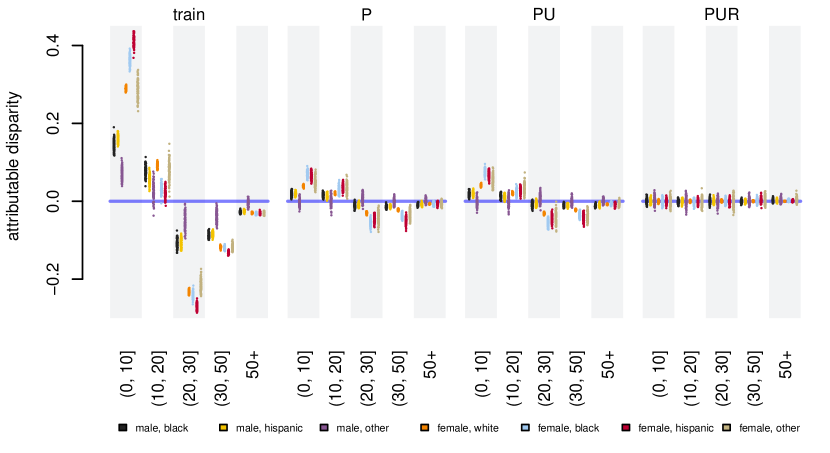
- The disparity ratio for income above $50K across protected groups (e.g., male/white vs. other) was reduced to approximately 100% on average in synthetic data generated from the PUR projection, indicating near-perfect demographic parity.
- Classifiers trained on synthetic data from the PUR projection maintained near-zero bias in predictions on test data, with the disparity ratio fluctuating around 100% and never falling below the 80% threshold.
- The p projection (demographic parity only) failed to eliminate indirect biases, as classifiers trained on such data re-introduced discriminatory correlations in predictions due to unaddressed confounding relationships.
- The pu projection (utility and parity) showed improved fairness over p alone, but only the full PUR projection—incorporating social realism—consistently preserved fairness in predictions on biased test data.
- The method successfully generated synthetic datasets that preserved the original data's size and structure while ensuring fairness, as confirmed by both direct disparity computation and classifier evaluation.
- The approach demonstrated robustness to finite-sample fluctuations, with deviations from parity attributed only to sampling noise and not systematic bias.

Better researchstarts right now
From reading papers to final review, dramatically reduce your research time.
No credit card · Free plan available
This review was created by AI and reviewed by human editors.