
[Paper Review] Dependence of the kinetic energy absorption capacity of bistable mechanical metamaterials on impactor mass and velocity
This study computationally investigates how impactor mass and velocity affect kinetic energy absorption in bistable mechanical metamaterials, revealing highly variable performance—ranging from 20.9× better to 0.08× worse than linear materials—due to solitary wave dynamics and damping effects. The findings show that optimal performance occurs when impactor parameters align with analytical predictions, and damping enhances energy absorption by stabilizing wave decay and promoting irreversible snapping.
Using an alternative mechanism to dissipation or scattering, bistable structures and mechanical metamaterials have shown promise for mitigating the detrimental effects of impact by reversibly locking energy into strained material. Herein, we extend prior works on impact absorption via bistable metamaterials to computationally explore the dependence of kinetic energy transmission on the velocity and mass of the impactor, with strain rates exceeding $10^2$ s$^{-1}$. We observe a large dependence on both impactor parameters, ranging from significantly better to worse performance than a comparative linear material. We then correlate the variability in performance to solitary wave formation in the system and give analytical estimates of idealized energy absorption capacity under dynamic loading. In addition, we find a significant dependence on damping accompanied by a qualitative difference in solitary wave propagation within the system. The complex dynamics revealed in this study offer potential future guidance for the application of bistable metamaterials to applications including human and engineered system shock and impact protection devices.
Motivation & Objective
- To understand how impactor mass and velocity influence kinetic energy transmission in bistable mechanical metamaterials under high strain rates.
- To identify conditions under which bistable metamaterials outperform or underperform conventional linear materials in impact absorption.
- To correlate performance variability with solitary wave formation and damping effects in the system.
- To provide analytical estimates of idealized energy absorption capacity under dynamic loading.
- To guide future design of impact protection systems by identifying optimal material-impactor pairings and damping tuning strategies.
Proposed method
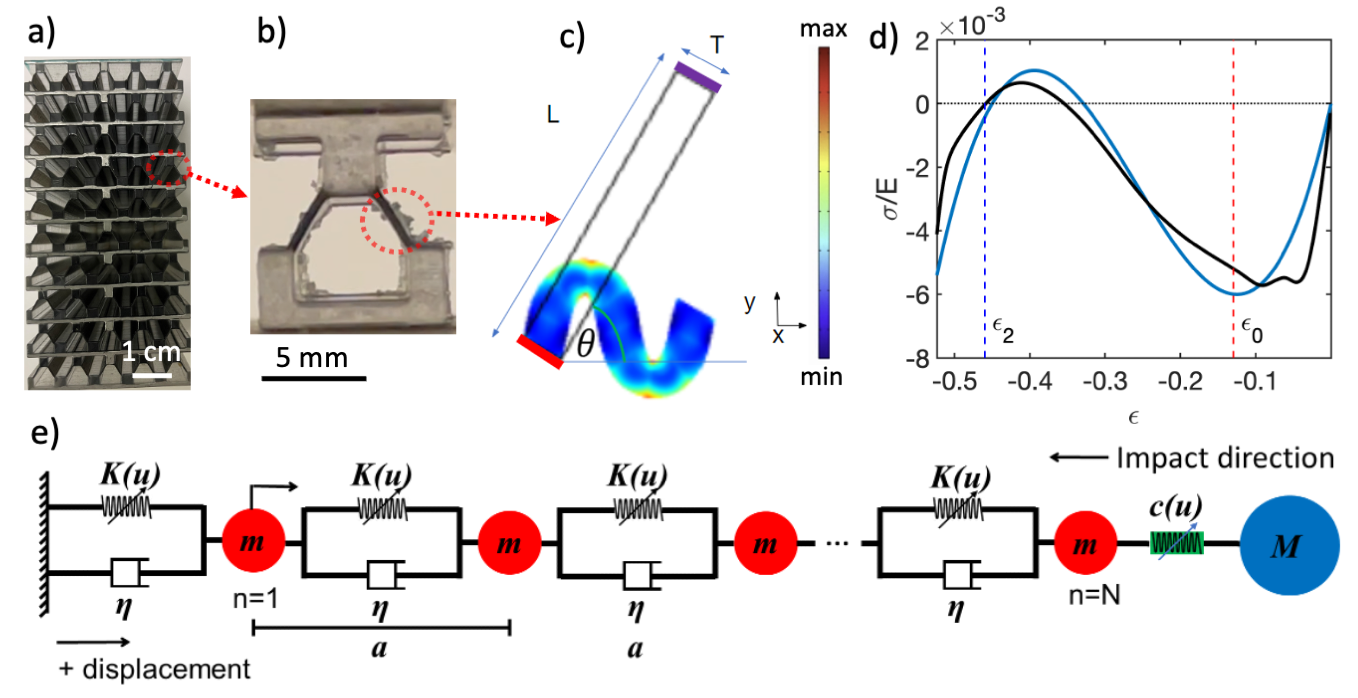
- A discrete element model (DEM) simulates a 1D chain of masses connected by bistable nonlinear springs with linear intersite damping and a contact spring at the boundary for impactor release.
- The model uses a 3rd-order polynomial fit of experimental stress-strain data to define the effective nonlinear spring behavior of the unit cell.
- Simulations vary impactor mass and velocity across a logarithmic sweep, with strain rates reaching ~195 s⁻¹, to assess kinetic energy transmission.
- Performance is quantified by normalized kinetic energy transmission (κ), comparing the bistable metamaterial to a linear control lattice.
- Damping is systematically included to analyze its effect on solitary wave propagation and energy absorption efficiency.
- Analytical estimates based on Eqs. 6 and 7 are used to predict idealized energy absorption capacity and validate simulation trends.
Experimental results
Research questions
- RQ1How does the kinetic energy transmission of a bistable mechanical metamaterial vary with impactor mass and velocity under dynamic loading?
- RQ2What role do solitary waves play in the performance variability of bistable metamaterials during impact?
- RQ3How does the inclusion of intersite damping affect solitary wave propagation and energy absorption in the system?
- RQ4To what extent can analytical models predict the dynamic energy absorption capacity of bistable metamaterials?
- RQ5Can the performance of bistable metamaterials be optimized through tuning of impactor parameters and damping?
Key findings
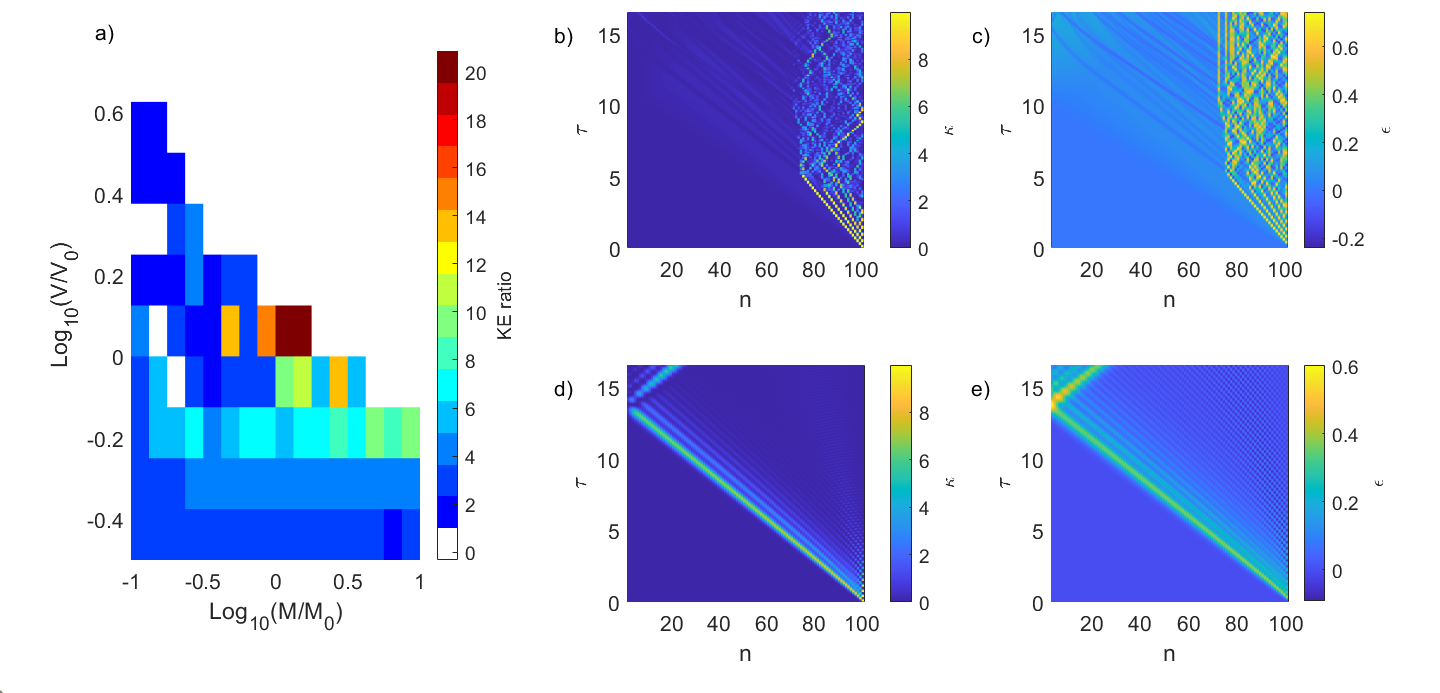
- The kinetic energy transmission of the bistable metamaterial ranged from 0.08× to 20.9× better than the linear control lattice in undamped simulations, depending on impactor mass and velocity.
- In damped simulations, performance varied from 0.21× to 34.6× better than the linear control, indicating a significant performance improvement due to damping.
- Damping reduced traveling wave amplitudes and promoted earlier, more permanent snapping of layers, enhancing energy absorption and reducing rebound effects.
- The best performance occurred at impactor conditions close to nominal (M/M₀ = 10⁻⁰.²⁵, V/V₀ = 10⁰.²⁵), aligning with analytical predictions from Eqs. 6 and 7.
- Solitary wave formation was strongly correlated with performance variability, with wave decay and interference patterns dictating energy transmission outcomes.
- The study suggests that future optimization of unit cell geometry and damping could broaden the range of effective impactor conditions for superior performance.
Read this paper
Open the full text in the Nubint reader and ask about any passage as you read.
Read this paper on NubintThis review was generated by AI from the original paper. Please check the paper before citing it.