
[Paper Review] Deriving a genetic regulatory network from an optimization principle
This paper derives a genetic regulatory network for Drosophila gap gene patterning by optimizing for maximal positional information under biological constraints. Using a stochastic spatial model with noise, diffusion, and regulatory feedback, it shows that optimal networks emerge when resource allocation and noise are minimized, revealing that cross-regulation and multiple maternal morphogens are essential for high-fidelity patterning.
Many biological systems approach physical limits to their performance, motivating the idea that their behavior and underlying mechanisms could be determined by such optimality. Nevertheless, optimization as a predictive principle has only been applied in very simplified setups. Here, in contrast, we explore a mechanistically-detailed class of models for the gap gene network of the Drosophila embryo, and determine its 50+ parameters by optimizing the information that gene expression levels convey about nuclear positions, subject to physical constraints on the number of available molecules. Optimal networks recapitulate the architecture and spatial gene expression profiles of the real organism. Our framework makes precise the many tradeoffs involved in maximizing functional performance, and allows us to explore alternative networks to address the questions of necessity vs contingency. Multiple solutions to the optimization problem may be realized in closely related organisms.
Motivation & Objective
- To determine how genetic regulatory networks evolve to maximize positional information in early embryogenesis.
- To investigate the role of noise, diffusion, and resource constraints in shaping optimal gene regulatory architectures.
- To assess how the number of gap genes and maternal morphogen inputs influence the robustness and precision of embryonic patterning.
- To evaluate the necessity of cross-regulation and feedback in achieving high-fidelity spatial patterning under biological constraints.
Proposed method
- Formulates a spatial-stochastic model of gap gene expression using coupled stochastic differential equations with protein production, degradation, diffusion, and noise.
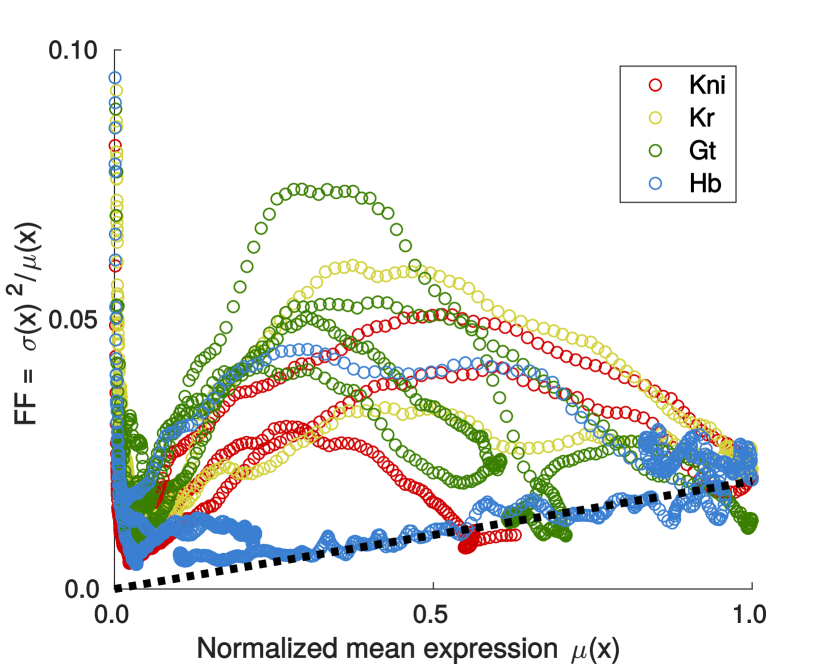
- Introduces normalized protein copy numbers and noise powers to enable comparison across genes with different maximal expression levels.
- Uses a regulatory function based on Hill-type kinetics to model gene activation in response to maternal and gap gene inputs.
- Applies a multi-stage optimization protocol combining simulated annealing and gradient descent to maximize positional information.
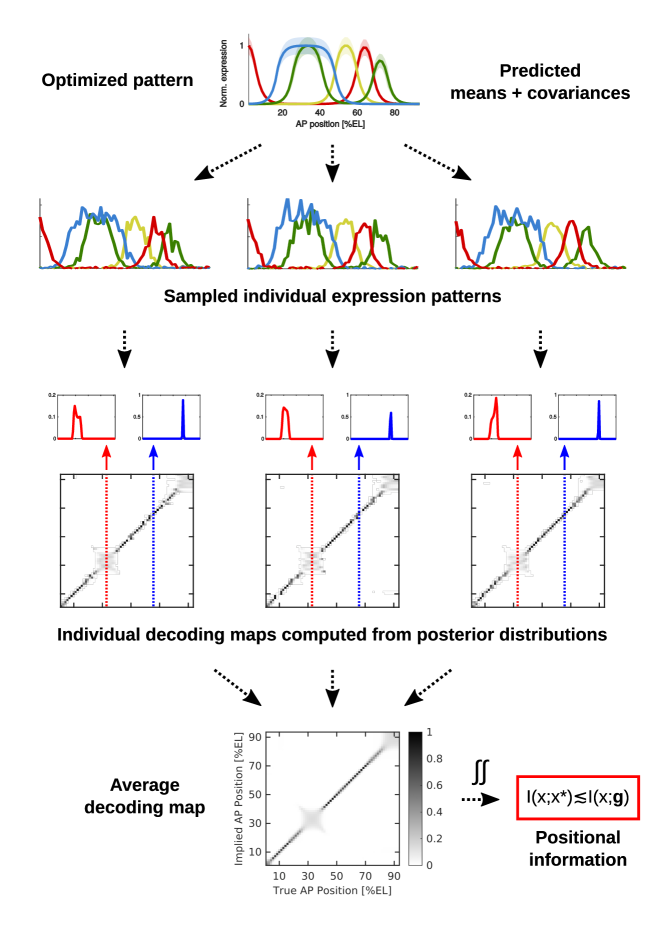
- Computes positional error and information using optimal decoding theory and measures pattern distance to assess diversity and robustness.
- Constrains regulatory strength and explores scenarios with reduced gene numbers or maternal inputs to test network robustness and design principles.
Experimental results
Research questions
- RQ1What regulatory network architecture maximizes positional information in the Drosophila embryo under realistic biological constraints?
- RQ2How do noise, diffusion, and resource allocation shape the optimal structure of the gap gene network?
- RQ3What is the minimal number of gap genes and maternal morphogen inputs required to achieve high-fidelity patterning?
- RQ4How does the absence of cross-regulation or limited regulatory strength affect the robustness and diversity of optimal patterns?
- RQ5To what extent can feed-forward regulation alone achieve high positional information, and how does it compare to full regulatory networks?
Key findings
- Optimal networks achieve maximal positional information of 4.84 bits with 5 gap genes, corresponding to 28 distinguishable positions, with only a 0.07-bit increase from 4 to 5 genes.
- The inclusion of 3 maternal morphogen gradients (anterior, posterior, terminal) enables optimal patterns with higher positional information than using only one gradient, especially at low regulatory strength.
- Cross-regulation and self-regulation significantly compensate for reduced regulatory strength, with H_max = 3 leading to a sharp decline in performance in feed-forward-only networks.
- With only one maternal morphogen input, optimal patterns become asymmetric and concentrate resources in the anterior, highlighting the importance of multiple inputs for balanced patterning.
- Networks with 3 gap genes show localized positional defects, while 4- and 5-gene networks achieve higher and more stable positional information.
- The diversity of optimal patterns is greatly reduced in feed-forward-only networks, especially under low H_max, indicating that feedback is crucial for robust and varied solutions.
Read this paper
Open the full text in the Nubint reader and ask about any passage as you read.
Read this paper on NubintThis review was generated by AI from the original paper. Please check the paper before citing it.