
[논문 리뷰] Design principles for shift current photovoltaics
이 논문은 파장함수에 의존하는 행렬 원소와 밴드 구조 간의 연관성을 규명하는 효과적 밴드모서리 모델을 분석함으로써, 이동 전류 광발전의 최적화를 위한 설계 원칙을 수립한다. 페로일렉트릭 폴리머와 GeS와 같은 단일층 정오각형 단하칼코겐화물이 최상의 후보로 규명되었으며, 이는 100 mA/W를 초과하는 광응답도 예측하고 있다—이러한 결과는 이동 전류 장치가 기존 태양전지의 효율성을 능가할 수 있음을 보여준다.
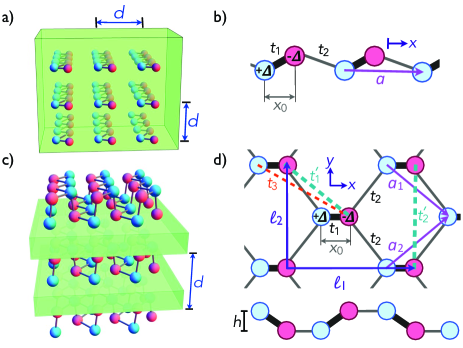
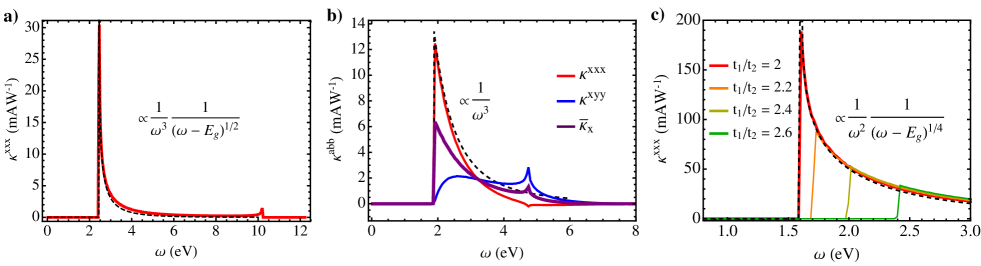
While the basic principles and limitations of conventional solar cells are well understood, relatively little attention has gone toward maximizing the potential efficiency of photovoltaic devices based on shift currents. In this work, we outline simple design principles for the optimization of shift currents for frequencies near the band gap, derived from the analysis of a general effective model. The use of a novel sum rule allows us to express the band edge shift current in terms of a few model parameters and to show it depends explicitly on wavefunctions via Berry connections in addition to standard band structure. We use our approach to identify two new classes of shift current photovoltaics, ferroelectric polymer films and single-layer orthorhombic monochalcogenides such as GeS. We introduce tight-binding models for these systems, and show that they exhibit the largest shift current responsivities at the band edge reported so far. Moreover, exploring the parameter space of these models we find photoresponsivities that can exceed $100$ mA/W. Our results show how the study of the shift current via effective models allows one to improve the possible efficiency of devices based on this mechanism and better grasp their potential to compete with conventional solar cells.
연구 동기 및 목표
- 기존의 pn 접합 한계를 초월해 이동 전류 광발전 효율을 극대화하기 위한 일반적인 설계 원칙을 규명하는 것.
- 전자 파동함수에 의해 결정되는 바이어스된 광전효과(BPVE)의 최적화에 있어 체계적인 이해 부족 문제를 해결하는 것.
- 밴드모서리 이동 전류 반응의 핵심 물리적 메커니즘을 간략화한 최소 효과 모델을 개발하는 것.
- 모델 매개변수를 실제 타이트바인딩 모델과 연계하여 뛰어난 광응답도를 보이는 물질을 예측하는 것.
- 이동 전류 광발전 장치가 기존 태양전지의 성능을 뛰어넘을 수 있음을 입증하는 것.
제안 방법
- 저자들은 밴드모서리 이동 전류를 효과적인 이중밴드 모델로 유도하여, 이를 공동 밀도 상태(JDOS)와 파동함수에 의존하는 행렬 원소의 곱으로 표현한다.
- 파동함수 비대칭성이 강화된 반-디랙 유사 밴드 분포가 이동 전류 계수를 극대화하는 데 최적임을 규명한다.
- 밴드 에너지와 게이지 불변 파동함수 양(특히 베리 기울기 및 양자 미터릭)을 모두 사용해 아비-아이티오 데이터에 타이트바인딩 모델을 피팅함으로써 정확한 파동함수 구조를 확보한다.
- 모델은 GeS와 같은 실제 물질에 대해 파arameter를 피팅함으로써 검증되었으며, 밴드 갭, 효율 질량, 베리 기울기의 도함수 등의 입력을 사용하였다.
- 효과 모델에서는 이동 전류를 해석적으로 계산하고, 타이트바인딩 프레임워크에서는 수치적으로 계산함으로써 매개변수 공간 탐색이 가능해졌다.
- 이 접근법은 밴드 갭 근처에서 이동 전류 반응을 극대화하기 위해 모델 매개변수를 최적화함으로써 고응답도를 보이는 물질을 예측할 수 있게 해준다.
실험 결과
연구 질문
- RQ1물질 특성에 관계없이 밴드 모서리에서 이동 전류 반응을 극대화하는 밴드 구조적 특성은 무엇인가?
- RQ2이동 전류에 기여하는 파동함수 의존성 요소를 예측 모델에 systematic하게 통합하는 방법은 무엇인가?
- RQ3높은 광응답도를 위한 최적의 밴드 구조와 파동함수 비대칭성 조합을 갖춘 물질군은 무엇인가?
- RQ4아비-아이티오 데이터에 기반한 최소 효과 모델을 사용해 실제 물질의 이동 전류를 정확히 예측할 수 있는가?
- RQ5이동 전류 광발전의 이론적 최고 광응답도는 얼마이며, 어떤 물질이 이를 근접하고 있는가?
주요 결과
- 페로일렉트릭 폴리머 필름과 단일층 정오각형 단하칼코겐화물(예: GeS)이 지금까지 보고된 바에 비해 가장 큰 밴드모서리 응답도를 보였다.
- 이동 전류 반응은 밴드 구조 외에도 전자 파동함수의 형태에 매우 민감하며, 반-디랙 유사 분포는 최적의 조건을 제공한다.
- 베리 기울기 및 양자 미터릭을 포함한 아비-아이티오 데이터에 기반해 타이트바인딩 모델을 피팅함으로써, 이동 전류에 핵심적인 파동함수 의존 물리적 메커니즘을 정확히 재현하였다.
- 최적화된 매개변수 영역에서 모델은 100 mA/W를 초과하는 광응답도를 예측하였으며, 이는 기존 광발전 장치의 평균 수준을 크게 뛰어넘는다.
- 저차원적이고 이방성 밴드 구조를 지닌 물질들과 강한 파동함수 비대칭성을 갖는 물질은 고성능 이동 전류 광발전 장치의 이상적인 후보이다.
- 본 연구는 파동함수 민감도 설계 원칙에 기반해 이동 전류 장치를 위한 물질을 식별하고 최적화하기 위한 일반적인 프레임워크를 수립하였다.
더 나은 연구,지금 바로 시작하세요
논문 읽기부터 검토까지, 연구 시간을 획기적으로 줄여보세요.
카드 등록 없음 · 무료 플랜 제공
이 리뷰는 AI가 만들고, 인간 에디터가 검토했습니다.