
[Paper Review] Determination of crossing-symmetric $ππ$ scattering amplitudes and the quark mass evolution of the $σ$ constrained by lattice QCD
This paper introduces a dispersion relation approach to constrain the $σ$ resonance pole position in $\pi\pi$ scattering from lattice QCD data, significantly reducing systematic uncertainty from amplitude parameterization. By enforcing crossing symmetry and analyticity via dispersive constraints on $S$-wave amplitudes at $m_\pi \sim 283$ and $239$ MeV, the method resolves the ambiguity in pole location and reveals the $\sigma$ evolves from a virtual bound state to a broad resonance as the quark mass decreases.
Lattice QCD spectra can be used to constrain partial-wave scattering amplitudes that, while satisfying unitarity, do not have to respect crossing symmetry and analyticity. This becomes a particular problem when extrapolated far from real energies, e.g. in the case of broad resonances like the $σ$, leading to large systematic uncertainties in the pole position. In this manuscript, we will show how dispersion relations can implement the additional constraints, using as input lattice--determined $ππ$ partial-wave scattering amplitudes with isospin--0,1,2. We will show that only certain combinations of amplitude parameterizations satisfy all constraints, and that when we restrict to these, the $σ$ pole position is determined with minimal systematic uncertainty. The evolution of the now well-constrained $σ$ pole with varying light quark mass is presented, showing how it transitions from a bound-state to a broad resonance.
Motivation & Objective
- Address the large systematic uncertainty in $\sigma$ pole position from lattice QCD due to ambiguous amplitude parameterization in the $I=0$ $S$-wave channel.
- Apply dispersion relations to enforce crossing symmetry and analyticity on lattice-determined $\pi\pi$ scattering amplitudes, reducing reliance on arbitrary parameterizations.
- Constrain the quark mass dependence of the $\sigma$ resonance by extending the analysis to two unphysical pion masses ($m_\pi \sim 283$ and $239$ MeV).
- Identify and eliminate unphysical amplitude parameterizations using metric cuts and consistency checks with the Olsson sum rule.
- Provide the first first-principles QCD determination of the $\sigma$ pole evolution with varying light quark mass.
Proposed method
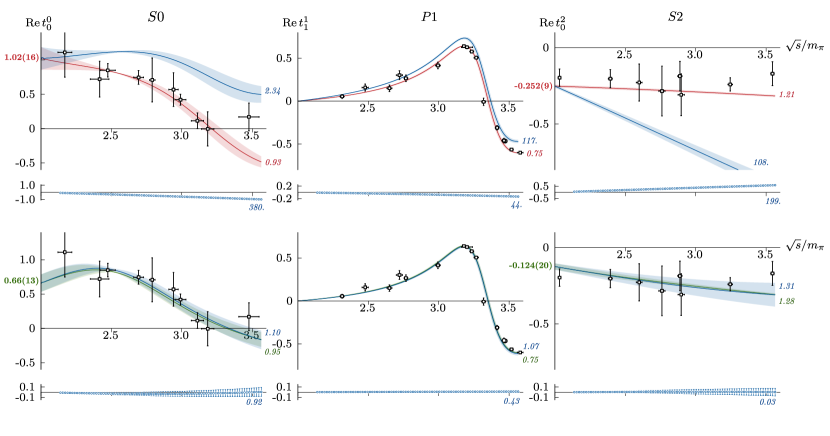
- Use lattice QCD spectra for $\pi\pi$ scattering at $m_\pi \sim 283$ and $239$ MeV to extract unitarity-satisfying $S$-wave amplitudes via finite-volume quantization.
- Apply twice-subtracted dispersion relations to enforce crossing symmetry and analyticity, transforming input amplitudes into dispersive representations.
- Implement metric cuts to reject parameterizations that violate physical constraints, such as unphysical subthreshold singularities or Adler zero inconsistencies.
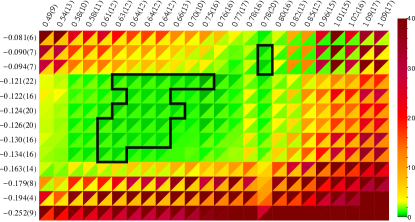
- Test consistency with the Olsson sum rule by computing $\left(\psi / \Delta\psi\right)^2$ to assess the degree of violation in dispersive solutions.
- Perform a systematic scan over $S0$ and $S2$ amplitude parameterizations, retaining only those that satisfy all physical and metric constraints.
- Extract the $\sigma$ pole position and residue from the final set of consistent dispersive amplitudes, focusing on the virtual-bound state pole closest to threshold.
Experimental results
Research questions
- RQ1Can dispersion relations reduce the systematic uncertainty in the $\sigma$ pole position arising from ambiguous amplitude parameterization in lattice QCD?
- RQ2How does the $\sigma$ resonance evolve from a virtual bound state to a broad resonance as the light quark mass is varied in lattice QCD?
- RQ3Which combinations of $S0$ and $S2$ amplitude parameterizations satisfy all physical constraints, including crossing symmetry, unitarity, and the Olsson sum rule?
- RQ4What is the impact of enforcing analyticity and crossing symmetry on the spread of $\sigma$ pole positions in the complex energy plane?
- RQ5Does the dispersive approach resolve the ambiguity in the $\sigma$ pole location at $m_\pi \sim 239$ MeV, where multiple parameterizations yield widely varying results?
Key findings
- The application of twice-subtracted dispersion relations reduces the systematic spread in $\sigma$ pole positions from lattice data by more than an order of magnitude, with the final uncertainty dominated by statistical error.
- Only a small subset of amplitude parameterizations—those satisfying metric cuts and the Olsson sum rule—survive the dispersive filtering, indicating strong physical constraints on acceptable forms.
- At $m_\pi \sim 283$ MeV, the $\sigma$ pole is found to be a virtual bound state, with the dominant solution located just below the $\pi\pi$ threshold in the complex energy plane.
- At $m_\pi \sim 239$ MeV, the $\sigma$ pole remains a virtual bound state, but the dispersion relation approach eliminates the large systematic scatter seen in unconstrained fits.
- The dispersive method reveals a smooth evolution of the $\sigma$ pole with quark mass, transitioning from a bound state at heavier masses to a broad resonance at lighter masses, consistent with chiral perturbation theory expectations.
- The coupling constants of the $\sigma$ pole exhibit large uncertainties only in cases where poles approach the left-hand cut or merge into a single pole, confirming the sensitivity of pole location to parameterization near singularities.
Read this paper
Open the full text in the Nubint reader and ask about any passage as you read.
Read this paper on NubintThis review was generated by AI from the original paper. Please check the paper before citing it.