
[Paper Review] Deterministic Creation of Large Photonic Multipartite Entangled States with Group-IV Color Centers in Diamond
This paper proposes a deterministic scheme for generating large photonic multipartite entangled states—specifically linear cluster states and GHZ states—using group-IV color centers (G4Vs), particularly the tin vacancy (SnV) in diamond. By employing an off-resonant Raman scheme for fast, high-fidelity spin control and Purcell-enhanced photon emission, the method achieves >99% gate fidelity and a state creation rate of up to 9 Hz for 100-photon states, demonstrating feasibility for scalable photonic quantum technologies.
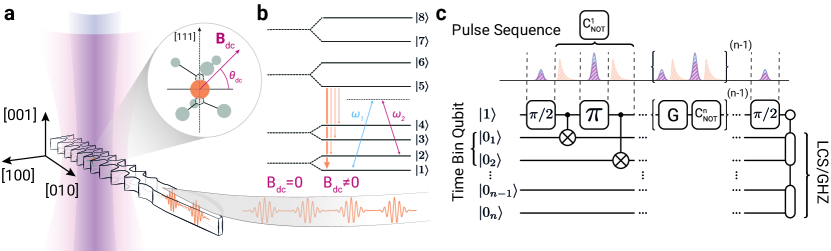
Measurement-based quantum computation relies on single qubit measurements of large multipartite entangled states, so-called lattice-graph or cluster states. Graph states are also an important resource for quantum communication, where tree cluster states are a key resource for one-way quantum repeaters. A photonic realization of this kind of state would inherit many of the benefits of photonic platforms, such as very little dephasing due to weak environmental interactions and the well-developed infrastructure to route and measure photonic qubits. In this work, a linear cluster state and GHZ state generation scheme is developed for group-IV color centers. In particular, this article focuses on an in-depth investigation of the required control operations, including the coherent spin and excitation gates. We choose an off-resonant Raman scheme for the spin gates, which can be much faster than microwave control. We do not rely on a reduced level scheme and use efficient approximations to design high-fidelity Raman gates. We benchmark the spin-control and excitation scheme using the tin vacancy color center coupled to a cavity, assuming a realistic experimental setting. Additionally, the article investigates the fidelities of the Raman and excitation gates in the presence of radiative and non-radiative decay mechanisms. Finally, a quality measure is devised, which emphasizes the importance of fast and high-fidelity spin gates in the creation of large entangled photonic states.
Motivation & Objective
- To develop a deterministic, scalable method for generating large photonic multipartite entangled states using solid-state emitters.
- To overcome limitations of microwave control in group-IV color centers by implementing fast, all-optical Raman-based spin gates.
- To optimize spin-photon entanglement and gate fidelities under realistic decoherence mechanisms, including radiative and non-radiative decay.
- To establish a quality metric that prioritizes fast, high-fidelity operations for scalable quantum information applications.
- To evaluate the feasibility of generating large-scale cluster and GHZ states with high fidelity and practical rates in realistic experimental settings.
Proposed method
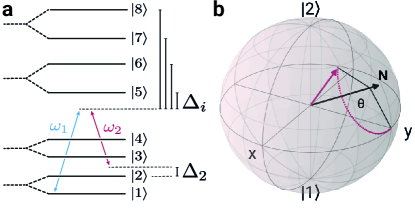
- Utilizes an off-resonant Raman scheme with Gaussian laser pulses to implement single-qubit spin rotations on the SnV center, avoiding slow microwave control.
- Employs a sawfish nanocavity to enhance the Purcell effect on the desired transition, increasing photon collection efficiency and indistinguishability.
- Models the spin dynamics using a 9-level Hamiltonian including Zeeman splitting and laser coupling, with approximations to enable efficient gate optimization.
- Incorporates relaxation processes (radiative and non-radiative decay) into the master equation to simulate realistic gate fidelities under decoherence.
- Optimizes pulse shapes and durations using numerical simulations to minimize transient population in non-target states, especially |7⟩ and |8⟩.
- Introduces a quality measure that balances state fidelity, creation rate, and temporal size, favoring short pulses to reduce photon loss in fiber links.
Experimental results
Research questions
- RQ1Can off-resonant Raman control achieve high-fidelity single-qubit gates on group-IV color centers in diamond, outperforming microwave-based methods?
- RQ2How do radiative and non-radiative decay processes affect the fidelity of spin and excitation gates in the SnV system?
- RQ3What is the optimal pulse duration and magnetic field strength for maximizing gate fidelity and state creation rate in a realistic experimental setup?
- RQ4How does the proposed scheme scale to large photonic multipartite entangled states (e.g., 100-photon linear cluster states) in terms of fidelity and rate?
- RQ5What role does photon collection efficiency play in the overall performance and scalability of the scheme?
Key findings
- A π-rotation gate fidelity of 0.9988 and an excitation gate fidelity of 0.9984 were achieved at a magnetic field of 8 T, significantly reducing transient population in non-target states.
- For a 100-photon linear cluster state, the quality measure reached Q(LCS,100) = 1.1 × 10⁻¹⁵ with a creation rate of 9 Hz using pulses shorter than 73.33 ps.
- The state creation rate drops exponentially with total coupling efficiency η, with η_total(100) ≈ 0.13 for η = 0.98, highlighting the need for near-unity coupling efficiency.
- Pulse durations below 73.33 ps maximize the quality of the generated states, reducing temporal size and minimizing fiber-induced photon loss.
- A 1% deviation in laser pulse power causes approximately 4% reduction in gate fidelity, indicating moderate robustness to control field imperfections.
- The study demonstrates that high-fidelity, deterministic generation of large photonic multipartite entangled states is feasible with G4Vs using all-optical Raman control, even without full optimization of pulse shapes.
Read this paper
Open the full text in the Nubint reader and ask about any passage as you read.
Read this paper on NubintThis review was generated by AI from the original paper. Please check the paper before citing it.