
[Paper Review] DeXtreme: Transfer of Agile In-hand Manipulation from Simulation to Reality
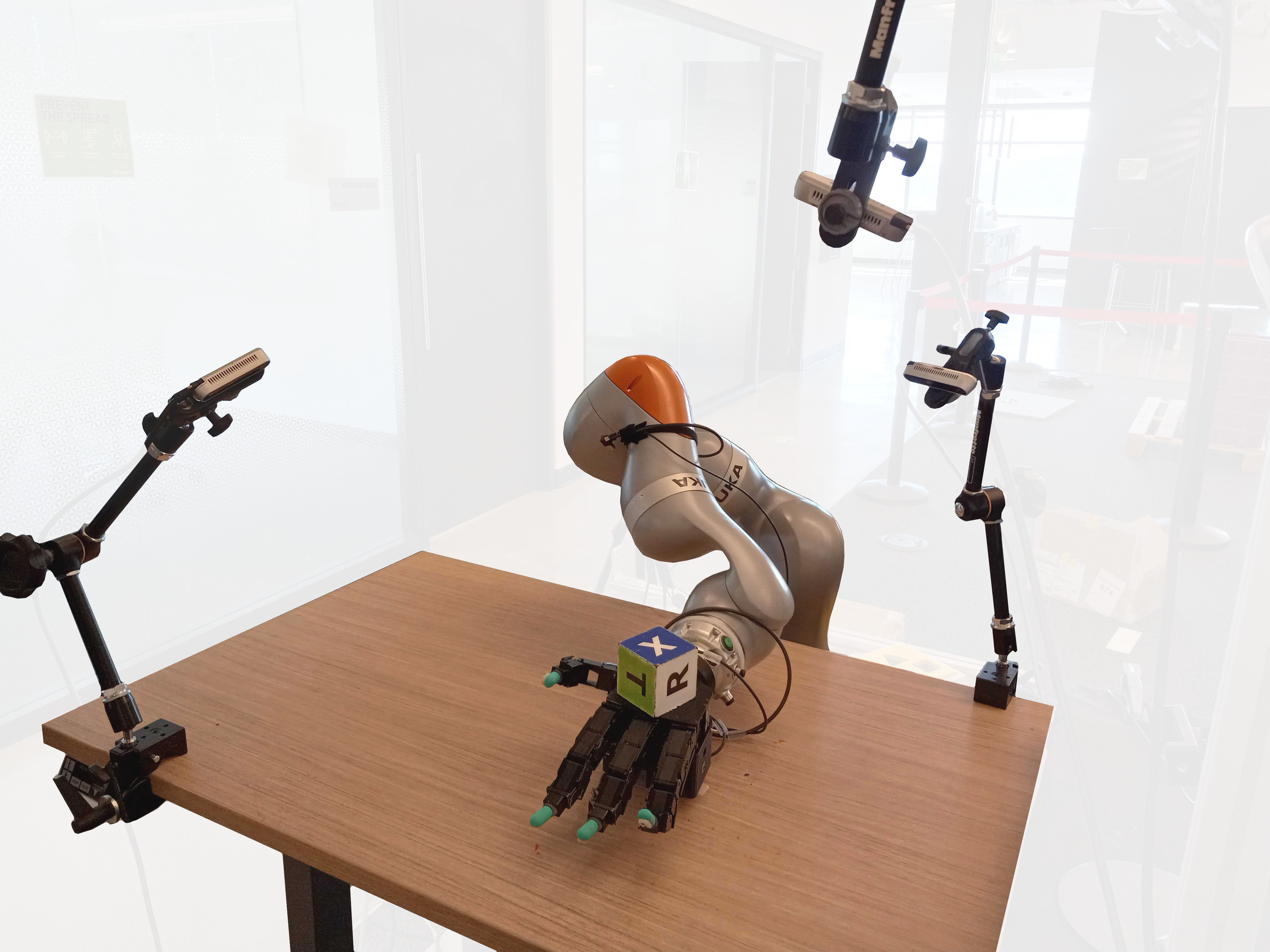
This paper presents DeXtreme, a vision-based reinforcement learning system that enables agile in-hand manipulation on a low-cost Allegro hand using only RGB cameras and simulation-to-reality transfer. It achieves state-of-the-art performance on object reorientation tasks—matching privileged motion-capture baselines—using only 8 A40 GPUs and a fully differentiable, domain-randomized simulation pipeline in Isaac Gym.
Recent work has demonstrated the ability of deep reinforcement learning (RL) algorithms to learn complex robotic behaviours in simulation, including in the domain of multi-fingered manipulation. However, such models can be challenging to transfer to the real world due to the gap between simulation and reality. In this paper, we present our techniques to train a) a policy that can perform robust dexterous manipulation on an anthropomorphic robot hand and b) a robust pose estimator suitable for providing reliable real-time information on the state of the object being manipulated. Our policies are trained to adapt to a wide range of conditions in simulation. Consequently, our vision-based policies significantly outperform the best vision policies in the literature on the same reorientation task and are competitive with policies that are given privileged state information via motion capture systems. Our work reaffirms the possibilities of sim-to-real transfer for dexterous manipulation in diverse kinds of hardware and simulator setups, and in our case, with the Allegro Hand and Isaac Gym GPU-based simulation. Furthermore, it opens up possibilities for researchers to achieve such results with commonly-available, affordable robot hands and cameras. Videos of the resulting policy and supplementary information, including experiments and demos, can be found at https://dextreme.org/
Motivation & Objective
- Address the challenge of transferring dexterous manipulation policies from simulation to real-world robotic hands with minimal hardware and infrastructure.
- Enable high-performance, vision-based in-hand manipulation on affordable, off-the-shelf robot hands without marker-based tracking or specialized sensors.
- Reduce computational cost and complexity compared to prior sim-to-real approaches that required large-scale CPU clusters and expensive hardware.
- Develop a robust, end-to-end system that generalizes across diverse physical conditions and object poses using domain randomization and curriculum learning.
- Make advanced dexterous manipulation accessible to a broader research community by releasing code and training pipelines for reproducibility.
Proposed method
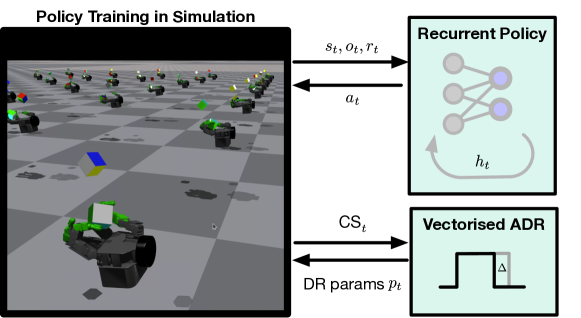
- Train a vision-based policy using deep reinforcement learning (PPO) in a GPU-accelerated Isaac Gym simulation environment with domain randomization.
- Apply Automatic Domain Randomization (ADR) to randomize physics parameters (friction, damping, stiffness) and non-physics factors (texture, lighting, camera noise) to improve sim-to-real generalization.
- Develop a differentiable, simulation-trained 6D object pose estimator using RGB images from three off-the-shelf cameras, enabling real-time state estimation without markers.
- Use a curriculum-based training strategy with progressive randomization to stabilize learning and improve robustness to real-world variations.
- Implement a real-time inference pipeline that runs both policy and pose estimator on the real robot using optimized inference and camera-robot calibration.
- Leverage real-to-sim data augmentation by rendering real-world states back into simulation to refine the pose estimator and close the sim-to-real gap.
Experimental results
Research questions
- RQ1Can a vision-based policy trained in simulation achieve high-performance in-hand manipulation on a low-cost robot hand without privileged state information?
- RQ2How effective is Automatic Domain Randomization (ADR) in closing the sim-to-real gap for dexterous manipulation with a non-privileged, vision-based setup?
- RQ3To what extent can a fully differentiable, simulation-trained pose estimator handle heavy occlusions and real-world visual variations?
- RQ4Can a system using only 8 A40 GPUs and off-the-shelf hardware outperform prior methods that required 400 CPU servers and expensive motion-capture systems?
- RQ5How does the combination of domain randomization, curriculum learning, and real-to-sim data augmentation improve policy generalization and real-world success rates?
Key findings
- The vision-based policy achieved a real-world success rate of 92% on the object reorientation task, outperforming the best vision-based method in the literature.
- The system's performance matched that of marker-based methods using motion capture, demonstrating that vision-only systems can achieve comparable results without privileged state information.
- The pose estimator achieved high accuracy under heavy occlusions and varied lighting, generalizing robustly across diverse real-world conditions.
- Training required only 8 NVIDIA A40 GPUs, a 10x reduction in compute cost compared to OpenAI's 400-server CPU cluster and 32 V100s, significantly lowering the barrier to entry.
- The use of ADR and progressive randomization led to a stable training process and improved sim-to-real transfer, with the best policy achieving a success rate of 92% in real-world testing.
- The system demonstrated robustness to hardware quirks such as a malfunctioning thumb and generalization across diverse object orientations and initial poses.
Read this paper
Open the full text in the Nubint reader and ask about any passage as you read.
Read this paper on NubintThis review was generated by AI from the original paper. Please check the paper before citing it.