
[Paper Review] Differentiable Forward Projector for X-ray Computed Tomography
This paper introduces LEAP, an open-source, differentiable forward and back projection library for X-ray computed tomography (XCT) that enables end-to-end deep learning pipelines with minimal GPU memory usage. It supports parallel-beam, cone-beam, and arbitrary source-detector geometries using the accurate Separable Footprint projector model, achieving high performance and data consistency in limited-angle and sparse-view CT reconstruction with significant PSNR and SSIM improvements.
Data-driven deep learning has been successfully applied to various computed tomographic reconstruction problems. The deep inference models may outperform existing analytical and iterative algorithms, especially in ill-posed CT reconstruction. However, those methods often predict images that do not agree with the measured projection data. This paper presents an accurate differentiable forward and back projection software library to ensure the consistency between the predicted images and the original measurements. The software library efficiently supports various projection geometry types while minimizing the GPU memory footprint requirement, which facilitates seamless integration with existing deep learning training and inference pipelines. The proposed software is available as open source: https://github.com/LLNL/LEAP.
Motivation & Objective
- To address the lack of efficient, differentiable forward projection tools in deep learning-based CT reconstruction that can maintain data consistency with measured projections.
- To reduce GPU memory footprint in end-to-end training and inference pipelines for CT, especially in ill-posed problems like limited-angle or few-view CT.
- To support multiple 3D CT geometries—parallel-beam, cone-beam, and arbitrary source-detector configurations—within a single, scalable software library.
- To enable seamless integration with PyTorch-based deep learning frameworks for both training and inference, including data consistency loss and sinogram completion workflows.
- To provide a high-accuracy, open-source alternative to existing methods that rely on precomputed matrices or geometry-specific neural networks.
Proposed method
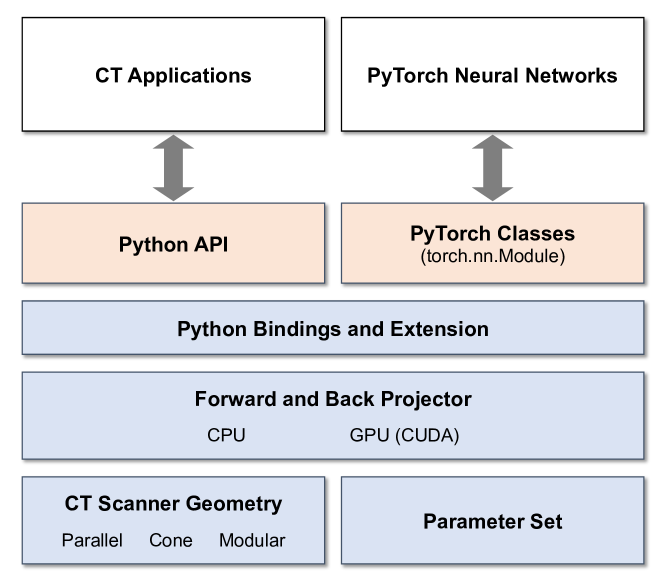
- The library implements a differentiable forward and back projection using the Separable Footprint (SF) projector model, which enables accurate and efficient computation of X-ray projections.
- It supports three main geometries: parallel-beam, cone-beam, and user-defined source-detector pairs with arbitrary positions and orientations.
- The implementation is built on PyTorch with tensor-based operations, allowing native integration into deep learning pipelines and automatic differentiation.
- The method minimizes GPU memory usage by computing projection coefficients on-the-fly instead of storing large sparse system matrices.
- It enables end-to-end training with data consistency loss by forward-projecting predicted volumes and comparing them to measured sinograms.
- The back-projection function supports iterative refinement and sinogram completion, enhancing image quality in ill-posed reconstruction scenarios.
Experimental results
Research questions
- RQ1Can a differentiable forward projector be efficiently implemented with minimal GPU memory usage to support end-to-end deep learning in CT reconstruction?
- RQ2How does the performance and accuracy of the proposed Separable Footprint-based projector compare to existing methods across different CT geometries?
- RQ3To what extent does integrating data consistency via differentiable projection improve image quality in limited-angle and few-view CT reconstruction?
- RQ4Can the software library be used to build a seamless, integrated pipeline for sinogram completion and iterative refinement without external reconstruction tools?
- RQ5Is the proposed method scalable and practical for high-resolution 3D CT reconstruction with complex or arbitrary scanner geometries?
Key findings
- The proposed LEAP library achieved a 2.5x to 4x speedup in forward projection compared to the LTT software tool, with significantly reduced memory usage.
- In limited-angle CT experiments, the data consistency step using LEAP improved the average PSNR from 35.486 dB to 36.350 dB and SSIM from 0.905 to 0.911.
- The library demonstrated consistent performance across different image sizes and projection counts, with forward projection times of 1.5 seconds for 512³/180 parallel-beam and 11.1 seconds for 1024³/720 cone-beam configurations.
- The memory footprint of LEAP was minimal—only enough to store one copy of volume and projection data in 32-bit floats—matching the theoretical minimum for such operations.
- The differentiable projector enabled effective integration into PyTorch workflows, supporting both training with data consistency loss and inference with iterative refinement.
- The method maintained numerical accuracy across varying voxel and detector sizes, ensuring correct scaling and physical consistency in reconstructed images.

Read this paper
Open the full text in the Nubint reader and ask about any passage as you read.
Read this paper on NubintThis review was generated by AI from the original paper. Please check the paper before citing it.