
[Paper Review] Differentially private inference via noisy optimization
This paper proposes a novel differentially private optimization framework using noisy gradient descent and noisy Newton methods to compute private M-estimators with global convergence guarantees under local strong convexity or self-concordance. It achieves near-minimax optimal estimation and enables asymptotically valid confidence regions via private variance estimation, significantly improving small-sample coverage through a bias correction method.
We propose a general optimization-based framework for computing differentially private M-estimators and a new method for constructing differentially private confidence regions. Firstly, we show that robust statistics can be used in conjunction with noisy gradient descent or noisy Newton methods in order to obtain optimal private estimators with global linear or quadratic convergence, respectively. We establish local and global convergence guarantees, under both local strong convexity and self-concordance, showing that our private estimators converge with high probability to a small neighborhood of the non-private M-estimators. Secondly, we tackle the problem of parametric inference by constructing differentially private estimators of the asymptotic variance of our private M-estimators. This naturally leads to approximate pivotal statistics for constructing confidence regions and conducting hypothesis testing. We demonstrate the effectiveness of a bias correction that leads to enhanced small-sample empirical performance in simulations. We illustrate the benefits of our methods in several numerical examples.
Motivation & Objective
- To develop a general optimization-based framework for differentially private M-estimation that ensures privacy while maintaining statistical efficiency.
- To establish global finite-sample convergence for noisy gradient descent under local strong convexity, achieving linear convergence to a near-optimal neighborhood.
- To introduce a differentially private Newton method with quadratic convergence under similar conditions, avoiding backtracking via fixed damped steps.
- To construct asymptotically valid confidence regions using differentially private estimators of the asymptotic variance via a noisy sandwich formula.
- To improve small-sample performance through a novel bias correction method for confidence region coverage.
Proposed method
- Uses noisy gradient descent with privacy-inducing noise added at each iteration, leveraging robust M-estimators to avoid issues from gradient clipping.
- Applies noisy Newton steps by injecting noise into both gradient and Hessian at each iterate, ensuring differential privacy while maintaining convergence.
- Employs a two-phase strategy: damped Newton steps with fixed step size η < 1 when far from solution, transitioning to pure Newton (η = 1) when a verifiable condition is met.
- Constructs differentially private confidence regions using a matrix-valued noise mechanism on the sandwich variance estimator, ensuring privacy of both variance components.
- Introduces a bias correction to the private variance estimator to enhance coverage probability in small samples.
- Calibrates privacy using μ-GDP (Gaussian Differential Privacy) and ensures convergence via local strong convexity or self-concordance assumptions.
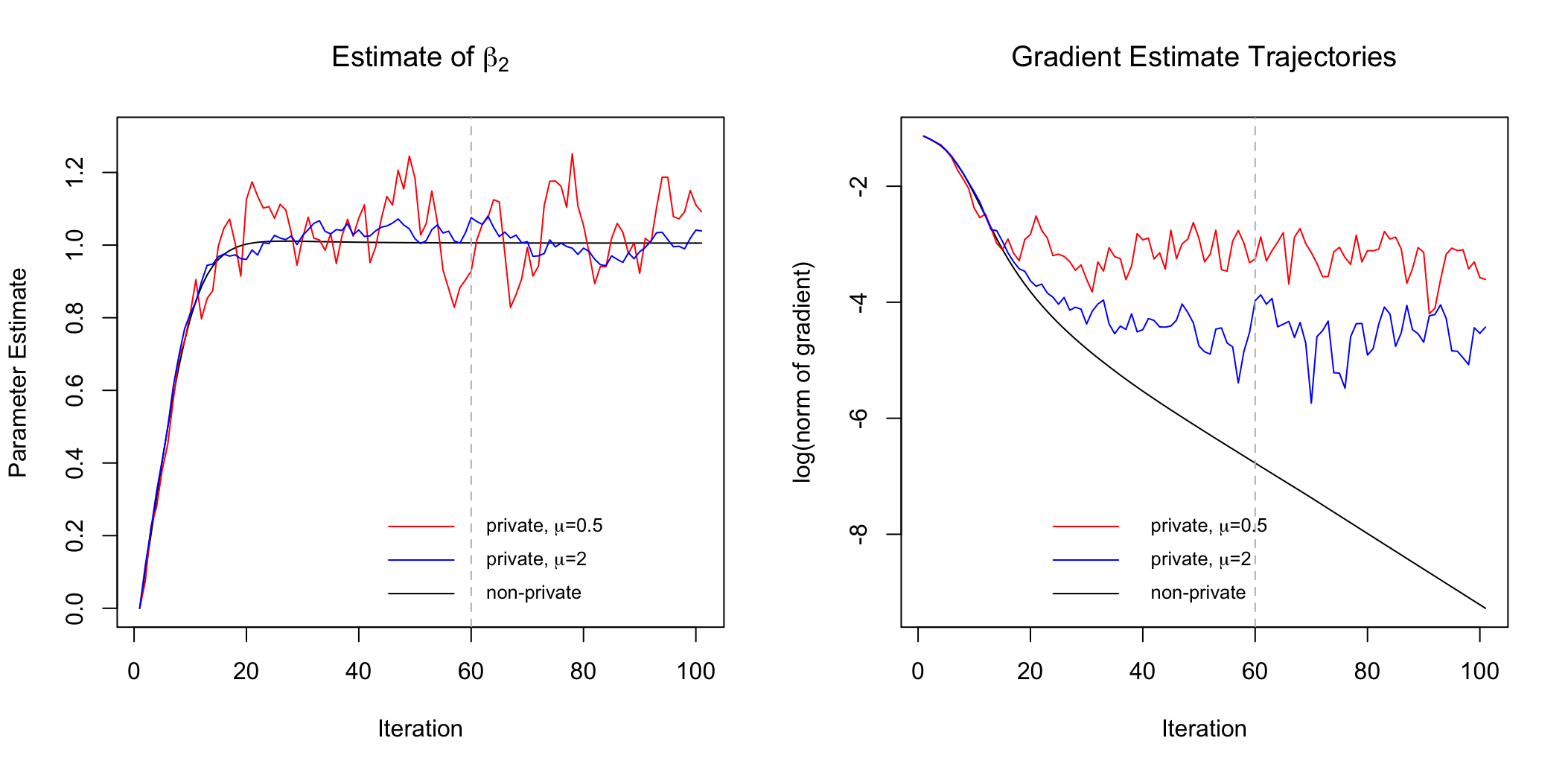
Experimental results
Research questions
- RQ1Can noisy gradient descent with robust M-estimators achieve global linear convergence and near-minimax optimality under differential privacy?
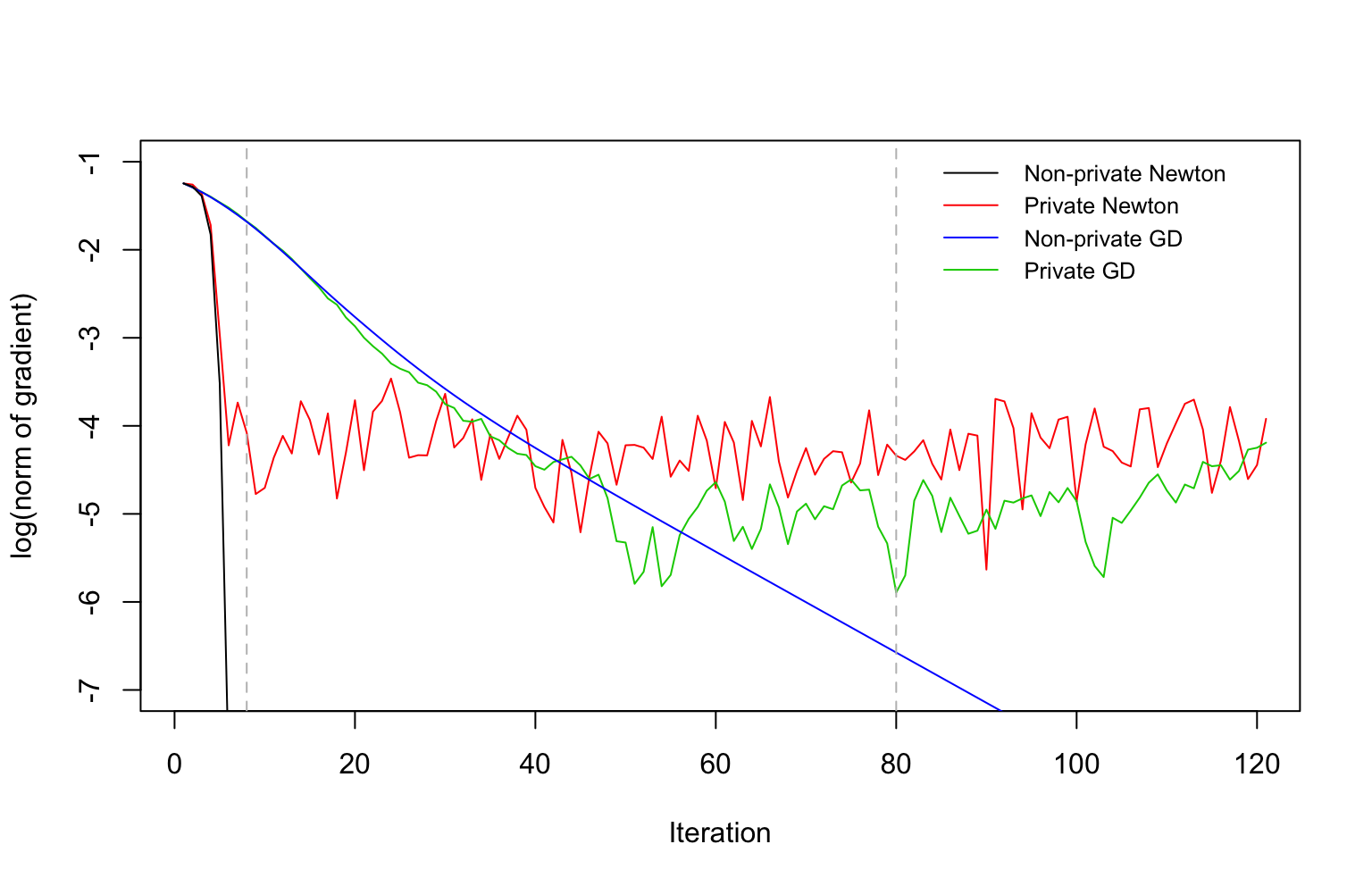
- RQ2Does a differentially private Newton method with noise in both gradient and Hessian achieve quadratic convergence and improved performance over gradient descent?
- RQ3Can private estimators of the asymptotic variance be constructed to enable asymptotically valid confidence regions under differential privacy?
- RQ4How does a proposed bias correction improve the empirical coverage of private confidence intervals in small samples?
- RQ5How do robust M-estimators compare to gradient clipping and objective perturbation in terms of estimation error and bias under differential privacy?
Key findings
- Noisy gradient descent with robust M-estimators achieves global linear convergence to a small neighborhood of the non-private M-estimator under local strong convexity, with high probability.
- The noisy Newton method converges quadratically to a near-optimal solution under local strong convexity or self-concordance, outperforming noisy gradient descent when initialized far from the optimum.
- The proposed confidence region construction using a private sandwich formula achieves asymptotic validity and significantly improves small-sample coverage probability via bias correction.
- In simulations, noisy gradient descent with robust weights outperforms objective perturbation and gradient clipping in bounded data regimes, especially when clipping is minimal.
- In unbounded data settings, noisy gradient descent with robust weights and objective perturbation with Mallows weights perform comparably, while gradient clipping introduces noticeable bias.
- The bias correction method substantially enhances empirical coverage of confidence intervals, particularly in low-sample regimes, without compromising privacy guarantees.
Read this paper
Open the full text in the Nubint reader and ask about any passage as you read.
Read this paper on NubintThis review was generated by AI from the original paper. Please check the paper before citing it.