
[Paper Review] Direct speech-to-speech translation with a sequence-to-sequence model
This paper proposes Translatotron, an end-to-end sequence-to-sequence model that directly translates speech from one language to speech in another without intermediate text representations. It leverages multitask training with speech-to-text transcription heads during training to stabilize learning, while enabling voice transfer to preserve the source speaker's voice in the output; though performance lags behind cascaded systems, it demonstrates the feasibility of direct speech-to-speech translation with end-to-end training and speaker identity preservation.
We present an attention-based sequence-to-sequence neural network which can directly translate speech from one language into speech in another language, without relying on an intermediate text representation. The network is trained end-to-end, learning to map speech spectrograms into target spectrograms in another language, corresponding to the translated content (in a different canonical voice). We further demonstrate the ability to synthesize translated speech using the voice of the source speaker. We conduct experiments on two Spanish-to-English speech translation datasets, and find that the proposed model slightly underperforms a baseline cascade of a direct speech-to-text translation model and a text-to-speech synthesis model, demonstrating the feasibility of the approach on this very challenging task.
Motivation & Objective
- To develop a direct end-to-end speech-to-speech translation system that bypasses intermediate text representations.
- To investigate whether multitask training with speech-to-text transcription heads can stabilize training for direct S2ST without compromising end-to-end inference.
- To enable voice transfer, preserving the source speaker’s voice in the translated output speech.
- To evaluate the model’s performance on real-world Spanish-to-English speech translation datasets, comparing it to cascaded baselines.
- To explore the feasibility of learning cross-lingual prosody and speaker identity transfer in a unified end-to-end framework.
Proposed method
- The model uses a stack of 8-layer bidirectional LSTM encoders with attention mechanisms to process input speech spectrograms and speaker embeddings.
- It employs a two-stream decoder: one for generating target spectrograms and another for phoneme prediction, enabling multitask learning with auxiliary transcription tasks.
- The speaker encoder extracts speaker embeddings from reference utterances, which are used during training to condition the voice transfer process.
- The model is trained end-to-end using a combination of synthetic targets and real speech data, with loss functions for translation, phoneme recognition, and voice transfer.
- Voice transfer is achieved by conditioning the decoder on both the source speech and a speaker embedding from a target speaker, allowing synthesis in the source speaker’s voice.
- A vocoder converts the predicted spectrograms into waveform outputs for evaluation.
Experimental results
Research questions
- RQ1Can an end-to-end sequence-to-sequence model achieve direct speech-to-speech translation without relying on intermediate text representations?
- RQ2How effective is multitask training with auxiliary speech-to-text transcription heads in stabilizing training for direct S2ST?
- RQ3To what extent can the model preserve the source speaker’s voice in the translated output speech?
- RQ4How does the performance of the direct S2ST model compare to a cascaded system of speech-to-text translation and text-to-speech synthesis?
- RQ5What are the main challenges in training a direct S2ST model, particularly regarding alignment and data scarcity?
Key findings
- The direct S2ST model achieves a BLEU score of 33.6 when conditioned on the source speaker’s voice, compared to 36.2 when using ground-truth target speaker embeddings.
- The model’s translation quality is slightly lower than a cascaded ST+TTS baseline, indicating that direct training remains challenging despite multitask supervision.
- Voice transfer performance is significantly lower when conditioning on the source speaker (MOS-similarity: 1.85) compared to using ground-truth target speakers (MOS-similarity: 3.30), suggesting poor generalization of speaker embeddings across languages.
- Conditioning on random target utterances yields similar BLEU (35.4) and MOS scores (3.08) to source speaker conditioning, indicating no significant content leakage from speaker embeddings.
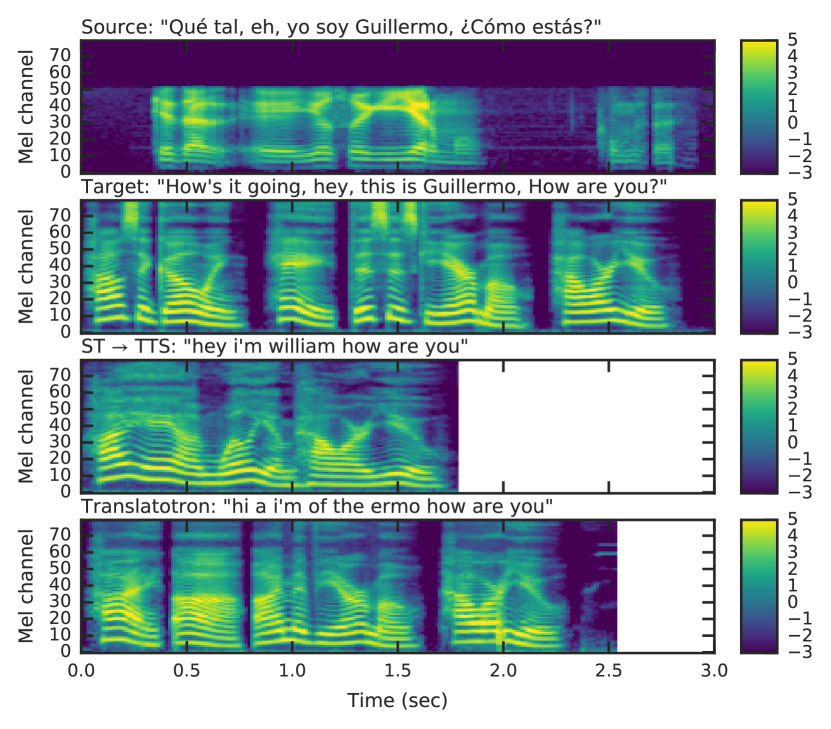
- The model successfully preserves cognates and proper names (e.g., 'Guillermo' is retained as 'Guillermo' rather than translated to 'William'), suggesting a bias toward direct phonetic retention.
- The model demonstrates that end-to-end training with auxiliary transcription tasks enables stable learning for direct S2ST, even with limited parallel speech data.
Read this paper
Open the full text in the Nubint reader and ask about any passage as you read.
Read this paper on NubintThis review was generated by AI from the original paper. Please check the paper before citing it.