
[Paper Review] Disk settling and dynamical heating: histories of Milky Way-mass stellar disks across cosmic time in the FIRE simulations
This study uses FIRE-2 cosmological simulations to analyze the kinematic evolution of Milky Way-mass stellar disks, distinguishing between disk settling (cosmological evolution) and post-formation dynamical heating. It reveals three eras of star formation: a turbulent pre-disk phase (σ_form peaking ~8 Gyr ago), an early-disk phase with high dispersion, and a late-disk phase with cold formation. Crucially, most velocity dispersion today is inherited at formation for stars younger than ~10 Gyr, with post-formation heating primarily increasing radial dispersion in younger stars.
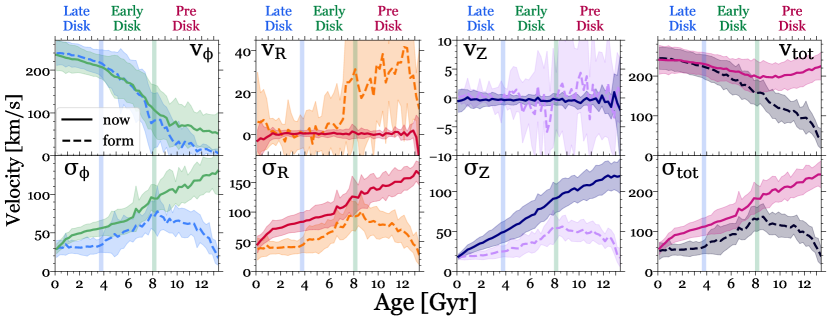
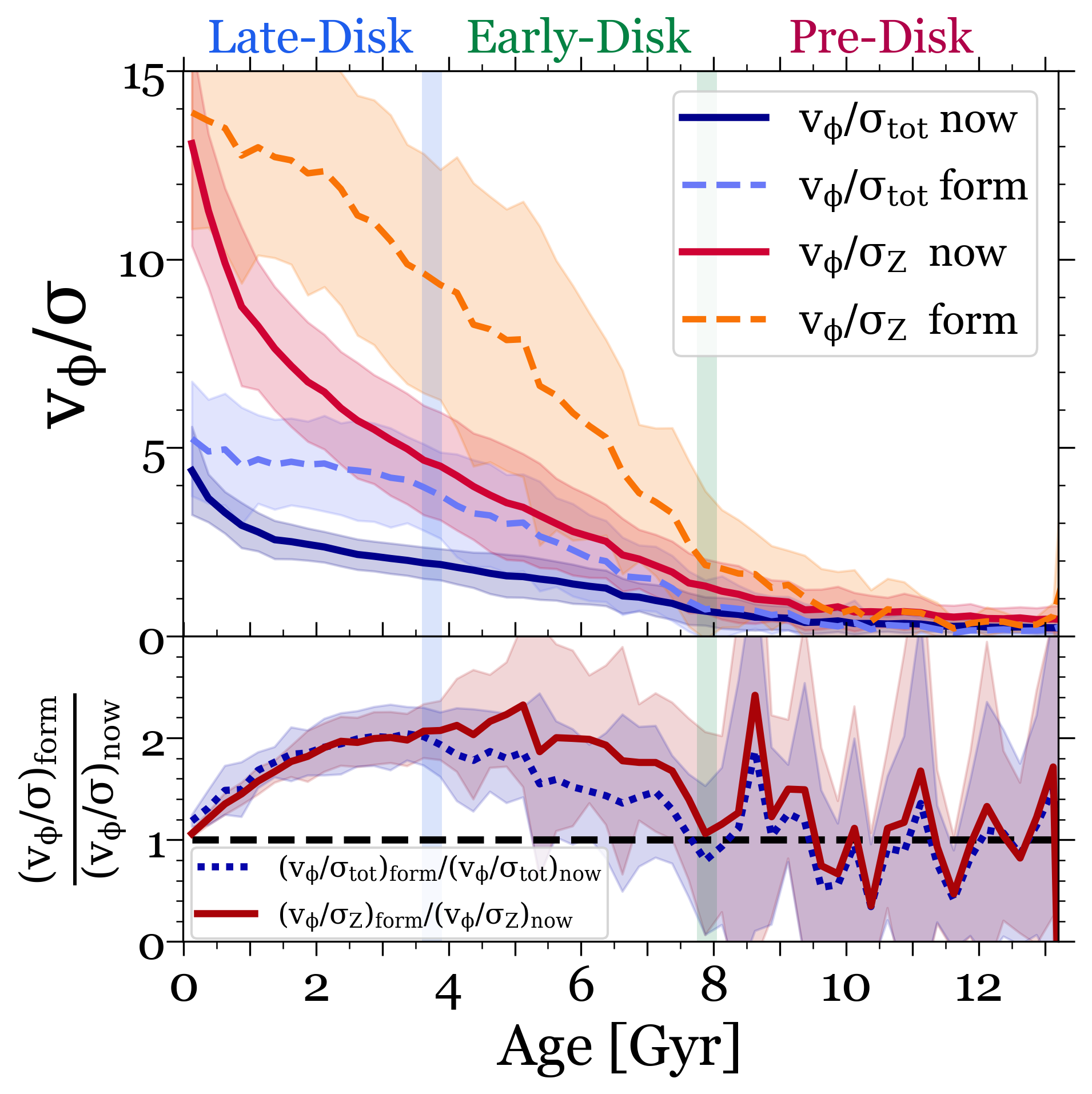
We study the kinematics of stars both at their formation and today within 14 Milky Way (MW)-mass galaxies from the FIRE-2 cosmological zoom-in simulations. We quantify the relative importance of cosmological disk settling and post-formation dynamical heating. We identify three eras: a Pre-Disk Era (typically >8 Gyr ago), when stars formed on dispersion-dominated orbits; an Early-Disk Era (~ 8 - 4 Gyr ago), when stars started to form on rotation-dominated orbits but with high velocity dispersion, sigma_form; and a Late-Disk Era (< 4 Gyr ago), when stars formed with low sigma_form. sigma_form increased with time during the Pre-Disk Era, peaking ~ 8 Gyr ago, then decreased throughout the Early-Disk Era as the disk settled and remained low throughout the Late-Disk Era. By contrast, the velocity dispersion measured today, sigma_now, increases monotonically with age because of stronger post-formation heating for Pre-Disk stars. Importantly, most of sigma_now was in place at formation, not added post-formation, for stars younger than ~ 10 Gyr. We compare the evolution of the three velocity components: at all times, sigma_R,form > sigma_phi,form > sigma_Z,form. Post-formation heating primarily increased sigma_R at ages < 4 Gyr but acted nearly isotropically for older stars. The kinematics of young stars in FIRE-2 broadly agree with the range observed across the MW, M31, M33, and PHANGS-MUSE galaxies. The lookback time that the disk began to settle correlates with its dynamical state today: earlier-settling galaxies currently form colder disks. Including stellar cosmic-ray feedback does not significantly change disk rotational support at fixed stellar mass.
Motivation & Objective
- To disentangle the contributions of cosmological disk settling and post-formation dynamical heating to the kinematics of Milky Way-mass stellar disks.
- To quantify how the velocity dispersion at formation (σ_form) and today (σ_now) evolve over cosmic time in high-resolution simulations.
- To compare simulated stellar kinematics with observations of the Milky Way, M31, M33, and PHANGS-MUSE galaxies to assess realism.
- To investigate whether early disk settling correlates with colder disks today and whether stellar cosmic-ray feedback alters rotational support.
- To determine whether observed disk kinematics reflect initial conditions or later dynamical processes, especially for old, metal-poor stars.
Proposed method
- Utilized 14 high-resolution FIRE-2 cosmological zoom-in simulations of Milky Way-mass galaxies with full physics including star formation, feedback, and cosmological evolution.
- Tracked individual stars from formation to present, measuring their velocity dispersion (σ_form) at birth and current dispersion (σ_now) to isolate post-formation heating effects.
- Classified star formation into three eras: Pre-Disk (≥8 Gyr ago), Early-Disk (8–4 Gyr ago), and Late-Disk (≤4 Gyr ago) based on orbital dynamics and dispersion evolution.
- Analyzed the three velocity components (radial, azimuthal, vertical) separately to assess anisotropy in heating: σ_R,form > σ_φ,form > σ_Z,form at formation.
- Quantified post-formation heating effects by comparing σ_now to σ_form, finding isotropic heating for old stars and radial-biased heating for young stars.
- Compared simulated kinematics to observed galaxies (MW, M31, M33, PHANGS-MUSE) and tested the impact of including stellar cosmic-ray feedback on rotational support.
Experimental results
Research questions
- RQ1How does the velocity dispersion at formation (σ_form) evolve over cosmic time in Milky Way-mass galaxies, and what drives its variation?
- RQ2To what extent is the current stellar velocity dispersion (σ_now) determined by initial conditions (σ_form) versus post-formation dynamical heating?
- RQ3How do the kinematics of stars formed in different eras—Pre-Disk, Early-Disk, and Late-Disk—compare in terms of σ_form and σ_now?
- RQ4Does the timing of disk settling correlate with the current coldness (low σ_now) of the disk, and is this correlation robust across simulations?
- RQ5Is the observed kinematic behavior of old, metal-poor stars in the Milky Way primarily due to initial formation conditions or later torquing from mergers and asymmetries?
Key findings
- The velocity dispersion at formation (σ_form) peaked ~8 Gyr ago during the Pre-Disk Era and then decreased as the disk settled, with σ_form remaining low in the Late-Disk Era.
- For stars younger than ~10 Gyr, most of the current velocity dispersion (σ_now) was already present at formation, indicating that post-formation heating contributes little to their kinematics.
- Post-formation heating increased σ_now monotonically with age, primarily affecting radial dispersion (σ_R) for stars ≤4 Gyr old, but acted nearly isotropically for older stars.
- At formation, velocity dispersions followed the order σ_R,form > σ_φ,form > σ_Z,form, indicating anisotropic initial conditions in the turbulent ISM.
- Galaxies that settled earlier today have colder disks, showing a strong correlation between early disk settling and low current σ_now.
- Including stellar cosmic-ray feedback in the simulations did not significantly alter the rotational support of the disk at fixed stellar mass, suggesting it is not a dominant factor in disk kinematics.
Read this paper
Open the full text in the Nubint reader and ask about any passage as you read.
Read this paper on NubintThis review was generated by AI from the original paper. Please check the paper before citing it.